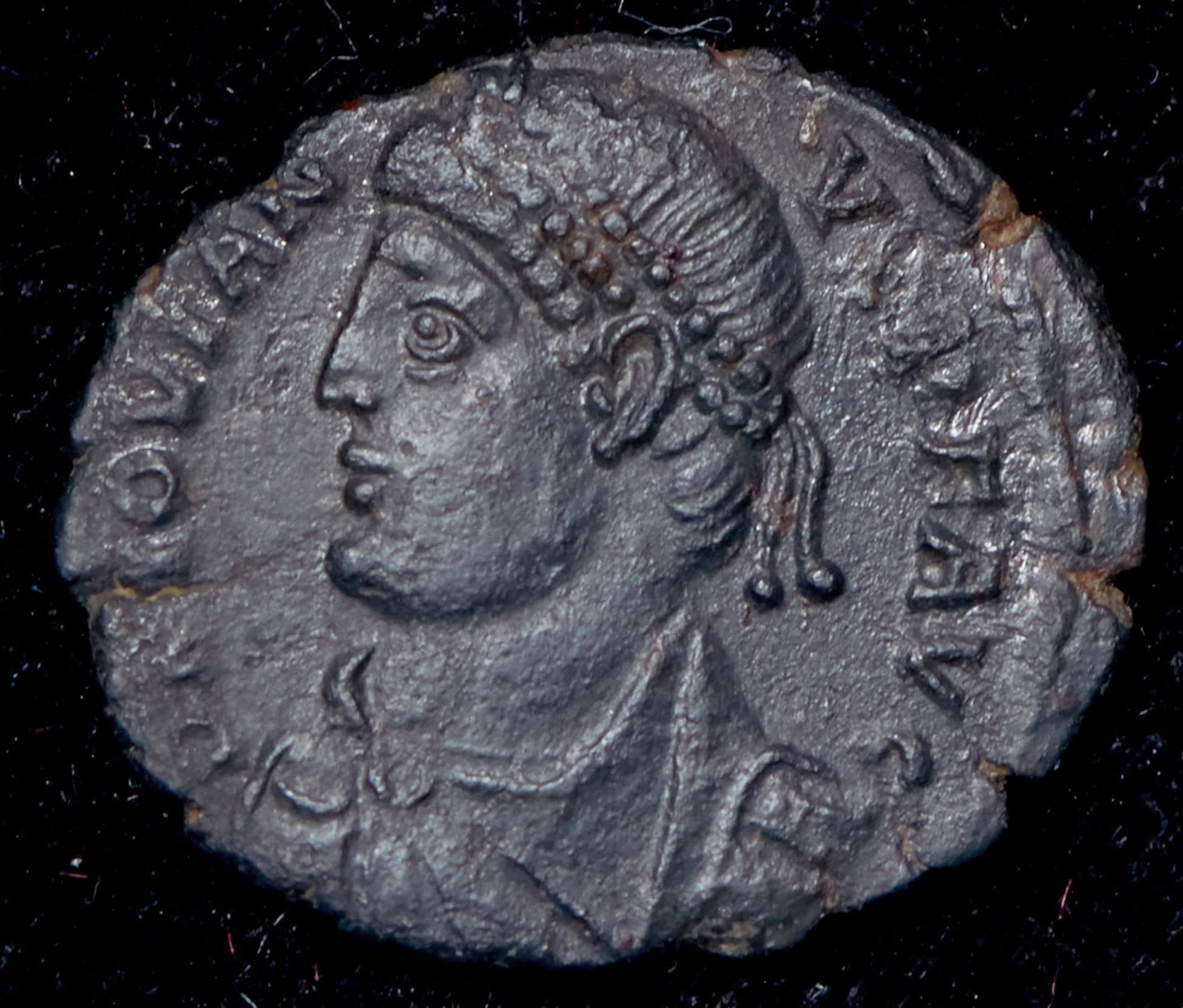

The life of Flavius Jovian, whose brief yet fateful reign became a bridge between the era of Julian “the Apostate,” the “last pagan,” and the rise of the Valentinian dynasty, began in 330 or 331 in Singidunum, present-day Belgrade. He was the son of Varronianus, the powerful comes domesticorum, whose authority at the court of Constantius II was so great that Jovian’s destiny seemed predetermined even before his birth. Ancient authors such as Ammianus Marcellinus and the compiler of the Epitome de Caesaribus preserved traditions about Varronianus’s prophetic dreams, in which he was instructed to give his son a name echoing the imperial epithet “Jovius,” dedicated to Jupiter. Later, when Jovian accompanied the body of the deceased Constantius II to Constantinople, the people and soldiers involuntarily saw in him a future ruler, mistaking him for the new Augustus even before his official proclamation.
Despite such a mystical beginning, Jovian’s real career long remained overshadowed by his father’s fame. He was not distinguished by outstanding talents or brilliant education, advancing through the ranks of the imperial guard more through family connections than personal achievements. Having risen to the rank of primicerius domesticorum under Julian the Apostate, he accompanied the emperor on his fateful Persian campaign of 363.

Christian tradition later created the legend that Julian had supposedly dismissed Jovian because of his faith, yet modern historians confirm that he remained at the head of the imperial bodyguards until Julian’s very death. Jovian possessed a majestic, though slightly stooped, bearing and was extraordinarily tall — so tall that it took a long time to find imperial robes of the proper size for him. He also had a pleasant face with blue eyes and was inclined toward cheerful company, good wine, and abundant food.
The turning point came on June 27, 363. Julian fell in battle without leaving an heir, and the exhausted Roman army, stranded in the heart of Persia, faced the need to choose a leader immediately. The high command split into two hostile camps: the veterans of Constantius II, led by Victor and Arintheus, opposed Julian’s “Gallic” protégés, such as Nevitta and Dagalaifus. After the respected prefect Sallustius refused the purple, citing his old age, the figure of Jovian emerged — a compromise candidate acceptable to all because of his political lack of independence. Ammianus Marcellinus caustically remarked that when the soldiers heard the name “Jovian” at the proclamation of the new emperor, they mistakenly thought that their favorite Julian had recovered from his wounds, but when they saw a tall and unfamiliar man, they burst into tears. Christian authors, by contrast, celebrated the moment, claiming that the army unanimously proclaimed itself Christian together with its new sovereign.
Jovian’s reign began under catastrophic circumstances. The Persian king Shapur II, learning of Julian’s death, increased pressure on the retreating Romans. Surrounded near Harcha and pressed against the flooded Tigris, the army was starving. In this critical situation, Jovian — fearing not so much the Persians as the possible appearance of rival usurpers in Gaul, especially Julian’s relative Procopius — agreed to unprecedented concessions. A humiliating thirty-year peace was concluded, under which Rome ceded to Persia five trans-Tigris provinces, including Arzanene and Corduene, and abandoned the key fortresses of Singara and the supposedly impregnable Nisibis. Moreover, the empire betrayed its ally, the Armenian king Arsaces II. Despite fierce criticism from pagan historians, who called this treaty an indelible stain on Rome’s honor, Jovian stubbornly upheld its terms, even refusing the inhabitants of Nisibis the right to defend their city themselves and forcing them to leave their homes within three days.

Trying to save face, Jovian launched a broad propaganda campaign, minting coins with inscriptions such as “Restorer of the Republic” and “Victory of the Romans,” while his army continued to suffer losses from hunger during the retreat. Upon reaching Antioch, the emperor turned to questions of internal stabilization and religion. His religious policy, though cautious, marked the final return of Christianity to the level of state power. He repealed Julian’s discriminatory laws, restored the privileges of the Church, and summoned the great defender of orthodoxy, Athanasius of Alexandria, recognizing the Nicene Creed. At the same time, he showed a certain degree of tolerance, keeping the pagan philosophers Maximus and Priscus at court, although in Antioch, with his tacit approval, the temple-library erected by Hadrian was burned.

In January 364, at Ancyra, Jovian solemnly entered the consulship together with his young son Varronianus, having listened to an elaborate panegyric by the rhetorician Themistius. However, his journey to Constantinople was suddenly and mysteriously cut short. On February 17, 364, in the frontier town of Dadastana, the emperor was found dead in his bed. He was only thirty-three years old and had ruled for just eight months. The causes of his death remained a mystery: some blamed carbon monoxide from a brazier in a freshly whitewashed room, others a fatal bout of indigestion after a heavy dinner, and still others whispered of poisoning. No investigation was ever conducted. Jovian’s body was taken to Constantinople and buried in the Church of the Apostles beside his wife Charito. Despite the brevity of his reign and the territorial losses, Jovian managed to lay the foundation for a new religious stability, later developed by Valentinian I and his brother Valens, who definitively established the Christian character of the empire.


