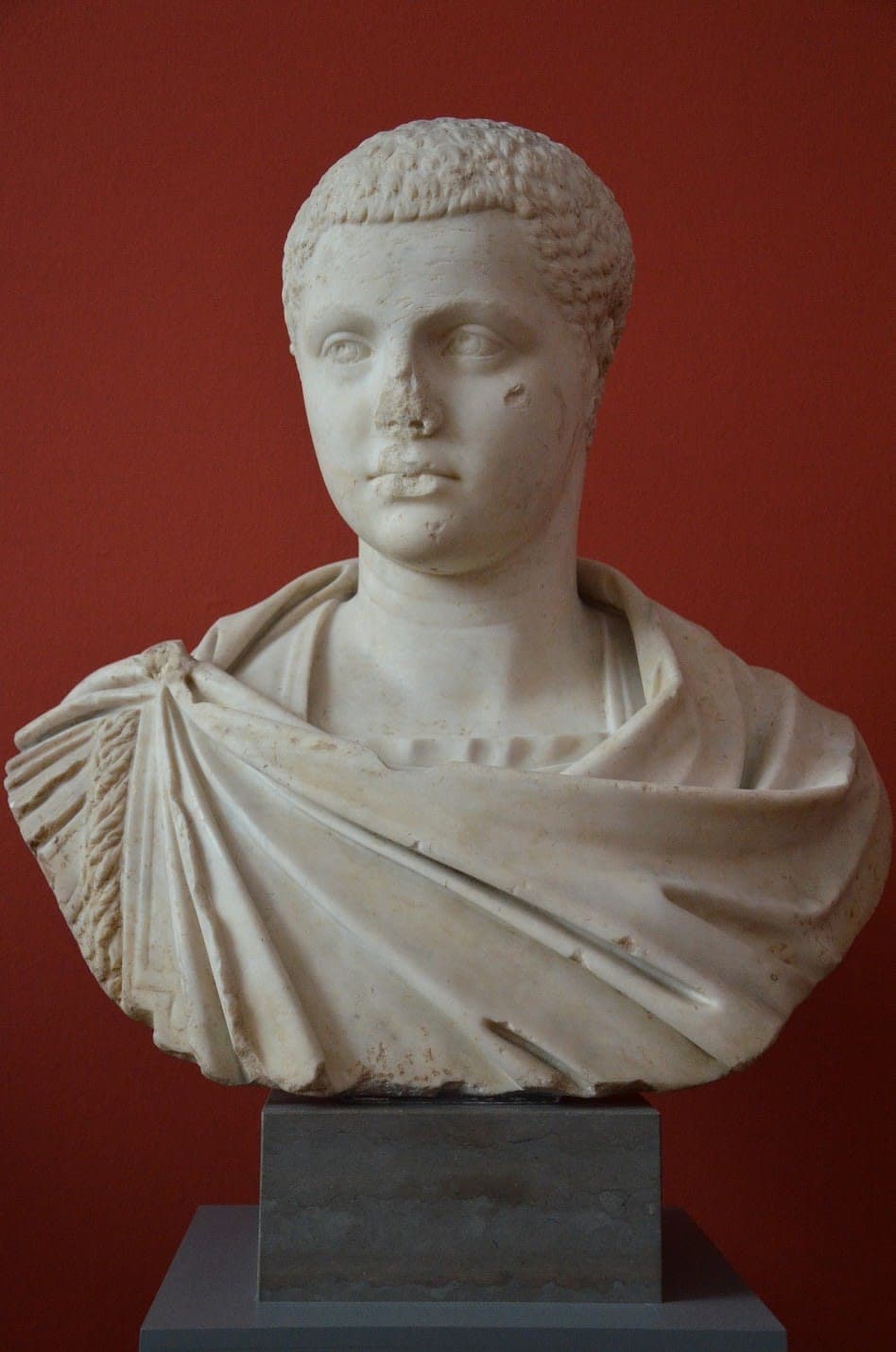

The story of the life and reign of Emperor Elagabalus is one of the strangest and most provocative pages in the Roman chronicles, where Eastern mysticism collided with the conservative spirit of the Eternal City. It all began in the year 204, when a boy was born who was destined to enter history under the name Elagabalus. His place of birth is not known for certain: it may have been Rome, where his parents were serving at the time, or the Phoenician city of Emesa. His father, Sextus Varius Marcellus, was an ambitious native of Syrian Apamea who, under Septimius Severus, managed to rise from the equestrian order to a seat in the Senate and the governorship of Numidia, where he died in 217.
However, the true power stood behind his mother, Julia Soaemias Bassiana. She was flesh and blood of the ruling dynasty: the daughter of the influential Julia Maesa and the niece of Empress Julia Domna herself. The Bassian family possessed an almost sacred status in Syria, holding the hereditary priesthood of the sun god Elagabal in Emesa. Legends connected their bloodline with the ancient Arab kings, the Sampsiceramids, and even with the names of Cleopatra and Mark Antony. Moreover, whispers persistently spread through the corridors of power that the young Bassianus was not Marcellus’ son at all, but the result of his mother’s secret affair with Emperor Caracalla — a rumor that would later become a key trump card in the struggle for the throne.

The boy’s childhood passed amid the splendor of the Roman court, but after the death of Caracalla in 217 and the rise of Macrinus, fortune turned away from the family. The new government exiled Julia Maesa and her relatives to Emesa. It was there that the thirteen-year-old Varius Avitus, the future Elagabalus, assumed the duties of priest of the “God of the Mountain.” Contemporaries described him as a youth of rare, almost unearthly beauty. In those years, no one called him Elagabalus — this name, which emerged from the mistaken fusion of the Semitic “El” meaning “god” and the Greek “Helios” meaning “sun,” would attach itself to him only centuries later thanks to fourth-century historians.

While the young priest danced at the altar, his grandmother Julia Maesa was weaving a web of conspiracy. Using her immense wealth and the soldiers’ dissatisfaction with Macrinus’ policy of austerity, she began a large-scale campaign of agitation. The decisive moment came at dawn on 16 May 218, when the Third Gallic Legion, stationed at Raphana, proclaimed the fourteen-year-old boy Caesar. To give the coup legitimacy, the youth took the name Marcus Aurelius Antoninus, openly declaring his “sonship” in relation to Caracalla.
The war for power was swift. Although Macrinus tried to declare his rival a “false Antoninus” and appease the troops with money, the legions passed one after another to the side of the young priest. The decisive clash took place on 8 June 218 at the Battle of Antioch. Elagabalus’ forces, commanded by the general Gannys, defeated the army of Macrinus. Macrinus himself fled, but was captured in Chalcedon and executed. The path to the throne was open. Even before Elagabalus arrived in Rome, the Senate, faced with an accomplished fact, recognized him as emperor, granted him the titles “Father of the Fatherland” and “Pontifex Maximus,” while his mother and grandmother received the titles of Augustae.
The new ruler spent the winter of 218–219 in Bithynia, showing the first signs of his despotic character. He did not wait for formal decisions from the Senate and instead bestowed honorary titles upon himself. In August or September 219, Elagabalus made his solemn entry into Rome. The city was shocked: instead of a stern Roman warrior, there appeared before them a youth in exotic Eastern robes, with painted eyes and rouged cheeks. To soften the shock, he sent the Senate a portrait of himself in priestly garments, ordering it to be hung above the statue of Victory — so that every senator, when offering sacrifice to the goddess, would involuntarily worship the emperor himself.


In Rome, a time of unprecedented change began. Elagabalus made it his goal to turn the god Elagabal into the supreme deity of the empire, pushing even Jupiter into second place. In 220, he proclaimed Elagabal the head of the pantheon and built a grand temple on the Palatine — the Elagabalium. Its main sacred object was a huge black conical meteorite brought from Emesa. Every day, the emperor performed rituals before it, accompanying them with dances to the sound of drums and cymbals. His religious zeal reached extremes: Elagabalus even underwent circumcision and refused pork, wishing to emphasize his devotion to the Syrian cult.

Scandals shook Rome one after another. The most outrageous was the emperor’s marriage to the Vestal Virgin Julia Aquilia Severa. Elagabalus explained this violation of the sacred vow of chastity, for which Vestals were traditionally buried alive, as a desire to produce “godlike children.” In total, he married five times, including a marriage to Annia Faustina, the widow of a nobleman whom he had executed. Yet the emperor’s private life went far beyond traditional marriages. Cassius Dio wrote with indignation about his relationship with the slave charioteer Hierocles, whom the emperor called his “husband” and whom he allowed to beat him until he was bruised in fits of passion. It was said that Elagabalus offered enormous sums to doctors capable of performing a sex-change operation on him, and that he preferred to be addressed as “lady” or “queen.”

His daily life was marked by incredible extravagance: the emperor allegedly refused to step on the ground, ordering his paths to be covered with golden sand, and rode in a chariot drawn by naked women. At the same time, the empire’s economy suffered: the gold content of the aureus and the silver content of the denarius steadily declined, while state offices were handed out to actors and freedmen.
By 221, the patience of the Praetorian Guard and the people had run out. The wise Julia Maesa, seeing that the throne beneath her grandson was shaking, persuaded him to adopt his cousin — Marcus Julius Gessius Alexianus, who took the name Alexander Severus. Alexander, who possessed a classical education and a calm temperament, immediately became the favorite of the army. Realizing his mistake, Elagabalus tried to eliminate his rival by spreading rumors about his illness, but this only hastened the final outcome.
On 11 March 222, a revolt broke out. Soldiers burst into the camp where both Caesars were present. When the Praetorians began to greet Alexander, Elagabalus ordered them arrested for disobedience. This became his final command. The enraged guards attacked the emperor. He tried to hide in a chest, but was discovered and killed at the age of only eighteen. His mother, Julia Soaemias, died while protecting her son in her arms until the very end. Their decapitated bodies were dragged through the streets of Rome, after which Elagabalus’ corpse was thrown into the Tiber.
With his death began a period of “condemnation of memory” — damnatio memoriae. His name was erased from documents, his images were destroyed or altered into portraits of Alexander Severus, and the black stone of Elagabal was sent back to Syria. Rome tried to forget as quickly as possible the four years of rule by the youth who had attempted to turn the empire into one endless Eastern festival, but who ultimately fell victim to his own audacity and to the cultural gulf between Rome and Emesa.


