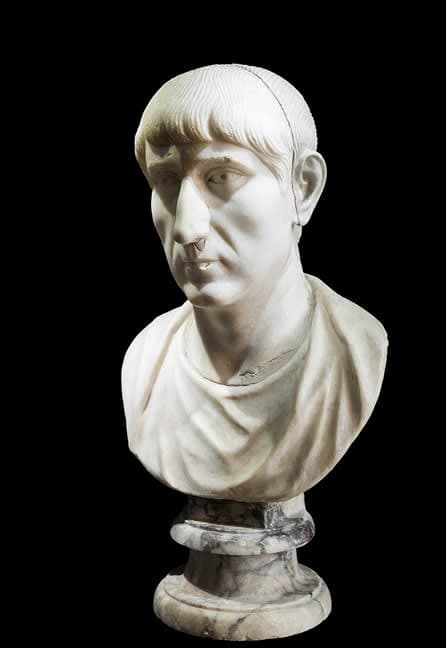

The life of Flavius Julius Constantius, who entered history as Emperor Constantius II, began on August 7, 317, in Sirmium, in the wealthy province of Pannonia. As the third son of the great reformer Constantine I and his second wife Fausta, the boy was from birth destined to bear the burden of power. The name given to him in honor of his grandfather, the renowned tetrarch Constantius I Chlorus, seemed to foreshadow his future role in preserving the unity of an empire torn apart by internal and external contradictions.

Constantius’s rise to the summit of power began extraordinarily early. On November 13 (according to other sources, November 8), 324, in Nicomedia, his father officially proclaimed him Caesar. The young ruler was entrusted with the eastern part of the empire, yet his military career began far in the West. While his brother Constantine II fought on the Danubian frontier, Constantius was sent to Gaul. There he proved himself a talented commander, inflicting a crushing defeat on the Goths and earning the honorary title Germanicus Maximus.
In 335, Constantine the Great, sensing his approaching end, outlined the circle of his successors, including his three sons — Constantine II, Constans, and Constantius II — as well as his nephew Dalmatius. A year later, in 336, during the grand celebration of the tricennalia in Constantinople, Constantius strengthened his position by marrying the daughter of Julius Constantius, his uncle. This union was meant to cement dynastic ties, yet reality proved far bloodier.
The death of Constantine the Great in 337 became the catalyst for a massive crisis. Having assumed the title of Augustus, Constantius received Asia and the whole East under his rule. The other parts of the empire were divided among his brothers and cousins: Constans took Italy and Africa, Constantine II received Gaul and Britain, while the nephews Dalmatius and Hannibalianus were given the Balkans and the Pontic kingdom respectively. However, this fragile balance did not last long. Constantius, who was then in Mesopotamia, hastened to the capital. There, under his tacit protection, a military mutiny broke out. The soldiers, unwilling to obey anyone except the direct sons of Constantine, exterminated almost the entire collateral branch of the dynasty. Two uncles and seven cousins of the emperor fell victim to the massacre, including Dalmatius and Hannibalianus. Having seized their territories, Constantius turned his gaze once more to the East in 338, where the endless war with Persia was flaring up again.


While Constantius was bogged down in war with the Persians, the West descended into chaos. In 340, during the fratricidal struggle between Constantine II and Constans, the former was killed, and the younger brother became the sole ruler of the western lands for a decade. To secure for himself a reliable rear and the loyalty of Constantius, Constans handed over the strategically vital city of Constantinople to him.
Yet the calm did not last. In 350, Constans fell at the hands of conspirators led by the military commander Magnentius. Constantius II now faced the task of crushing the usurper. Magnentius, relying on German mercenaries, was a formidable force. The first clash at Atrans ended badly for Constantius, but he refused peace. The decisive battle took place in 351 at Mursa in Lower Pannonia. It was the bloodiest battle of the century: Constantius lost 30,000 warriors, while Magnentius lost 24,000. The damage to Rome’s military strength was irreparable. Nevertheless, Magnentius was defeated. In 352 he retreated into Gaul, and in 353, after final defeat near Mount Seleucus, he committed suicide at Lugdunum. Through this turmoil, the Roman Empire was once again united under the rule of one man, though the price was dreadful: the Rhine frontier was broken by the Franks, who devastated Colonia Agrippina.

At the same time that he fought against Magnentius, Constantius had to suppress other centers of rebellion. In 350, Vetranio proclaimed himself emperor in Illyricum. Here Constantius displayed remarkable eloquence: meeting the opposing army near Serdica, he addressed the soldiers with such a fiery speech that they voluntarily went over to his side. Vetranio was deposed, but unlike many others, he was pardoned and sent into honorable retirement. Another relative, Nepotian, seized power in Rome, but held it for only a month before being overthrown by the men of Magnentius.

Understanding that it was impossible to govern such a vast empire alone, Constantius began to draw the last surviving relatives into power. On March 15, 351, he appointed Gallus as Caesar and gave him in marriage his sister Constantina. However, Gallus did not justify the trust placed in him and in 354 was executed for cruelty and suspicious ambitions. In 355, the emperor, overcoming inner resistance, appointed his last cousin Julian as Caesar, sending him to pacify Gaul. In the same year, the absurd rebellion of the general Silvanus broke out, provoked by forged letters from court intriguers. Silvanus was killed by the assassin Ursicinus before full-scale war could even begin.

The internal policy of Constantius II was marked by religious zeal. His reign became the age of the triumph of Arianism. Having lost in Constans the defender of orthodox faith, the emperor began a determined offensive against his opponents. In 356, at the Council of Milan, the great Athanasius of Alexandria was condemned and exiled. The empire sank into theological disputes that often spilled over into street fighting. At the same time, Constantius harshly persecuted pagans, banning sacrifices and confiscating the property of temples.

In the spring of 357, wishing to emphasize the greatness of his authority, Constantius visited Rome. It was his first visit to the Eternal City, and it became a grand triumph “over Roman blood,” as the historian Ammianus Marcellinus bitterly remarked. The emperor was astonished by the scale of the capital. He spoke before the Senate and the people, admired the Pantheon, the forums, and the Theatre of Pompey. Sensing that he could not surpass his ancestors in building, he decided to leave his mark by erecting a huge Egyptian obelisk in the Circus Maximus. However, alarming news of Sarmatian and Quadi raids on the Danube forced him to leave Rome after only thirty days.
The military campaigns on the Danube in 358–359 became one of the most successful chapters of his reign. Crossing the Ister (Danube) over a pontoon bridge, Constantius swept through the barbarian lands with fire and sword. The Sarmatians and Quadi, caught off guard, begged for peace. Particularly dramatic was the clash with the Limigantes. Having invited them to negotiations, Constantius nearly fell victim to their treachery, but reacted in time. In a ferocious battle in the marshes, the barbarians were almost annihilated and their settlements burned. For these victories, the emperor assumed for the second time the title “Sarmaticus Maximus.”
Meanwhile, the situation in the East remained grave. The Persian king Shapur II besieged Nisibis three times, and although the city held out, the general situation was not in Rome’s favor. In the Battle of Singara in 348, Constantius lost the chance of victory because of the indiscipline of his soldiers. In 359, a new massive Persian invasion began.

The end of Constantius’s reign was darkened by news from Paris: in 360, the Gallic legions proclaimed Julian Augustus. Torn between the Persian threat and internal rebellion, Constantius hesitated. Only in the autumn of 361 did he move against Julian. But fate decided otherwise. On the journey, the emperor was struck down by a violent fever. In Mopsucrene the heat became so unbearable that his body could not be touched. Feeling death approaching, Constantius II appointed Julian as his successor, thereby preventing yet another civil war.
The personality of Constantius has remained controversial in history. Ammianus Marcellinus described him as a sober, moderate, and physically hardy man, an excellent horseman and archer. Yet he was tormented by suspicion and paranoia. He descended into almost mad cruelty in persecuting those whom he considered enemies of the throne, surrounding himself with ditches and removable bridges even in his own bedroom. Small in stature, with bowed legs but a majestic bearing, he strove until his final breath to be worthy of the shadow of his great father, holding in his hands the slipping grandeur of the Roman Empire.


