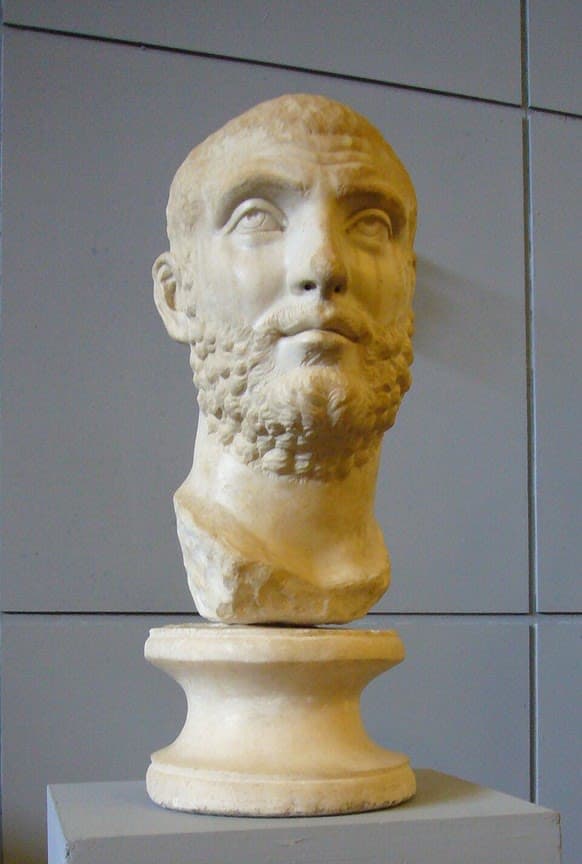

The story of Marcus Aurelius Carinus represents one of the darkest and at the same time most instructive pages in the chronicle of the late Roman Empire, where the grandeur of power was invariably accompanied by the ruthless propaganda of the victors. His path to the summit began around 250, and although history has preserved only scant fragments of information about his early years, his appearance on the great political stage was swift and loud. Everything changed in 282, when the legions of Raetia and Noricum, tired of the harsh discipline of Emperor Probus, proclaimed Carinus’s father — the praetorian prefect Marcus Aurelius Carus — as their ruler. The fate of Probus was sealed in Sirmium, where his own soldiers, unwilling to fight the new claimant, committed murder, opening the way for a new dynasty.

At the time of his father’s accession, Carinus was already a mature man, burdened with family and state responsibilities. He was married to Magnia Urbica and, according to some evidence, had a son named Nigrinianus, who was meant to continue the line. In September 282, Carus, seeking to secure the throne for himself, granted his sons the titles of “most noble Caesars” and “leaders of the youth.” However, the political geography of the empire required the presence of imperial authority on several fronts at once. While Carus and his younger son Numerian prepared for an ambitious Persian campaign, crushing along the way the hordes of the Quadi and Sarmatians — for which all three, including Carinus, who remained in the rear, received the title “Germanicus Maximus” — the elder son was left in Rome. He was entrusted with the most difficult task: governing all the western provinces under the supervision of experienced advisers.

The beginning of 283 was marked by Carinus’s further elevation: he held the office of ordinary consul together with his father and was soon raised to the rank of Augustus, becoming a full co-ruler. When Emperor Carus then died in mysterious circumstances in the East, Carinus effectively became the senior Augustus, holding the reins of power over a vast territory. Unlike his younger brother, he displayed considerable administrative and military talents, which allowed him to preserve the loyalty of the capricious legions. He spent the winter of 283/284 in Rome, sharing the consulship with Numerian, but peace did not last long. The interests of the state summoned him to distant Britain, where he led a military campaign celebrated by the poet Olympius Nemesianus and brought him the title “Britannicus Maximus.”
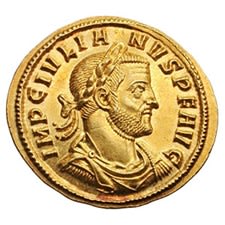
However, the dynastic idyll collapsed in November 284, when news arrived from the East of Numerian’s death. This vacuum of power immediately produced a wave of usurpations. In Italy, the praetorian prefect Sabinus Julianus raised a rebellion, while in the Danubian provinces, in Pannonia, the corrector Marcus Aurelius Julianus declared himself ruler. Carinus, who at that moment was in Britain, acted with lightning decisiveness. In early 285, he moved his troops south and, in a bloody battle near Verona, crushed Sabinus Julianus, then suppressed the revolt in Illyricum. But the main threat still lay ahead: the eastern army refused to recognize his authority and proclaimed as its leader Diocles, who would become known to the whole world as Diocletian.
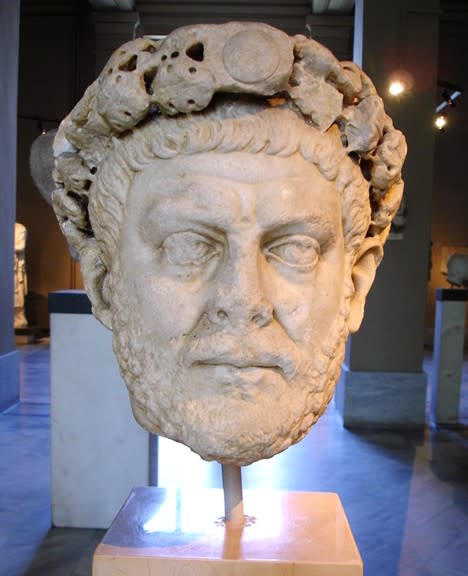
The decisive clash between the two titans occurred in July 285 on the banks of the River Margus in Moesia. The scale of the battle was enormous, and according to many sources, Carinus’s army was in fact gaining the upper hand over the forces of Diocletian. But it was here that history took its sharpest turn, colored by tones of personal revenge and betrayal. The official tradition says that at the moment of probable triumph, the emperor was stabbed by one of his own officers, whose wife he had allegedly seduced. Other chronicles paint a different picture: Carinus was abandoned by his troops between Viminacium and Mons Aureus, falling victim to a large-scale conspiracy. The fact that the praetorian prefect Aristobulus not only kept his post under Diocletian but continued a brilliant career indirectly supports the version of betrayal by Carinus’s inner circle.
After his death, Carinus was subjected to damnatio memoriae — the condemnation of memory — which allowed his enemies to freely shape him into the image of a monster. The pages of the Historia Augusta, written by Flavius Vopiscus, are full of descriptions of his incredible excesses: from nine successive marriages to bedrooms strewn with roses from Milan and banquets where mountains of exotic meat were served. He was accused of corrupting the youth, arrogance toward the Senate, and wearing precious stones even on his shoes. Modern historians, however, urge us to view these descriptions through the prism of Diocletian’s harsh propaganda. It is unlikely that so worthless a ruler as Vopiscus portrays could have successfully commanded armies in Britain and Gaul, as well as effectively suppressing rebellions by experienced military leaders. Most likely, Carinus was a capable but harsh leader whose image was deliberately blackened in order to justify the coup and legitimize the new regime. Nevertheless, his death brought an end to the short-lived dynasty of Carus and opened the door to the age of the Tetrarchy, which would forever change the face of Rome.


