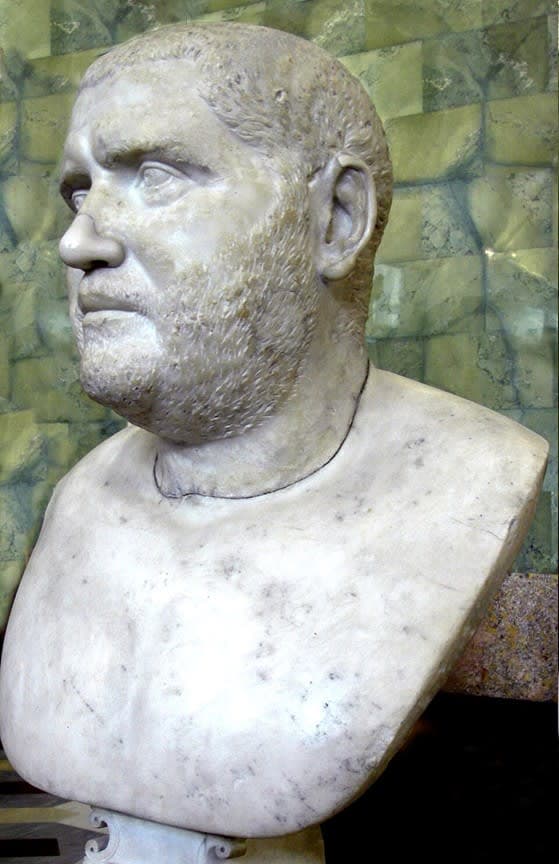
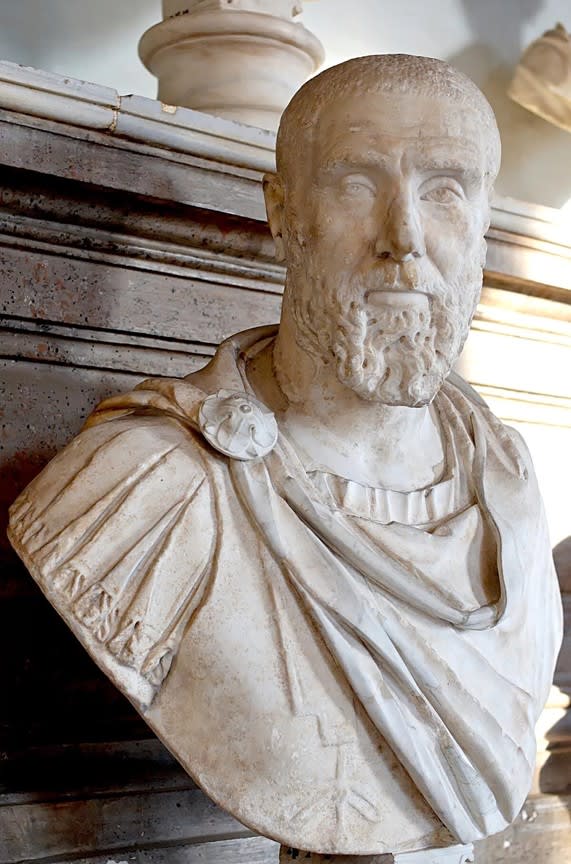
The life of Balbinus before his ascent to the summit of power is wrapped in the half-light characteristic of that troubled age. The exact date of his birth remains a matter of debate: the Byzantine chronicler John Zonaras claimed that when Decimus Caelius was proclaimed emperor in 238, he was about sixty years old, which would place his birth in 178. However, scholars find inconsistencies in this. For example, Balbinus’ admission into the prestigious priestly college of the Palatine Salii — which accepted only young men from the noblest families — is dated to the period between 191 and 198. This leads historians such as M. Grant to suggest that Balbinus was older and was born around 165 or 170. In any case, by the time of his triumph, he was already a very old man by ancient standards.
Balbinus liked to embellish the question of his origins with legends. He vainly traced his lineage back to Cornelius Balbus Theophanes — a mythical fusion of two real figures from the time of Pompey and Caesar. In reality, Decimus Caelius most likely came from a wealthy patrician family whose roots may have reached back to the Spanish province of Baetica. His father or uncle, Caelius Calvinus, was governor of Cappadocia, while his mother belonged to the influential Aquilius family. The Historia Augusta emphasizes that Balbinus possessed an enormous fortune, which he not only inherited but also increased, becoming one of the richest men in Rome.
Balbinus’ political career was a model of the cursus honorum. Herodian noted that he “governed provinces impeccably,” among them Asia, Africa, Bithynia, Galatia, Pontus, Thrace, and Gaul. The scale of his administrative experience was remarkable. Balbinus held the consulship twice: first as suffect consul, probably around 203 or 211, and then as ordinary consul in 213 together with Emperor Caracalla himself.
Despite his tall stature and impressive appearance, Balbinus was known as a gentle, even timid man. Unlike his future co-ruler Pupienus, who was famous for his severity, Decimus Caelius was a master of speech and a poet. His house on the slope of the Esquiline was a center of intellectual life, and his eloquence saved him more than once in senatorial debates. Yet this very softness of character would later become his Achilles’ heel in a confrontation with enraged soldiers.

The collapse of the Severan dynasty in 235 brought Maximinus Thrax to power — the “soldier emperor,” who had never seen Rome and squeezed the empire dry for the sake of wars on the northern frontiers. Financial oppression and the loss of Mesopotamia because of the Persian invasion caused the situation to explode in 238. After the tragic deaths of Gordian I and his son in Africa, the Senate found itself facing imminent execution: Maximinus was already leading his legions from Sirmium toward Italy.
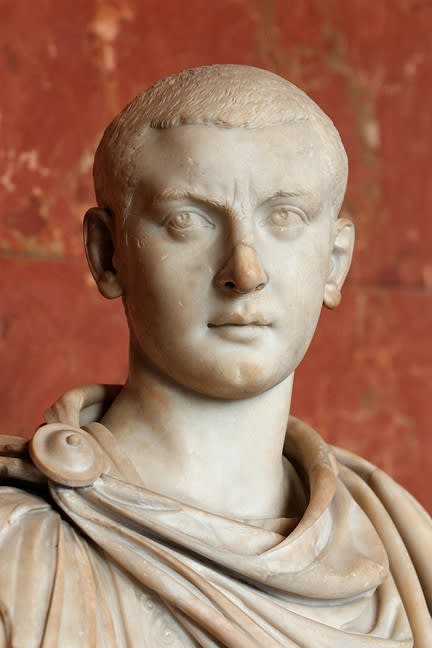
In this atmosphere of mortal fear, the Senate decided on a unique step. Gathering in the Temple of Jupiter Capitolinus — or in the Temple of Concord — the senators created a commission of twenty men, the vigintiviri. From among them, by free vote, two emperors were chosen: Balbinus and Pupienus. This was an attempt to revive republican collegiality: both received equal powers, and both became Pontifices Maximi. The Senate solemnly confirmed its right to elect rulers, throwing down a challenge to the army.
However, the rejoicing of the aristocracy was short-lived. The Roman mob, which hated Pupienus for his former severity as prefect, blocked the road to the Capitol. The crowd demanded power for the family of Gordian. Only when the emperors brought out and showed the people the thirteen-year-old grandson of Gordian I, Marcus Antonius Gordianus, and proclaimed him Caesar, did the revolt subside. The Senate’s constitutional dream of an “elective monarchy” cracked on the very first day.

The division of roles was logical: while Pupienus went north to lead the defense against Maximinus, Balbinus remained in Rome. But his rule in the capital turned into a nightmare. In his colleague’s absence, a real civil war broke out in the city. The immediate cause was the murder of two unarmed Praetorians directly in the Senate chamber by two senators — Gallicanus and Maecenas.
The enraged guards shut themselves inside their camp, the castra praetoria, while Gallicanus incited the people and the gladiators to storm it. Balbinus appealed for peace in vain; when he tried to go out to the crowd, he was pelted with stones and beaten with clubs. The townspeople cut off the camp’s water supply, and during the Praetorians’ subsequent sortie, much of Rome was burned, while the streets drowned in blood. By showing indecision and weakness, Balbinus finally lost control of the situation.
Meanwhile, in the north, an unexpected resolution occurred. Maximinus Thrax, bogged down in the siege of Aquileia, was killed by his own soldiers. Pupienus returned to Rome as a triumphator. Balbinus greeted him with outward joy, arranging a “hecatomb” — a sacrifice of one hundred bulls — but inside him, envy of his colleague’s glory was growing.
Despite the brevity of their reign, Balbinus and Pupienus managed to leave a mark on the empire’s economy. Faced with empty treasuries and the need to pay enormous donatives to the soldiers, they resumed the minting of the antoninianus. However, this coin was debased: its weight fell to 4.75 grams, and its silver content did not exceed 49 percent. By distributing 250 denarii per person to the people, the emperors effectively set in motion the wheel of inflation, which would later become a scourge of the empire.
On the foreign policy front, the situation was no less alarming: the Carpi invaded Lower Moesia, the Goths plundered Histria, and the Persians under Ardashir captured Carrhae and Nisibis. The emperors planned to divide their duties: Pupienus intended to go east against the Persians, while Balbinus would go north against the Goths. But these plans were not destined to come true.
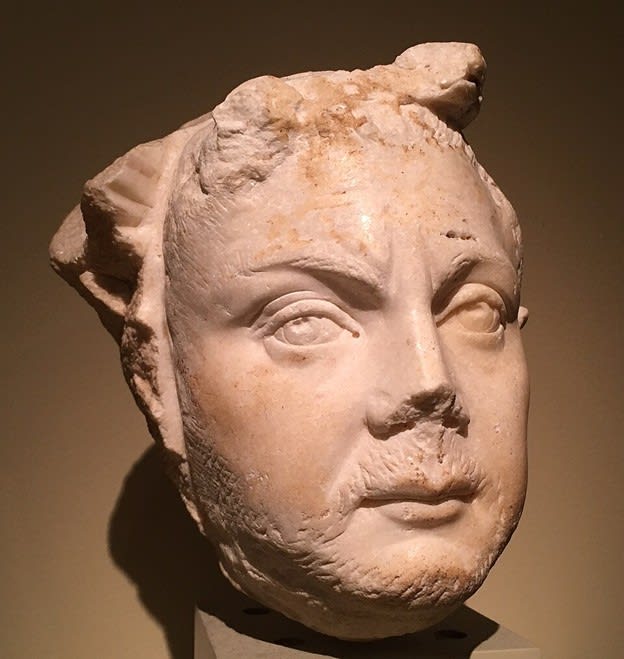
Mutual distrust reached its peak. Balbinus, proud of his noble birth, and Pupienus, proud of his experience, constantly argued over precedence. The Praetorians, who secretly mourned Maximinus and hated the senatorial rulers, waited for their moment.
The end came in July 238 during the Capitoline Games. The guards burst into the imperial palace. At that moment, the co-rulers had their final, fatal quarrel. Pupienus begged Balbinus to summon the loyal German bodyguards for help, but Balbinus, blinded by suspicion, decided that his colleague wanted to use the Germans to seize sole power and refused.
The Praetorians seized both Augusti. Their clothes were torn off, and they were tortured and beaten before the eyes of the whole city as they were dragged toward the camp. When the Germans finally rushed to the rescue, it was already too late: the guards finished off the captive emperors and threw their mutilated bodies into the street. The joint reign of Balbinus and Pupienus lasted only ninety-nine days. The young Gordian III was proclaimed the new and sole ruler, while Balbinus was subjected to damnatio memoriae — condemnation of memory.
For a long time, Balbinus remained only a name in the chronicles, until in 1927–1928 his grand sarcophagus was discovered on the Appian Way. On it, the emperor is depicted together with his wife: on the lid they recline at life size, while in the reliefs he appears now in a toga, now in military armor, crowned by the goddess Victory. This is a rare case in which we can see the face of a “senatorial emperor” not only on coins, but also in marble.
The story of Balbinus is the tragedy of a man who possessed every virtue suited to peacetime, but who was crushed by an age in which power belonged not to the wisest or the noblest, but to the one who could keep the loyalty of the legions. His death marked the final decline of the Senate’s political influence, transforming it from a governing body into a decorative symbol of Rome’s former greatness.


