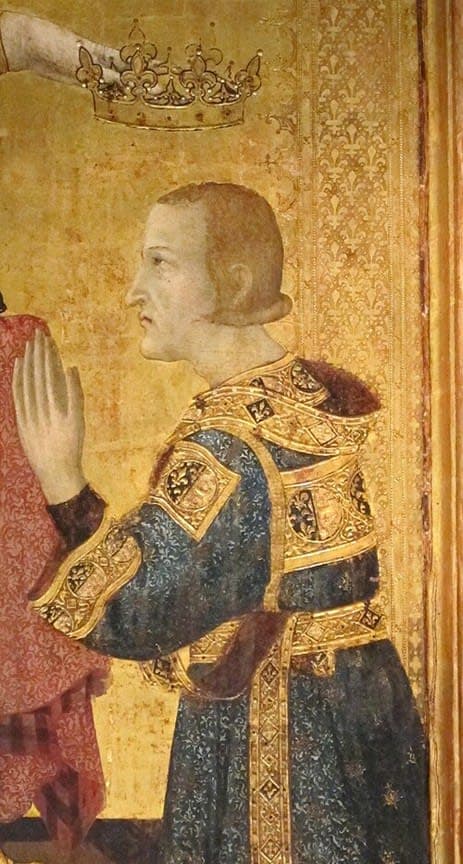

Robert of Naples, who went down in history as one of the most distinguished, enlightened, and influential monarchs of his time, was initially not considered a future ruler of the kingdom at all. He was born as the third son of Charles II the Lame, who ruled Naples from 1285 to 1309, and his wife, Queen Mary of Hungary. It seemed that his destiny was to remain in the shadow of his elder brothers, but the complexities of European politics and dynastic dramas had prepared an entirely different fate for him.

His elder brother, Louis, renounced worldly affairs and political ambitions, choosing to devote his life entirely to religion. He took monastic vows and subsequently became Bishop of Toulouse. The Church later canonized him, and the celebrated painter Simone Martini immortalized this sacred moment in a painting depicting Saint Louis of Toulouse solemnly placing a crown upon Robert's head.
His second brother, Charles Martel, inherited legitimate claims to the Hungarian throne through their mother, Mary of Hungary. Following the death of King Ladislaus IV of Hungary, he became deeply involved in a fierce struggle for the Crown of Saint Stephen. He even managed to secure a formal coronation, but died unexpectedly before establishing control over the entire country.
His cause was continued by his son, Charles I Robert. This prince eventually emerged victorious from the Hungarian civil conflict and secured the throne for himself, but to achieve this victory, he was forced to permanently sacrifice his dynastic rights to the Kingdom of Naples.
As a result of this succession of renunciations, deaths, and political agreements, Robert, despite being the third son, became the official heir to the throne of Charles II.

Robert's path to actual power began long before his father's death, during an era of exceptionally complex diplomatic maneuvering over the lost island of Sicily.
In 1295, through the active mediation of the Holy See, the historic Peace of Anagni was concluded. Under the terms of this treaty, King James II of Aragon officially renounced his claims to Sicily in favor of the Angevin dynasty.
To strengthen this political alliance through family ties, Robert married Yolande, the sister of James II.
However, the grand diplomatic triumph soon collapsed. The proud Sicilians categorically refused to recognize the cynical transfer of their island from one ruler to another, arranged without their consent.
Driven by anger and their desire for freedom, they elected Frederick II, the younger brother of James of Aragon, as their new king.
War erupted once again, but the resources of the House of Anjou had been exhausted.
In 1302, a new treaty, deeply disappointing to the Neapolitans, was signed at Caltabellotta.
Charles II and Robert were forced to recognize Frederick II as King of Sicily for life. In practice, this meant abandoning their exhausting and seemingly hopeless struggle to recover the island.

In 1309, following his father's death, Robert officially ascended the throne of the Kingdom of Naples.
Having lost Sicily, he redirected the entire focus of his policies toward mainland Italy, where for many years he became the undisputed leader of the Guelph faction, the supporters of the Roman papacy.
His leadership faced a severe test between 1311 and 1313, when the army of Holy Roman Emperor Henry VII descended upon the Italian Peninsula.
This ambitious German monarch sought to revive the traditions of the emperors of the 10th–12th centuries and establish genuine, rather than merely nominal, imperial authority over rebellious Italy.
In May 1312, after temporarily subduing the defiant Lombard communes through military force and devastation, Henry VII made a triumphant entry into Rome.
However, the city was divided. The right bank of the Tiber and the strategically important St. Peter's Basilica remained firmly under the control of regular Neapolitan troops, brilliantly commanded by John of Achaea, Robert's own brother.
The emperor committed all his forces to the assault but failed to overcome the determined resistance of the Angevin regiments.
Consequently, Henry VII was forced into a humiliating compromise and was crowned on July 22, 1312, in the Basilica of San Giovanni in Laterano. Afterward, having failed to achieve his objectives, he left the Eternal City for good.

On August 24, 1313, Henry VII died unexpectedly, but Robert did not halt his offensive.
He continued his extensive and relentless war against the Ghibellines, the supporters of the emperor, in Northern Italy.
In 1317, Pope John XXII, as a mark of profound gratitude for Robert's defense of the interests of the Holy See, elevated the Neapolitan monarch to the prestigious and honorary position of Senator of Rome.
Using this status as a foundation for his authority, Robert began rapidly expanding his sphere of influence.
In 1318, he secured the complete submission of the powerful city of Genoa, and in 1319, Brescia recognized his authority.

Robert's military and political genius enabled him to emerge with honor from confrontations with subsequent German rulers.
In 1328, he successfully and resolutely opposed another emperor, Louis IV the Bavarian, frustrating his plans to establish control over the Italian Peninsula.
In 1330, Neapolitan forces inflicted a crushing defeat upon the ambitious son of Henry VII, John of Bohemia, forcing him to leave Italy in disgrace.
However, Robert of Naples was remembered by later generations not only as a formidable military commander and master of political intrigue, but also as a true Renaissance figure.
His profound erudition, love of books, and generous patronage of the arts earned him enthusiastic praise from such giants of the early Renaissance as Francesco Petrarch and Giovanni Boccaccio.
They regarded him as one of the most educated monarchs in Europe.
Robert was the very man whose recognition Petrarch himself sought.
Before traveling to Rome to receive the prestigious laurel crown in a solemn ceremony on Capitoline Hill in 1341, the great poet considered it the highest honor to appear before the King of Naples and submit his knowledge and talent to the monarch's rigorous but fair judgment.
As a mark of boundless respect, Petrarch dedicated his monumental epic poem Africa to the king.
Unfortunately, this work was published only after both the great poet and the enlightened monarch had passed away.

Robert found his final resting place in a magnificent tomb located in the Monastery of Santa Chiara in Naples.
He left behind the image of a ruler who remarkably combined the ferocity of a medieval warrior, the cold calculation of a statesman, and the refined taste of a patron of the approaching Renaissance.


