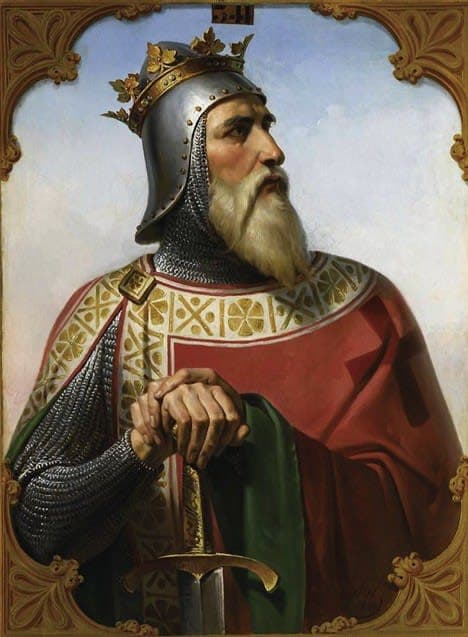

Robert Guiscard was the sixth son of the minor Norman knight Tancred of Hauteville. He arrived in southern Italy in 1046, when his elder brothers had already found success. Unlike them, however, Robert had to start from scratch. Rebuffed by his brother Drogo of Apulia, he spent two years as a mercenary—an experience that hardened his character and earned him the nickname “Guiscard,” meaning “the Cunning” in Latin. This sobriquet—and his reputation—were won in Calabria, where, according to chroniclers, he displayed remarkable guile and resourcefulness while raiding Byzantine and monastic lands.
His military talent emerged at the Battle of Civitate on 18 June 1053, where the Normans crushed the army of Pope Leo IX and took him prisoner, greatly accelerating their advance in the region. After the death of his brother Humphrey in August 1057, Robert—ignoring the rights of his nephews—was elected count of Apulia, the first step in building his personal domain.
From 1057 Robert’s chief aim was to expel Byzantium from southern Italy—a long and difficult process that took nearly fourteen years.


Together with his younger brother Roger, Guiscard gradually seized the remaining Byzantine-controlled cities. The climax came with the capture of Reggio in 1060, where siege engines were used for the first time. The conquered lands were divided between the brothers. The war in Apulia, however, seesawed. Vassal discontent and Byzantine financial backing fueled continual revolts. In 1068, when the Byzantine Empire was distracted by the Seljuk advance, Robert easily reasserted control over the rebellious towns, leaving the Byzantines only their last fortress—Bari.
From 5 August 1068 to 16 April 1071 the Normans besieged Bari, employing a fleet to impose a naval blockade for the first time. Despite attempts by the Byzantine navy to break the blockade, on 16 April 1071 the townspeople opened the gates and the city fell. This marked the final expulsion of the Byzantines from the region.
In 1076 Robert besieged Salerno, the last independent Lombard principality. Prince Gisulf II, through tyrannical rule and profiteering in provisions, provoked a popular uprising; the citizens opened the gates to Guiscard on 13 December 1076. Salerno, now the new ducal capital, was annexed to Robert’s dominions.
In 1059 Pope Nicholas II, seeking allies against Emperor Henry IV, granted Robert the title duke of Apulia, Calabria, and Sicily. This act not only legitimized his conquests but also freed him from vassal dependence on the Holy Roman Empire. The papacy, in turn, gained in Guiscard a powerful protector.

Relations with the papacy were not always smooth. Pope Gregory VII excommunicated Robert twice (in March 1074 and on 3 March 1078), displeased with his aggressive policy. But faced with the common threat posed by Henry IV, who had besieged Rome, the pope was forced to come to terms with Guiscard. On 29 June 1080 at Ceprano a new alliance was concluded, under which Robert pledged to aid the pope.
In 1081 Robert Guiscard, exploiting dynastic discord in Byzantium, launched a major expedition to the Balkans. His goal was grand: to seize Constantinople. The Norman fleet, commanded by his son Bohemond, defeated Byzantine and Venetian forces at the Battle of Dyrrhachium on 18 October 1081. This victory opened the road into the Balkans.
In 1082, however, news of a revolt in Apulia and Henry IV’s advance on Rome forced Robert to break off his triumphant campaign. In 1084 he marched on Rome, relieved the besieged Pope Gregory VII, and then turned the city over to his troops for sack. The fire the Normans set on 27 May 1084 became one of the most destructive in the Eternal City’s history.
Returning to the Balkans in 1084 to resume the war against Byzantium, Robert Guiscard was struck by an epidemic that weakened his army and infected him personally. He died of illness on 17 July 1085 on the island of Cephalonia. His body was taken to Italy and buried in the Church of the Holy Trinity in Venosa.



