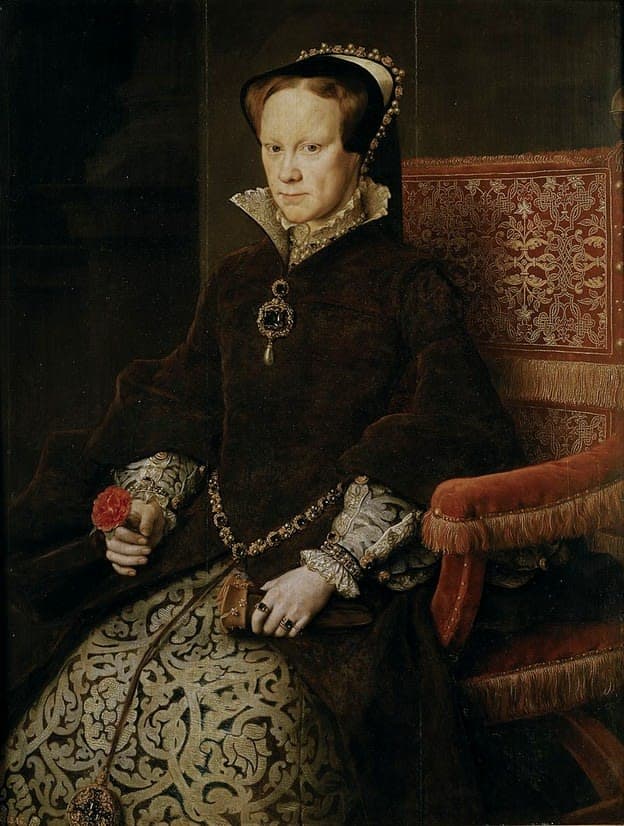

Mary I was born on 18 February 1516 at Greenwich. She was the only surviving child of King Henry VIII and Catherine of Aragon, and her birth brought great joy to the royal family. The girl was named after Henry’s beloved sister, Mary Tudor, Queen of France.

Mary’s early years were spent in luxury and frequent moves prompted by outbreaks of disease. Her household was large and dressed in her colors blue and green. From childhood she was a bargaining chip in her father’s diplomatic games. In 1518 she was betrothed to the French dauphin, and in 1522 to her cousin, the Holy Roman Emperor Charles V, for whom Mary felt romantic affection.

The princess’s education, designed by the Spanish humanist Vives, was very strict. She studied languages, philosophy, and theology, but she was not prepared at all for governing a state. In 1525, when it became clear Henry VIII would have no son by Catherine, Mary was proclaimed Princess of Wales and sent to Wales to administer her new domains no easy task, as the Welsh hated the English.
Mary’s life changed dramatically in 1527. Tired of the lack of a male heir, Henry VIII decided to annul his marriage to Catherine in order to wed Anne Boleyn. If this plan succeeded, Mary would be rendered illegitimate and lose all rights to the throne. After Henry unilaterally divorced, Mary’s life became a succession of humiliations. She was separated from her mother and sent to serve her stepmother, Anne Boleyn.

After Anne Boleyn’s execution in 1536 and the birth of a son, Edward, by Henry’s third wife, Jane Seymour, Mary though restored in law remained under suspicion. Her fate depended on the king’s ever-changing marriages.
After Henry VIII’s death in 1547, her brother Edward VI came to the throne. He was still a child, and the realm was ruled by Protestant regents. A convinced Catholic, Mary refused to accept Protestantism, which led to her withdrawal from court and constant friction with the regents. In 1553, as Edward VI lay dying of tuberculosis, he was induced to sign a settlement that excluded Mary and her sister Elizabeth from the succession and transferred the crown to Lady Jane Grey.

After Edward VI’s death, Jane Grey was proclaimed queen. She had little support, however. Mary seized the moment, fled to East Anglia, gathered adherents, and evading capture took the throne. Her reign began with the arrest and execution of her political opponents, including the sixteen-year-old Jane Grey and her family.
Mary’s chief aim was the restoration of Catholicism in England. She returned the country to papal jurisdiction, re-established the monasteries, and launched a harsh campaign against Protestants. From February 1555 mass executions began: around three hundred people were burned, including leading Protestant churchmen such as Thomas Cranmer. This cruelty earned her the sobriquet “Bloody Mary.”
In 1554 Mary married Philip, son of Charles V, who was twelve years her junior. The marriage was deeply unpopular in England. The people disliked the haughty Spanish prince and his entourage. Parliament refused to recognize Philip as king, and he had no right to interfere in the governance of the realm.
Mary’s reign was overshadowed by misfortunes. In 1557 a terrible epidemic of “sweating sickness” swept England, claiming thousands of lives, especially among the nobility. In 1558 Calais the last English enclave on the Continent was lost, a severe blow to national prestige.
The queen’s health, already fragile, deteriorated. She declined throughout the autumn of 1558. On 17 November 1558 Mary I died at St James’s Palace. On the same day her loyal ally, Cardinal Pole, also died.


Barely two hours after her death, her sister Elizabeth ascended the throne. Mary was buried in Westminster Abbey in a shared tomb with Elizabeth, who died forty-five years later. Their joint epitaph reads: “Partners both in throne and grave, here rest we two sisters, Elizabeth and Mary, in the hope of resurrection.”


