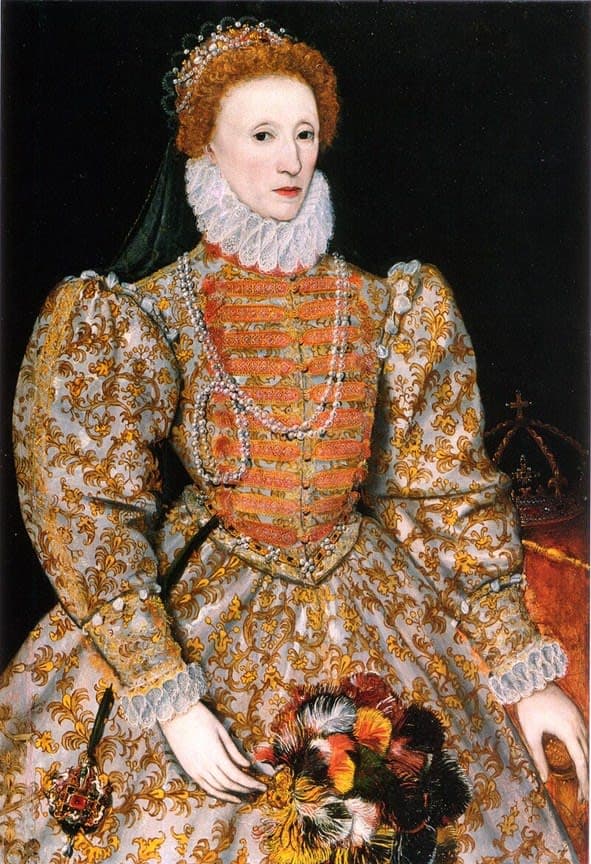

Elizabeth I was born on 7 September 1533 at the royal palace in Greenwich. She was the daughter of Henry VIII and Anne Boleyn. The birth of a daughter disappointed the king, who had hoped for an heir. At two and a half, Elizabeth lost her mother executed on fabricated charges of adultery after which Henry declared her illegitimate.

Elizabeth’s youth was spent in disgrace. She was kept away from the royal court, and after the death of her brother Edward VI and the accession of the devout Catholic Mary I, her life was in danger. Elizabeth was suspected of plots and even confined to the Tower, yet each time she managed to prove her innocence. During these years she received a brilliant education under the humanist Roger Ascham, mastering several languages and the classical canon. It was likely then that she formed the steadfast aversion to marriage she maintained throughout her life.

On 17 November 1558 Queen Mary I died, and two hours later the twenty-five-year-old Elizabeth came to the throne. She was slender, red-haired, and remarkably industrious. She appointed her loyal ally William Cecil as her principal secretary, and her childhood friend Robert Dudley became Master of the Horse.
Her early rule was aimed at reconciliation and stabilizing a country split between Catholics and Protestants. She was crowned on 15 January 1559 and soon adopted the Act of Uniformity, which restored the Reformation while allowing a measure of tolerance. She styled herself “Supreme Governor” of the Church, thereby avoiding open conflict and civil war.
Parliament immediately pressed the queen to marry to secure an heir for England. Elizabeth, however, evaded marriage throughout her reign. Her long attachment to Robert Dudley sparked endless rumors, but she insisted she remained a virgin.


Elizabeth’s chief rival for the English crown was her cousin Mary Stuart, great-granddaughter of Henry VII. Many Catholics considered Elizabeth illegitimate and backed Mary as the rightful queen. In 1560, after the death of the regent queen Mary of Guise, Elizabeth secretly supported the Scottish Protestants, leading to their victory over French forces and the Treaty of Edinburgh. Mary Stuart, then still Queen of France, refused to ratify the treaty beginning their long feud.

After a Catholic rising in England was crushed, Pope Pius V in 1570 issued the bull Regnans in Excelsis, excommunicating Elizabeth. This prompted harsher measures against Catholics and a series of plots aiming to kill Elizabeth and place Mary Stuart on the throne.
Elizabeth I’s reign saw economic and industrial growth. She stabilized the pound, founded the Royal Exchange, and stimulated the textile industry. England was transformed from a backward realm into a leading commercial and industrial power in Europe. Prosperity rose across the country, as numerous historical records attests.
Elizabeth also turned England into a formidable naval power. She secretly sponsored Francis Drake and other “sea dogs,” who plundered Spanish ships and raided colonies. This policy led to open Anglo-Spanish war in 1585. In 1588 the Spanish “Invincible Armada” attempted to invade England but was decisively defeated a pinnacle of England’s maritime might.


Despite these successes, her reign was clouded by social problems. Rising prices, taxes, and epidemics sparked popular unrest. The queen, however, handled crises deftly, using both harsh repression (imposition of martial law) and populist measures (the passage of the Poor Law), which laid the foundations of social relief.
Her rule became the golden age of English culture. Elizabeth patronized the theater, and it was in her era that William Shakespeare’s genius flourished. She herself was highly educated and took a keen interest in science and the arts.
Her reign also advanced relations with the Russian Tsardom. She corresponded with Ivan the Terrible, who even proposed marriage. Though no match ensued, these contacts strengthened the trading alliance between England and Russia.


By the end of her life, Elizabeth afflicted by poor eyesight and insomnia grew increasingly withdrawn. The deaths of her closest friends, including Robert Dudley and William Cecil, undermined her health. She died on 24 March 1603, remaining unmarried and childless.
With Elizabeth I’s death the Tudor dynasty came to an end. Her successor was James I, son of her rival Mary Stuart, marking the beginning of the Stuart dynasty.


