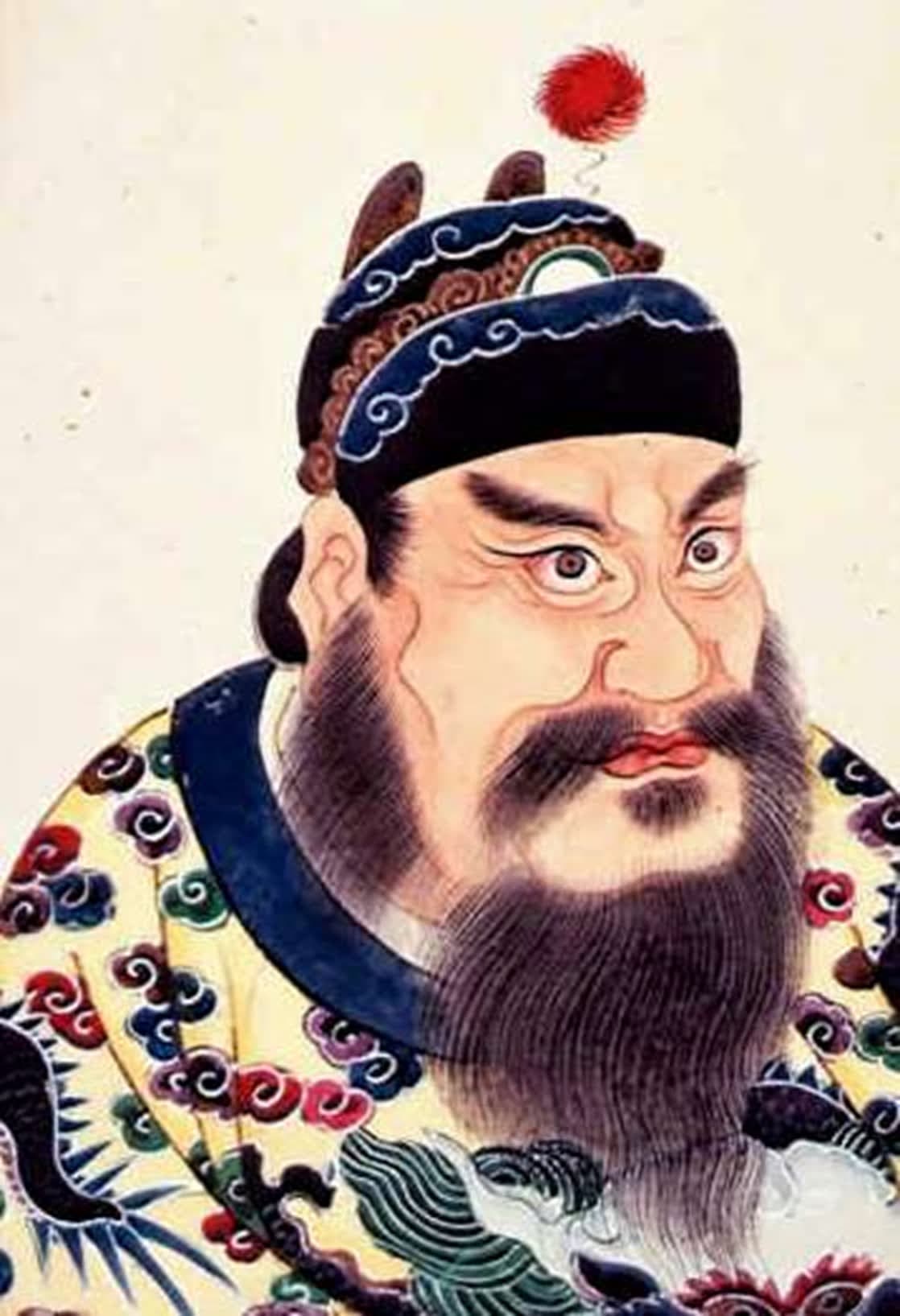
Born in 259 BCE in Handan, the capital of the state of Zhao, where his father, Lord Zhuangxiang, was being held as a hostage, the child was named Zheng — “the first” (after the month of his birth). His father’s position—as a ruler’s grandson by a low-rank concubine—virtually excluded him from inheriting the throne. The turning point came after Zhuangxiang’s acquaintance with the wealthy merchant Lü Buwei, who undertook to “make” a ruler out of an unlikely claimant.
The personal story of Ying Zheng (the future emperor) quickly became the focus of political rumor. According to Sima Qian, he was the son of a Zhao concubine presented to Zhuangxiang by Lü Buwei, and the woman was allegedly already pregnant; hence the gossip that Lü Buwei was his “real” father. Other accounts indicate that Ying Zheng’s mother came from a powerful Zhao clan—probably what saved her and her son when, during yet another war, the ruler of Zhao planned to execute the Qin hostages. With guards bribed using Lü Buwei’s money, Zhuangxiang escaped to the Qin forces. Owing to Lü Buwei’s intricate machinations, after the old king’s death and a brief reign by the crown prince Anguo, Zhuangxiang himself ascended the throne, but ruled less than three years; the young Ying Zheng then inherited power.
In 246 BCE, at age thirteen, Ying Zheng became king of Qin—a state already among the strongest under Heaven. The prime minister and regent Lü Buwei gathered about a thousand scholars at court and initiated the compilation of the encyclopaedia Lüshi Chunqiu, which became an intellectual emblem of the age. That same year, the engineer Zheng Guo from Han began construction of a 150-km irrigation canal (between the Jing and Luo rivers; modern Shaanxi). In ten years, it watered 40,000 qing (≈264.4 thousand hectares), triggering a powerful economic upswing. At the height of the work, he was accused of spying for Han, but he persuaded the king of the project’s benefit, was pardoned, and brought it to completion.
Meanwhile, a dynastic drama unfolded. After Zhuangxiang’s death, Lü Buwei openly cohabited with Ying Zheng’s mother. To deflect attention, she was “given” the eunuch Lao Ai who, according to Sima Qian, was not actually a eunuch—the castration papers were forged with bribes. Lao Ai rapidly concentrated power, and by the time Ying Zheng came of age (238 BCE) he was little more than a “boy at court.” That same year he decisively seized power. An investigation initiated by him confirmed the secret relationship between his mother and Lao Ai and the birth of two children, one of whom was being groomed as heir. Lao Ai forged the state seal, began mustering troops, and attempted to attack the palace; a battle near Xianyang cost several hundred lives and ended in Ying Zheng’s victory. The revolt was crushed; Lao Ai, his relatives, and accomplices were executed, and culpable courtiers were harshly punished. In 237 BCE, Lü Buwei—implicated in the plot—was exiled to Shu (Sichuan), but killed himself en route. Ying Zheng’s mother was first banished, then, at his advisers’ insistence, returned to court.
By the mid-220s BCE it was clear: Qin would redraw China’s political map. At thirty-two, Ying Zheng took his native Handan; around this time his mother died, and he displayed phenomenal memory and personal vindictiveness, ordering retribution against the family’s enemies who had humiliated his parents thirty years earlier. The following year came the famous assassination attempt: Jing Ke, sent by Prince Dan of Yan, nearly killed him, but the ruler personally fought him off with a sword, inflicting eight wounds. Two further attempts also failed.
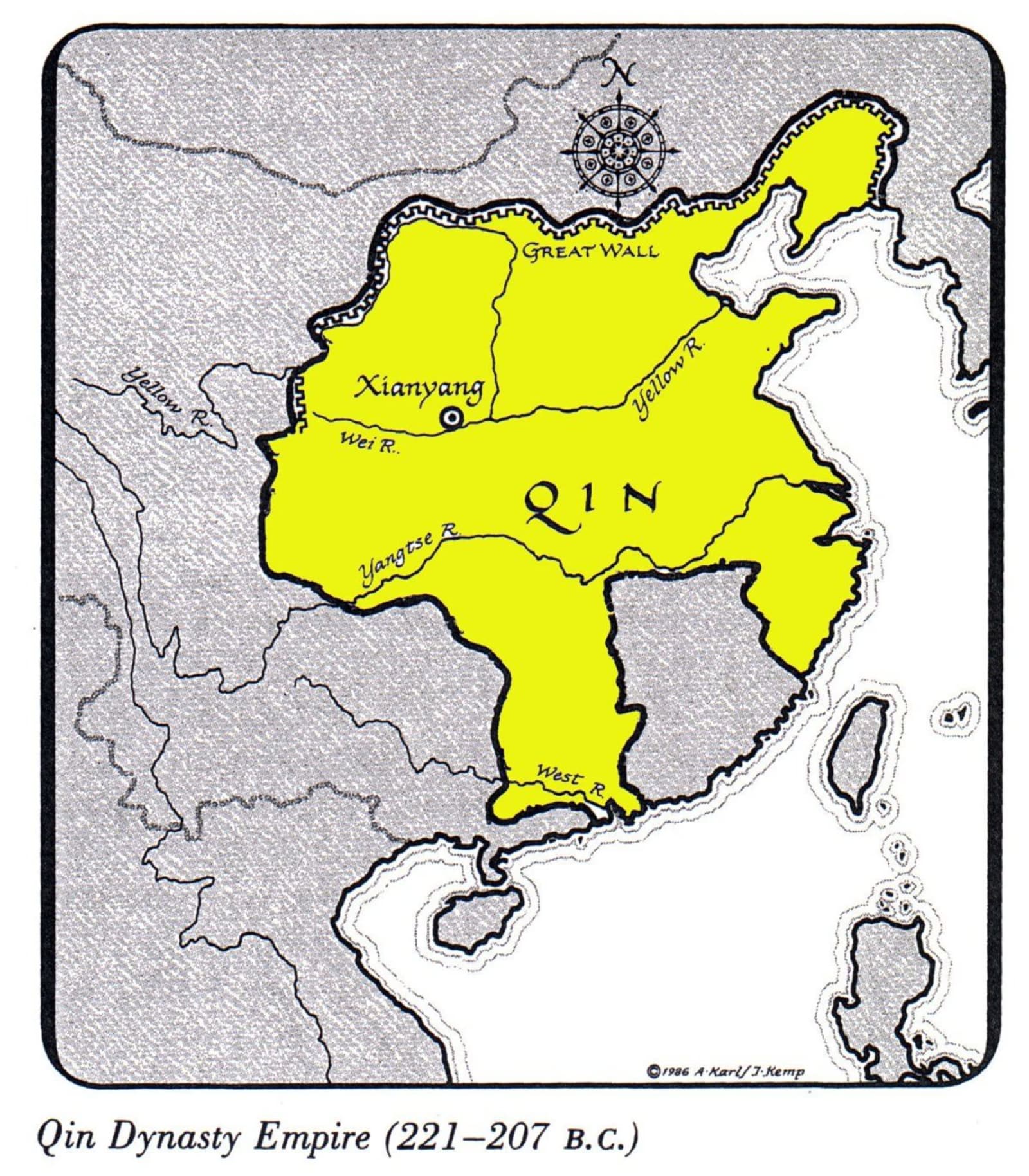
Ying Zheng then systematically crushed the neighboring states and annexed them: in 230 BCE Han fell; in 225, Wei; in 223, Chu; in 222, Zhao and Yan; in 221, Qi. In 221 BCE, at thirty-nine, Ying Zheng unified China for the first time in history and assumed the title Qin Shi Huang—“First Emperor of Qin,” bringing the Warring States period to an end. The new empire’s capital became Xianyang. The nobility of the conquered states—about 120,000 families—were relocated there, allowing the court to keep the elites under control. On Li Si’s advice, the emperor rejected granting fiefs to kinsmen, blocking the usual road to feudal decentralization.
The empire was divided into 36 commanderies (jun), then prefectures, then counties, and finally townships of about a hundred households, the entire vertical subordinated to the center. A “unification of standards” became symbolically and practically crucial: the captured enemy weapons were melted down into huge bells and twelve bronze colossi; throughout the land a single axle width for chariots was imposed, and script, currency, measures, and weights were standardized. This “infrastructure of unity” outlived the short-lived dynasty by millennia; modern Chinese character forms directly descend from Qin script.
Qin built space as a network. About 7,000 km of hard-surfaced roads with a three-lane scheme were laid, with stone bridges, inns, and relay stations for couriers. In the north, disparate frontier lines were joined into a single defensive belt—the Great Wall; by some estimates, several hundred thousand to a million people took part in the works. A key hydrotechnical achievement was the Lingqu Canal, 36 km long, linking the Xiang River (Yangtze basin) with the Li River (Xijiang basin); construction began in 214 BCE.

During the last decade of his life, the emperor was more often on the road than in the palace. He made five major inspection tours across the empire, reached the sea for the first time in 219 BCE, erected stelae with self-commentary on his achievements, and inaugurated the monarchic tradition of ascents to Mount Tai. For security during his travels he sent out several identical carriages around the realm, hid behind a curtain, and even the guards did not always know his exact location.
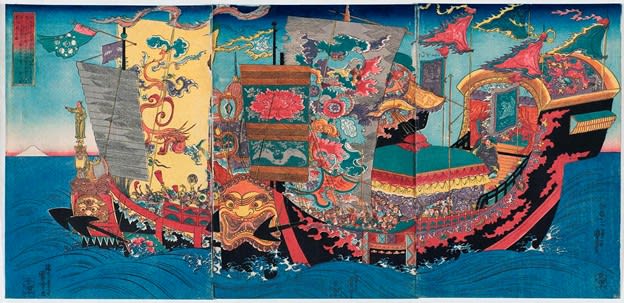
Above all, Qin Shi Huangdi feared death. This fear set a special “metaphysical program” for his rule. He associated with Daoist wonder-workers and sent expeditions in search of an elixir of immortality. In 219 and 210 BCE, Xu Fu, a court magician, led parties to Zhifu Island (Shandong; one route may have stretched toward the Japanese islands), but Xu Fu’s expedition never returned. In 210 BCE, hearing that “giant fish” blocked the way to the isles of immortals, the emperor went to sea and shot one with a bow. Soon he felt ill, returned to the mainland, and never recovered.

At Li Si’s urging, in 213 BCE an order was issued to burn all books in the empire, creating a “social amnesia” meant to cement the new order. The seizures did not affect treatises on agriculture, medicine, and divination, nor the imperial archives and the annals of Qin rulers. Tradition also dates to this period the exemplary “burial alive” of 460 Confucian scholars who had mocked the search for immortality and criticized the regime. Disappointed by the failure to find the elixir and secluded from the world, the emperor traveled less and less, expecting deification but receiving growing discontent. Several uncovered plots deepened his suspicion and isolation.
On September 10, 210 BCE, Qin Shi Huang died in the palace at Shaqiu. It was reported that the cause was “immortality pills” containing mercury. Fearing revolt and a struggle for power, the chief of the secretariat, the eunuch Zhao Gao, and the prime minister Li Si concealed the emperor’s death until they reached Xianyang: the body was placed in a carriage, and carts of rotting fish were driven before and behind to mask the smell of decay; “in the emperor’s name” they received letters and sent replies. Upon arrival in the capital, the death was officially announced.
By tradition, the throne should have gone to the eldest son, the crown prince Fusu. But Zhao Gao and Li Si forged the testament, placing the younger son Huhai (Qin Er Shi) on the throne. The same “will” ordered Fusu and his patron, General Meng Tian, to commit suicide. Fusu obeyed and killed himself, while Meng Tian, doubting the will’s authenticity, was arrested and executed along with his brother, the censor Meng Yi. Huhai proved completely incapable of rule, and supporters of the former dynasties rose up. In 206 BCE the lineage of Shi Huang was exterminated, the Qin Empire collapsed, and in its place arose the new Han Empire.
Nothing expresses Shi Huangdi’s scale of power better than his tomb complex near Xi’an. Construction began immediately after the empire was founded; according to Sima Qian, 700,000 laborers and craftsmen were mobilized, and the outer wall’s perimeter reached 6 km. In 1974 archaeologists identified the mound and found there the famous Terracotta Army. The emperor’s own burial chamber remains unopened. The complex became one of China’s first UNESCO World Heritage sites and remains a symbol of early imperial China.


