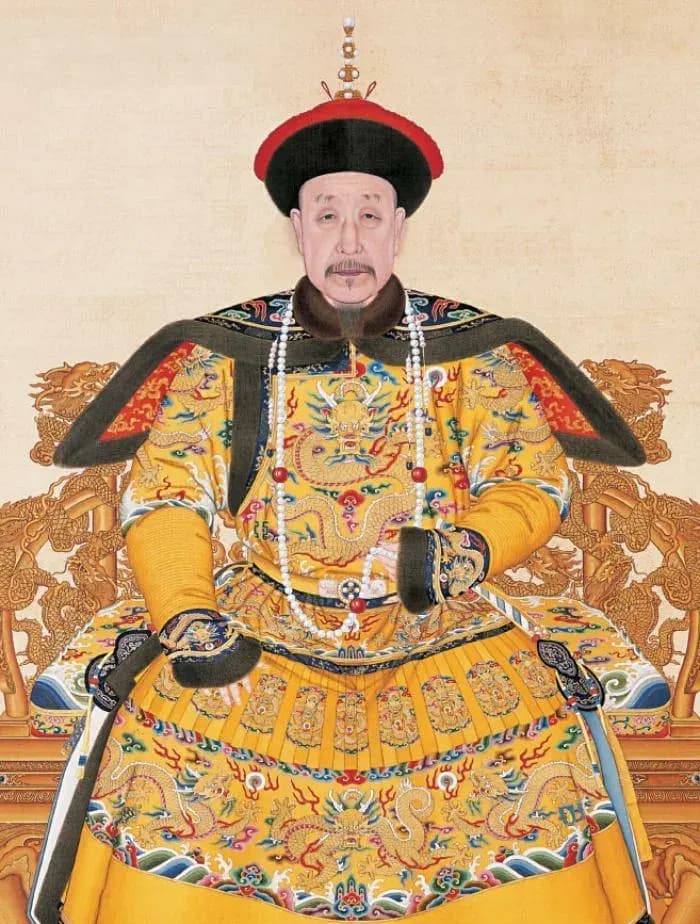

Hongli, grandson of Emperor Kangxi and son of Yongzheng, ascended the throne in 1735 after his father’s sudden death. He adopted the reign title Qianlong and from the outset strove to emulate his grandfather Kangxi, presenting himself as the ideal Confucian ruler, a great conqueror, and an enlightened patron of learning. Like his predecessors, he personally administered the empire, delving into all affairs of state.

One of Qianlong’s chief problems was the weakening of the Banner estate of Manchu warriors, the backbone of the army and ruling elite. The impoverishment and dispossession of soldiers and junior officers continued. To halt this process, in 1753 the emperor transferred lands repurchased by the treasury to the management of Banner administrations. This was meant to provide income to sustain the increasingly destitute warriors, but it failed to stop the overall decline of the estate.

Qianlong also tried to address dispossession by creating new agricultural settlements for Manchus in southern Manchuria. Yet his efforts to preserve the Manchus’ “sacred homeland” from Chinese settlers proved futile. Despite bans issued in 1740, 1762, and 1776, Chinese migration into Manchuria continued, eroding traditional Manchu landholding.
Qianlong continued the fiscal and administrative reforms of his predecessors. In 1741–1742 he reformed the population registration system, making it more accurate and comprehensive, including for non-Han peoples. This increased the number of registered inhabitants from 143 million (1741) to 313 million (1795). But it could not hide the fact that arable land per capita was steadily declining, fueling social tension.
Social discontent erupted in numerous minority uprisings. In 1735 a Miao revolt in Guizhou, triggered by official abuses and excessive taxes, broke out. Although troops from six provinces were deployed, the rebels were ultimately defeated.
The Qing authorities’ brutality only worsened matters. Punitive expeditions led by imperial commissioner Zhang Guangsi caused mass killings and the destruction of villages but failed to crush resistance completely. The Miao fought on until 1739, and a new rising flared in 1740, joined by the Yao and Dong peoples. Only after bloody repression did Qianlong grant concessions, exempting the Miao from taxes and restoring traditional judicial practices.
In 1747, Qing forces under Zhang Guangsi met fierce resistance from the Tubo (a Tibetan tribe) in Sichuan. The Tubo inflicted several defeats on the Chinese army, and Zhang Guangsi himself was captured and executed. Although Qing forces later suppressed the revolt, Tubo resistance continued until the mid-1760s.
Qianlong’s reign was a period of large-scale conquests. He focused on expanding westward, seeking to subjugate Tibet, Dzungaria, and Kashgaria. His campaigns benefited from the fragmentation and internal strife of these polities.
After Gyurme Namgyal, the Tibetan ruler, was assassinated by Manchu resident-officials, an uprising erupted in Lhasa. Qianlong seized the opportunity to bring Tibet firmly to heel. In 1751 he abolished princely titles and tightened control over the country, placing administration in the hands of ambans (resident ministers) under the direct supervision of Qing residents.


Qing diplomacy actively undermined the unity of the Dzungar Khanate, fanning internecine strife. In 1754, the exiled Dzungar prince Amursana fled to China and sought Qianlong’s help, providing a pretext for invasion. In 1755, the Qing army occupied Dzungaria, abolished the khanate, and divided it into four subordinate principalities.

However, Amursana, deceived in his expectations, rebelled. Qianlong responded with orders for the mass extermination of the Oirat population. This brutality drove the remaining princes to join the insurgency. During this war, Qing forces repeatedly invaded the Altai and Kazakhstan, triggering the mass flight of Oirats and Altai peoples into Russian territory.

While the Oirats were fighting, an anti-Manchu uprising also broke out in Northern Mongolia under Prince Chingunjav. He sought to unite with the Oirats, but Qianlong, fearing such an alliance, managed to divide the opposition. Chingunjav was defeated and executed in 1757.
In 1757, Qing forces advancing from China dealt a final defeat to the rebels. Amursana fled to Russia, where he died of typhus. By Qianlong’s order, 85% of the Oirat population of Dzungaria was annihilated, leaving the region utterly devastated.


Qianlong exploited internal conflicts in Kashgaria (Eastern Turkestan) among rival currents of the Muslim clergy. Relying on the “White Mountain” Khojas, he seized control of the region. But the brothers Burhan-al-Din and Khan Khoja rose against Qing tutelage. Qing forces under Zhao Hui besieged cities but met stubborn resistance. Only after major reinforcements arrived and local lords were bribed was resistance broken in 1759. The Khoja brothers were killed, and Kashgaria was fully incorporated into the Qing Empire.

By the late 1750s, Qianlong had completed his great conquests, significantly expanding the empire’s borders and making it one of the most powerful states in the world.

After his vast conquests, Emperor Qianlong focused on administering the immense empire. His policy in the new territories aimed at integration and tight control.
Kashgaria, together with Dzungaria, received the name Xinjiang (“New Frontier”) and became a place of exile for political opponents. Power there was shared between Manchu officials and local Muslim bek feudal lords, who in turn were subordinate to a governor-general. This system allowed the Manchus to rule by leaning on a loyal local elite that helped subdue the Uyghur and other populations.
Qianlong was troubled by the depopulation of Dzungaria after the Oirat genocide. To address this, he began resettling Manchu, Chinese, and Mongol troops there, as well as the Solon and Daur peoples from Manchuria. In 1764, several thousand Sibo were moved to the Ili region. Military-agricultural colonies were also established for exiled Uyghur resisters and migrants from other areas. In 1771, some Torghuts who had fled Russia returned to Dzungaria. Even so, the region remained sparsely populated.
In Mongolia, Qianlong continued a policy of fragmentation, increasing the number of principalities from 74 to 82. He created new posts for Manchu residents to strengthen military control. To prevent the possible empowerment of Mongol khans through the Buddhist church, he forbade selecting the Bogd Gegen (head of Mongolian Buddhists) from the Khalkha princely families, decreeing that reincarnations must be found exclusively in Tibet. This strengthened imperial authority but fostered greater feudal fragmentation in Mongolia, with the number of principalities growing fifteenfold over time.
In the mid-18th century, the Qing Empire stood at the height of its power, which led to a more isolationist policy aimed at “closing” the country. Fearing that an external threat might coincide with domestic uprisings as had happened to the Ming Qianlong tightened control over foreigners. In 1757, foreign trade was restricted to the port of Guangzhou. Foreigners were forbidden to learn Chinese, and Chinese who taught them faced execution.
Alongside external isolation, Qianlong imposed harsh ideological control known as the “literary inquisition.” Strict censorship rules were introduced, banning mention of Manchu rulers’ names, criticism of non-Chinese dynasties, and writings about struggles against nomads. All “seditious” books were to be destroyed. From 1774 to 1784, over 2,500 works were completely or partially destroyed, and nearly 14,000 volumes were burned. Possession could be punished by death. This policy caused enormous damage to Chinese scholarship and culture.


At the same time, the emperor organized massive cultural projects, engaging thousands of scholars in compiling encyclopedias such as the Siku Quanshu. Although this effort preserved many texts, it went hand-in-hand with censorship and falsifications.

Despite internal problems, Qianlong continued to pursue an aggressive foreign policy. His sense of omnipotence pushed him into new wars against southern neighbors.
Qianlong launched two invasions of Burma (Myanmar), both of which ended in complete failure. Burmese forces inflicted serious defeats on the Chinese; the Qing commander hanged himself. Peace in 1769 was concluded largely because Burma went to war with Siam. Despite the debacle, Qianlong declared that Burma had offered “symbolic” submission, allowing him to save face.

Taking advantage of a plea for help from the Vietnamese emperor of Annam who had fled to China, Qianlong sent a 200,000-strong army into Vietnam. Initially the Qing troops won several victories and seized the capital. But Nguyen Hue quickly mustered an army and dealt the invaders a crushing defeat. The Qing forces were almost annihilated, and their commander fled. Qianlong was forced to recognize Nguyen Hue as ruler of Vietnam.

Despite outward displays of strength, these failures revealed a mismatch between the empire’s external power and its internal condition. Decline began in the 1770s. Corruption, tax exploitation, and social tension grew. The population was rising faster than the area of cultivated land, impoverishing the peasantry.
During Qianlong’s reign, national and religious discrimination intensified. Chinese outside the Eight Banners were barred from top state offices. Muslims were forbidden to hold civil posts, and southwestern minorities were excluded from government service altogether.
Although Qianlong proclaimed religious tolerance, in practice he suppressed other religions in favor of Confucianism. He restricted freedom of worship for Muslims, banning the construction of new mosques and the pilgrimage to Mecca. Qing authorities adroitly stoked interethnic and religious animosities, pitting Chinese against Muslims and Mongols to retain control and strengthen imperial power.
As Qianlong aged, real power increasingly passed to his all-powerful favorite, a young Manchu named Heshen. His rise was meteoric: from imperial bodyguard he became the de facto ruler. In 1776 Heshen headed the Imperial Household Department, and in 1786 he became Grand Councillor (chancellor). He attained final supremacy in 1790, when his son married the emperor’s daughter. At times he held up to twenty high offices, and his wealth amassed through bribery, corruption, and embezzlement exceeded several years of the imperial treasury’s revenues.
Heshen built a clique of relatives and protégés that corroded the state apparatus. Officials at every level followed his example; office-selling and arbitrary rule flourished. All this unfolded as the elderly emperor gradually withdrew from governance.
In 1788, Nepalese Gurkhas invaded Tibet. Qianlong used the occasion to send an army under his relative Fuk’anggan. Qing forces not only expelled the Gurkhas but advanced to Kathmandu. Under the 1792 treaty, Nepal acknowledged tributary status, returned plunder, and pledged not to violate Tibet’s borders. The campaign, though costing 6 million taels, strengthened Manchu influence in Tibet, where Qing residents gained the right to appoint officials and control finances. Fearing foreign influence, especially from Great Britain, the Qing empire sealed Tibet off from the outside world.


In the late 18th century, Britain’s growing economic and colonial expansion collided with China’s isolationist policy. Seeking to open Chinese markets, the British government in 1792 sent a mission to Beijing headed by George Macartney.

In 1793, Macartney was received as the envoy of a “distant barbarian state,” treated as yet another tributary. Qianlong and Heshen refused negotiations and rejected all British demands, including opening new ports and establishing a diplomatic mission. The Macartney Embassy failed completely. The Qing court continued to regard itself as the center of the universe, oblivious to the rapidly changing global balance of power.
Over a century of Manchu rule, China’s population tripled, while cultivated land expanded by only two-thirds. This produced an acute food crisis and mass impoverishment. Thousands of peasants, unemployed people, and vagrants became tinder for social explosion. Anti-Manchu sentiment intensified, and national-liberation currents merged with social protest.
Under these conditions, the influence of secret societies (huìdàng) grew, such as the White Lotus. Despite brutal persecution, their activity gained momentum.
In 1774, the “White Sun” sect revolted in Shandong; it was crushed only after fierce fighting and mass executions.
In 1786, the “Eight Trigrams” sect rose in Zhili (Hebei), but that rebellion was likewise suppressed.
In 1787, a major uprising erupted in Taiwan led by the Heaven and Earth Society. The rebels proclaimed the restoration of the Ming dynasty and seized almost the entire western half of the island. Suppressing it required a 100,000-strong army; only by 1788 were the main rebel forces defeated.
One of the last major uprisings Qianlong faced was the renewed Miao rising of 1795 in Guizhou and Hunan. Protesting land seizures and official abuses, the Miao overthrew Qing authority across a vast area. The government sent a huge army, but the rebels held out doggedly. Only by early 1797 was the revolt suppressed its root causes unresolved.
In February 1796, at 85, Emperor Qianlong abdicated, not wishing to reign longer than his great-grandfather Kangxi. The throne passed to his fifteenth son Yongyan. However, Qianlong retained real power, and the all-powerful Heshen continued to run the state. Heshen lost his power only after Qianlong’s death in 1799.
Qianlong died at 87, leaving behind an empire outwardly mighty yet internally decaying an empire entering an era of stagnation.


