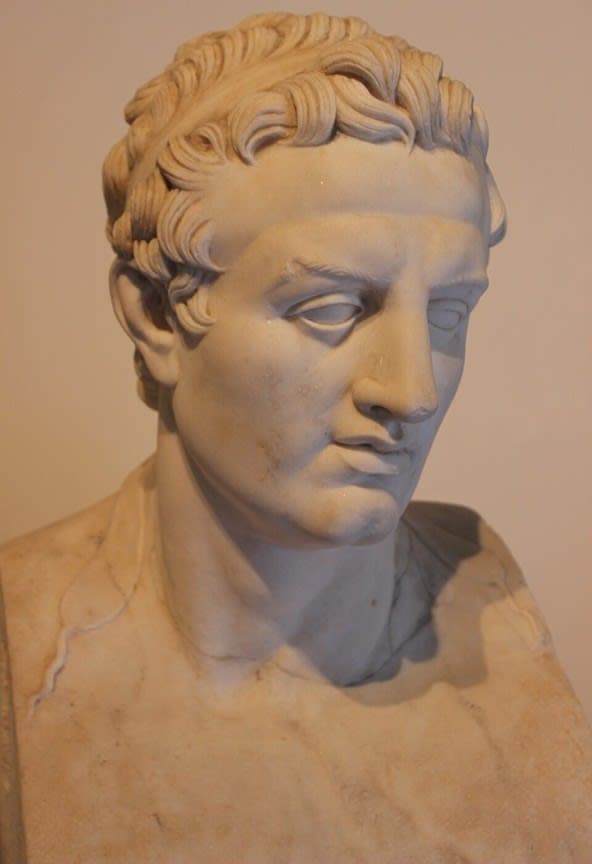

In November 247 BCE a man ascended the Egyptian throne whose character sharply contrasted with the refined temperament of his father, Ptolemy II. Ptolemy III, then in his early thirties, was by blood the son of Ptolemy II and Arsinoe I, daughter of Lysimachus. However, official propaganda, striving for the sacred purity of the dynasty, styled him the son of the “Sibling Gods” — Ptolemy II and Arsinoe II Philadelphus. Contemporaries quickly realized that a ruler had come to power in Alexandria in whose veins flowed the blood of the great commanders of the past. He resembled his grandfathers — Ptolemy Soter and the stern Lysimachus — far more than his own parent.

His reign began amid an international crisis. According to the treaty that ended the Second Syrian War, the new king’s sister, Berenice Syra, was to rule in Antioch, and her children were to inherit the Seleucid throne. But the death of Antiochus II in 246 BCE at Ephesus shattered this fragile peace. His first wife Laodice, thirsting for power and revenge, regained influence over her husband before his death and then sent assassins to Antioch. Berenice fought desperately in the fortress of Daphne, but both she and her young son were brutally murdered. This double killing became for Ptolemy III not merely a personal tragedy but a casus belli challenging the honor of Egypt.
Before leading his phalanxes eastward, Ptolemy III secured his rear by concluding the long-awaited marriage with Berenice of Cyrene. This reunited Cyrenaica with Egypt under a single crown. The young queen, possessing a truly Macedonian will, sent her husband off to war — a conflict later called the Third Syrian (or Laodicean) War. As a sign of devotion she dedicated locks of her hair in the temple of Arsinoe-Aphrodite, praying for her husband’s safe return. When the hair mysteriously vanished from the temple, the astronomer Conon declared that it had become a new constellation. This poetic image was immortalized by the great Callimachus in the poem The Lock of Berenice, made famous by Catullus’s Latin translation.
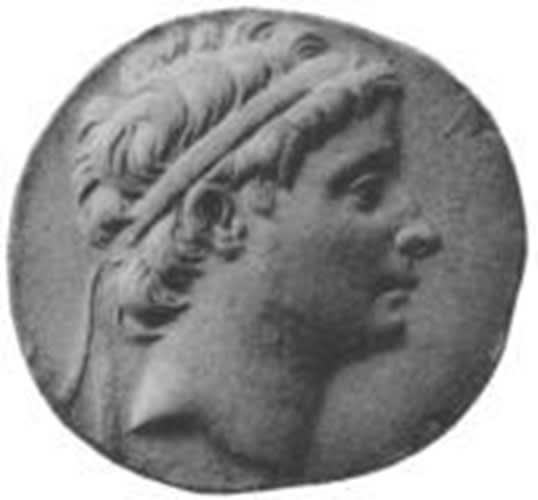
Ptolemy III’s military campaign turned into an unprecedented triumph. Unlike his father, Ptolemy personally led the army. The Egyptian forces, reinforced with war elephants — which began to be trained in Egypt for the first time — swept away Laodice’s resistance.
We learn of the scale of this campaign from the “Adulis Inscription” and from historical accounts. Ptolemy III did not merely seize Syria and Phoenicia. He crossed the Euphrates and marched victoriously through Mesopotamia, Babylonia, Susiana, Persia, and Media. In January 244 BCE the Egyptians stormed Babylon, defeating the army of the local governor Belat-Ninua.
The king employed cunning: letters were circulated in the name of the “living” Berenice and her son, urging cities to join the Egyptian side. Thus Seleucia Pieria, Soli, and Antioch fell, where Ptolemy was greeted as a liberator. His treasury was enriched by colossal booty — 40,000 talents of silver and priceless treasures. But most important for the Egyptians was the return of 2,500 sacred statues of gods that had once been carried off by the Persians. It was for this deed that the Egyptian people called him Euergetes (“Benefactor”).
Ptolemy’s victorious march was interrupted by sudden news of a revolt in Egypt itself. The likely cause was a low inundation of the Nile and the threat of famine. The Canopus Decree later noted that Ptolemy III and Berenice II showed wisdom by purchasing grain at high prices in Syria and Cyprus to save their subjects.
While Ptolemy was returning home, Seleucus II Callinicus attempted to recover what had been lost. His enormous fleet was destroyed by a storm, which the cities of Asia interpreted as divine punishment. Left almost alone, Seleucus managed to regroup and launch a counteroffensive. However, in 242–241 BCE he suffered another defeat in Palestine and was forced to seek help from his brother Antiochus Hierax (“the Hawk”).

In 241 (or 240) BCE peace was concluded. Although Ptolemy III did not retain Babylon, he secured key positions in Asia Minor and Syria, including the strategically vital Seleucia Pieria. Egypt regained its status as the leading power of the Mediterranean.
The second half of Euergetes’ reign passed in relative calm. He became a wise arbiter in Greek affairs, first supporting the Achaean League and later the Spartan king Cleomenes III. When a catastrophic earthquake struck Rhodes and toppled the Colossus, Ptolemy III demonstrated generosity, allocating hundreds of tons of silver and copper, supplies of grain, and thousands of workers to rebuild the city.
Under Ptolemy III the Library of Alexandria reached its zenith. He collected manuscripts with almost fanatical zeal. Legend says that he deceived the Athenians: having taken the official manuscripts of Aeschylus, Sophocles, and Euripides under a massive deposit for copying, he kept the originals and returned only copies to Athens, forfeiting the deposit of 15 talents.


In 238 BCE the famous Canopus Decree was issued, in which Ptolemy III attempted to reform the calendar. He was the first to propose introducing a leap day every four years so that festivals would not “drift” through the seasons. Although this reform did not take root among the conservative population, it foreshadowed the Julian calendar.
Ptolemy III left a deep mark on Egyptian architecture. It was under him, in August 237 BCE, that construction began on the great Temple of Horus at Edfu — one of the most magnificent and best-preserved monuments of ancient Egypt.
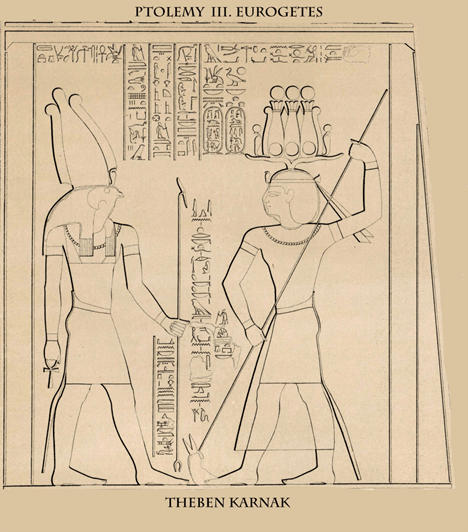
He completed the naos of the temple of Isis on the island of Philae and built a temple of Osiris at Canopus. Notably, on one of the pylons at Karnak, Ptolemy III is depicted not in traditional pharaonic attire but in a Greek chiton — a unique departure from rigid canonical norms, emphasizing his dual nature as a Macedonian king and an Egyptian god.
Ptolemy III Euergetes died in February 222 (or 221) BCE at about sixty years of age. His reign marked the period of Egypt’s greatest territorial and economic flourishing. As a sober and energetic leader, he managed to combine military power with concern for his subjects and patronage of the sciences. Although later sources sometimes confused him with the “luxurious” Ptolemy VIII, attributing to him the name Tryphon, history remembers him as the Benefactor — the king who returned the gods to their temples and transformed Alexandria into the true center of the world.


