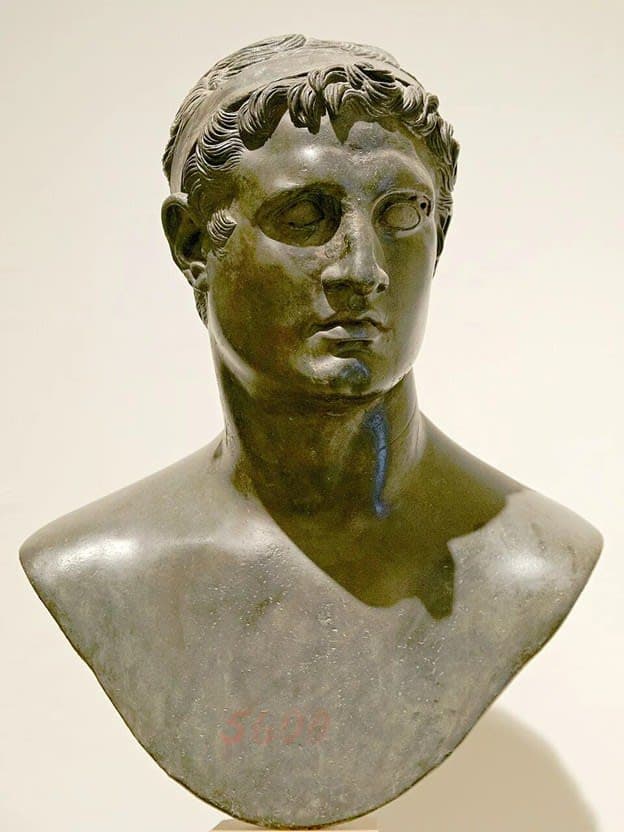

Ptolemy II was born on February 10, in 309 or 308 BCE on the island of Cos, where at that time his father’s powerful fleet was stationed. His path to the throne was not predetermined, for as the younger son he received the crown over the heads of his elder brothers, born to Eurydice, the daughter of Antipater. From 285 BCE he became his father’s co-ruler, and after the death of the great Ptolemy Soter in 283 or 282 BCE he assumed sole power over the richest state of the oikoumene.

The son Ptolemy differed strikingly from the father Ptolemy. If Ptolemy Soter was somewhat rough and accustomed to solving problems with a spear, Philadelphus was a man of a new type — a refined, fair-haired erudite. Educated by the greatest minds of his time — the poet Philitas of Cos and the philosopher Strato of Lampsacus — he absorbed a passion for geography, zoology, and literature. Even his physical weakness and tendency toward corpulence benefited the state: ill health made him “the most educated of men.” On the advice of Demetrius of Phalerum he sought truth in books that “are not afraid to tell kings the truth to their face.” Under him Egypt fought constantly, but by the hands of mercenaries and through the talents of admirals; the king himself went on campaign only once, up the Nile.

The beginning of his reign coincided with the grand collapse of the old world. In 281 BCE the last companions of Alexander the Great, Seleucus and Lysimachus, clashed in the final battle. After Lysimachus’s death, Seleucus became an almost absolute master of Asia, which frightened the young Ptolemy. The situation was complicated by his half-brother Ptolemy Ceraunus (“Thunderbolt”), who, having killed Seleucus, seized the Macedonian throne.
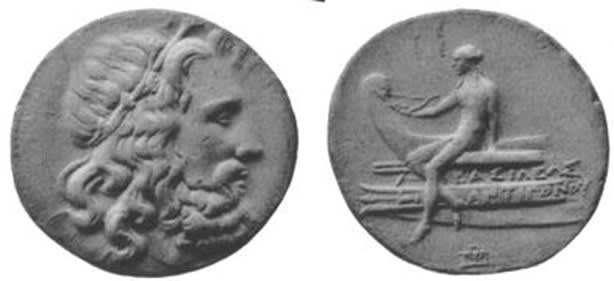
Yet chaos became Egypt’s ally. Ceraunus became mired in intrigues and soon fell in battle against the Galatians (Gauls) who burst into the Balkans. While Macedonia drowned in turmoil and the throne was occupied by accidental figures such as Antipater Etesias (so nicknamed because his “reign” lasted only 45 days — the duration of the seasonal winds), Ptolemy II strengthened his position. In the end, a fragile balance took shape in the region between three great dynasties: the Antigonids in Macedonia, the Seleucids in Asia, and the Ptolemies in Egypt. To secure peace in the west, Ptolemy even accepted a “gift” from Antigonus Gonatas in the form of 4,000 Galatian mercenaries, who were destined to play a fateful role in Egypt’s history.

Between 279 and 269 BCE, Alexandria’s political course was directed by a will far firmer than that of the king himself. His sister Arsinoe II returned to Egypt, having fled Macedonia after Ceraunus’s bloody betrayal. She was a woman of rare intelligence and icy composure. To take her place on the throne, she removed her brother’s lawful wife — Arsinoe I — accusing her of plotting to kill her husband. The first wife was exiled to Coptos, and her physician and accomplices were executed.

Then Ptolemy took a step that shocked the Greeks but delighted the Egyptians: he married his own sister. The poet Sotades, who dared to mock this “incest,” was thrown into the sea in a lead coffin. Arsinoe received the title “Philadelphē” (Loving her brother). She became the true architect of Egyptian foreign policy, striving to recover the lands of her late husband Lysimachus. Under her influence the court began eliminating “inconvenient” members of the family: the king’s brother Argaeus was executed, and another half-brother on Cyprus as well. Even the aged Demetrius of Phalerum, who had once advised giving the throne to Ceraunus, ended his days after the bite of a poisonous snake within prison walls.
In 276 BCE, Ptolemaic ambitions led to an open clash with Antiochus I. The First Syrian War began. Egyptian priests at Sais described it in traditional pharaonic tones: “the king cut off heads and poured out streams of blood,” but the reality was more complex. Ptolemy acted through amphibious landings and raids, seeking to exhaust the enemy.

The poet Theocritus, in his panegyrics, celebrated how the king carved off pieces of Phoenicia, Arabia, and Cilicia for himself. The Egyptian fleet under Patroclus and Callicrates dominated the Aegean Sea, bringing Lycia, Caria, and Pamphylia under its control. Samos became the principal Egyptian base. In Ionia and at Miletus, Ptolemy’s influence grew through generous gifts and the “liberation” of cities from taxes. At Sidon the king installed his admiral Philocles, and Tyre, with his support, regained its independence.
Antiochus I did not sit idle, and in 275–274 BCE he moved against Ptolemy with Bactrian elephants and a huge army. Seleucid cuneiform indicates that the Egyptians were forced to retreat. Antiochus captured Damascus by stratagem, taking advantage of the fact that the Egyptian strategos Dion had relaxed vigilance during a festival. The threat was so great that Ptolemy and Arsinoe personally arrived at the Isthmus of Suez in November 274 BCE to organize the defense against a possible invasion of Egypt itself.
The situation was further complicated by a stab in the back: the king’s half-brother Magas, ruler of Cyrene, declared himself an independent king and marched on Alexandria. He reached Chios (50 km from the capital) but was forced to turn back because of an uprising of the Libyan Marmaridae tribes in his rear. Ptolemy wanted to pursue him, but encountered a mutiny by those very 4,000 Galatians “gifted” by Antigonus. The barbarians planned to plunder the Egyptian treasury. Ptolemy’s reaction was brutal: all the Galatians were driven onto a deserted island in the Nile Delta, where every last one of them died of hunger. This was the only deed that Theocritus could celebrate as a personal military exploit of a non-warlike king.
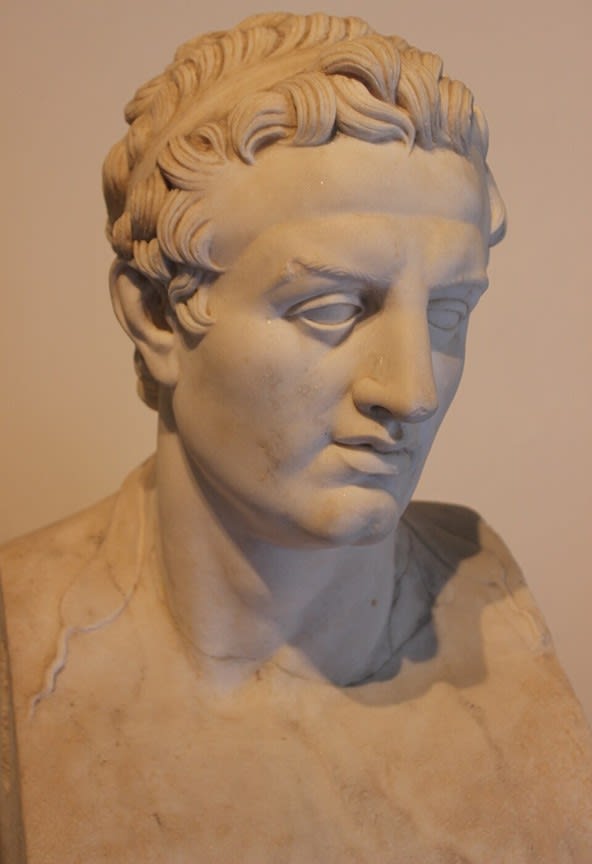
The war ended around 272 BCE in a compromise, possibly because of a plague epidemic in Asia. In 269 BCE Arsinoe II died, leaving her husband in deep grief. Ptolemy raised her to the rank of a goddess. Across Egypt and the Greek world, temples of Arsinoe appeared; in Alexandria her two-meter statue carved from a single topaz became an object of veneration.
Ptolemy II definitively fastened the divine status of the dynasty, instituting the cult of his parents as the “Savior Gods” and his own with his wife as the “Sibling Gods.” Every four years in Alexandria the “Ptolemaia” were held — festivals rivaling the Olympic Games in splendor. The famous procession of 274 BCE, with hundreds of golden wreaths, exotic animals, and statues of the gods, became a symbol of Egypt’s inexhaustible wealth.
The last years of Arsinoe II’s life and the period after her death are shadowed by a historical mystery. From 266 to 258 BCE, some “son” of Ptolemy II appears in official documents as a co-ruler. However, in 258 BCE he suddenly disappears from the pages of history.
Scholars still debate who he was: an elder son by the first wife who died in youth? Or a son of Arsinoe II by Lysimachus, whom she sought to make heir to the Egyptian throne? The most convincing version holds that he was the elder brother of the future Ptolemy III Euergetes. The disappearance of the co-ruler opened the path to power for Ptolemy III, who, despite being the son of the exiled Arsinoe I, always officially styled himself the son of the “Sibling Gods,” emphasizing the continuity of sacred authority.

By the mid-260s BCE, Arsinoe II’s influence continued to determine Alexandria’s course even after her death. Ptolemy II, having still not achieved a decisive success in Syria, shifted the center of gravity of his policy to Greece. In 266 BCE, the Athenian Chremonides raised a revolt against Macedonian domination, and Ptolemy, faithful to the precepts of his ancestors, hastened to proclaim himself the “defender of Greek freedom.”
The war that entered history as the Chremonidean War became a severe test for Egyptian ambitions. While the Macedonian king Antigonus Gonatas tightened the siege ring around Athens, the Egyptian fleet under the command of Patroclus camped off the coast of Attica. However, Patroclus displayed remarkable passivity. He justified his inaction by claiming that his Egyptian sailors were not trained to fight on land. Despite landings at Koroni and attempts by the Spartan king Areus to break through the Isthmus, the coalition collapsed.

Antigonus Gonatas showed iron resolve, and even when his own Galatian mercenaries mutinied at Megara, he crushed them and returned to the siege. By 261 BCE Athens fell. Chremonides fled to Egypt, and Ptolemaic influence in the Aegean Sea was seriously shaken. Egyptian diplomacy demonstrated its indecisiveness, which led to the strengthening of Macedonia and the creation of a powerful anti-Egyptian league.
The following years turned into a prolonged struggle for naval supremacy. Around 260 BCE the Egyptian fleet clashed with the Macedonian fleet in decisive battles near the islands of Cos and Andros. Despite the power of the Egyptian ships, Antigonus Gonatas won a crushing victory. Legend says that Antigonus, seeing the enemy’s numerical superiority, asked his warriors: “And for how many ships do you count me?”
The defeat at Cos (or Andros, since historians still debate the exact location and number of battles) marked the end of Egyptian hegemony in the Aegean. The situation was worsened by a disaster at Ephesus, where the Rhodian admiral Agathostratus outwitted Chremonides by luring his fleet into a trap. Egypt was forced to yield territory: Rhodes took Caunus, and Antigonus dedicated his flagship, the Isthmia, to the god Apollo as a sign of triumph.
At this same time (around 258 BCE), the mysterious “Son” — the co-ruler of Ptolemy II — disappears from the pages of history. He likely bore the nickname Andromachus (“fighter at Andros”). According to one version, he was the king’s elder son who, after the naval defeat, attempted to declare himself an independent ruler at Ephesus. His end was tragic: he was stabbed to death in the Temple of Artemis by mutinous Thracian mercenaries.
Meanwhile in the west, in Cyrenaica, the old ruler Magas died. His widow Apama, who hated the Ptolemies, tried to sabotage the betrothal of her daughter Berenice to the Egyptian heir. She invited Prince Demetrius the Fair from Macedonia, who quickly seized power in Cyrene. However, his affair with the widow Apama herself led to a bloody finale: the young Berenice led a conspiracy, and Demetrius was killed in the bedroom of his lover. Ultimately, after a decade of turmoil and republican experiments, Cyrene returned under Egyptian control through Berenice’s marriage to the future Ptolemy III Euergetes.

In 261 BCE Antiochus II Theos ascended the Syrian throne, eager for revenge. The Second Syrian War began, lasting many years. Antiochus II, allied with Macedonia and Rhodes, systematically drove the Egyptians out of Asia Minor. Egypt lost Ephesus, Miletus, and Cilicia. Ptolemy II, realizing that military fortune had abandoned him, resorted to his favorite tactic — a diplomatic marriage.

In 252 BCE peace was concluded. Antiochus II agreed to divorce his wife Laodice and marry Ptolemy’s daughter Berenice, nicknamed Phernophorus (“Bringer of Dowry”). Ptolemy personally escorted his daughter to Pelusium and then regularly sent her water from the Nile, believing in its miraculous properties. The aging king hoped that his grandson would become heir to the Seleucid Empire, not suspecting what terrible tragedy this union would bring after his death.
While armies fought for Syria, Ptolemy II built a global trade empire. In 273 BCE he became the first Hellenistic king to send an embassy to Rome, foreseeing the rise of a new power in the West. During the First Punic War he maintained wise neutrality, refusing Carthage a loan while preserving friendly relations.
In the south, Ptolemy led an expedition into Ethiopia (Nubia). He was interested less in land than in exotic goods and resources. He founded the city of Ptolemais Epitheras (“the Hunting City”) specifically for capturing and transporting wild elephants, which were trained for his army.
To channel the flow of Indian and Arabian goods to Alexandria, the king refurbished the ancient canal between the Nile and the Red Sea and built the ports of Berenice and Arsinoe. An ambassador, Dionysius, was sent to the great kings of India, making Egypt the principal intermediary in trade between East and West.
Within Egypt, Ptolemy II created a system that became a model of enlightened absolutism. His revenues were colossal: the treasury held thousands of tons of silver, and annual income amounted to millions of artabas of grain. These funds supported a magnificent court and the advancement of science.
Under him, the holdings of the Library of Alexandria reached half a million scrolls. Callimachus compiled the world’s first catalog (“Pinakes”), and scholars received complete freedom of research.
In Alexandria, the dissection of human bodies was permitted for the first time, allowing Herophilus and Erasistratus to make breakthroughs in anatomy. The great Archimedes and the astronomer Aristarchus of Samos worked there.

One of Ptolemy’s most important cultural acts was organizing the translation of the Old Testament into Greek. Seventy translators produced a text that made Jewish wisdom accessible to the entire Hellenistic world.
Toward the end of his life, Ptolemy II Philadelphus suffered from gout and mental distress. Legend says that, looking from the window of his golden palace at poor Egyptians warming themselves on the sand and eating scraps, the king wept, envying their carefree lives.
In 247 BCE he appointed his son Ptolemy III Euergetes as co-ruler. Ptolemy II died on January 27, 246 (or 245) BCE at the age of 63, having reigned nearly 39 years.
He left Egypt at the zenith of its glory. Alexandria became the “beacon” of civilization, and the Lighthouse of Pharos, whose construction was completed during his reign, entered the list of the Wonders of the World. Despite military setbacks at sea, Ptolemy II Philadelphus proved that soft power, science, and trade can build an empire no less durable than one forged on the point of a sarissa.


