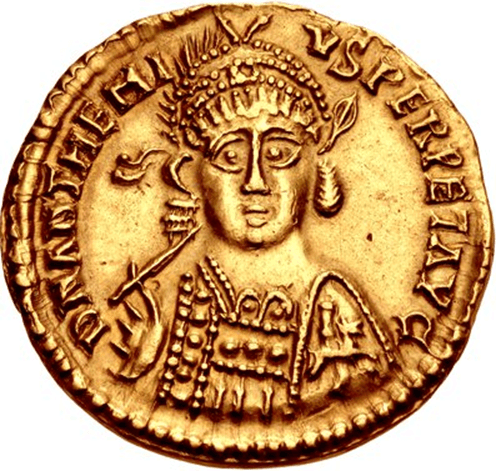
Anthemius was born around 420 in magnificent Constantinople.
The blood of the highest imperial elite ran through his veins. His father, Procopius, held the supreme military office of magister militum per Orientem between 422 and 424.
His grandfather, also named Anthemius, served as Praetorian Prefect and from 405 to 414 was effectively the ruler of the entire eastern half of the Roman Empire.
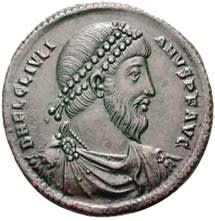
Moreover, Anthemius’s ancestry could be traced back to the usurper Procopius, a relative of Emperor Julian the Apostate himself.
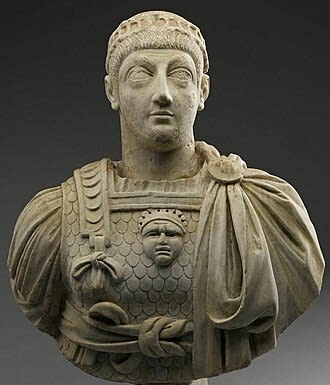
In his youth, Anthemius travelled to Alexandria, the intellectual capital of the Mediterranean world.
There, in the celebrated school of the Neoplatonist philosopher Proclus, his sharp intellect was formed.
He studied alongside men whose names would later become prominent in history: Marcellinus, the future independent ruler of Dalmatia; Flavius Messius Phoebus Severus; and the talented pagan poet Pamprepius.
His deep immersion in ancient philosophy permanently gave Anthemius the character of a sophisticated Hellenic intellectual — a trait that would later play a fateful role in his relations with the harsher Roman West.
The Empire, however, needed not only thinkers but warriors.
In 453, Anthemius’s status rose dramatically when he married Marcia Euphemia, daughter of the Eastern emperor Marcian.
After receiving the title of comes and command in Thrace, he did not remain at court enjoying imperial luxury. Instead, he travelled to the harsh Danubian frontier to supervise the strengthening of its defenses.
The young commander’s achievements were so impressive that already in 454 he was recalled to Constantinople, awarded the prestigious rank of patrician, and appointed Magister Militum of the East.
In 455, Anthemius reached the pinnacle of Roman honorary offices when he became consul together with the Western emperor Valentinian III.
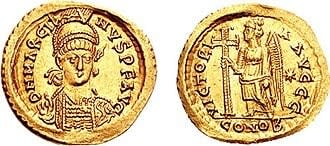
Emperor Marcian regarded his brilliant son-in-law as a legitimate potential successor to either the Western or Eastern throne.
History, however, took another course.
In January 457, Marcian died unexpectedly before he could formally designate an heir.
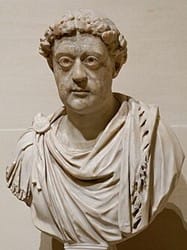
With Marcian’s death, real power in Constantinople fell into the iron grip of Aspar, the all-powerful military commander of Alan origin.
As a barbarian, Aspar could not place the imperial diadem on his own head, but he needed an obedient ruler who would carry out his wishes.
Anthemius, with his ambition, enormous prestige, and political independence, represented a serious threat to Aspar.
The general therefore chose a more manageable candidate — the military commander Leo I.
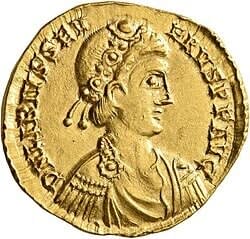
Despite the collapse of his hopes for the throne, Anthemius remained loyal to the state.
Retaining the rank of magister militum, he became a powerful shield of the eastern frontiers.
Around 460, his legions inflicted a crushing defeat on the Ostrogoths of King Valamir in Illyricum.
During the severe winter of 466–467, Anthemius further enhanced his reputation by defeating the Hunnic forces of Hormidac, who had dared to cross the frozen Danube.
Meanwhile, catastrophe was unfolding in the West.
After the death of Emperor Libius Severus in 465, the Western Roman Empire was left without a ruler.
The Vandal king Genseric immediately took advantage of the situation.
From his stronghold in Carthage, he repeatedly devastated the coasts of Italy.
Genseric intended to place his own puppet on the vacant Western throne — the aristocratic Roman Olybrius.
The choice was no coincidence.
Olybrius was married to one daughter of the murdered Emperor Valentinian III, while Genseric’s own son Huneric was married to the other.
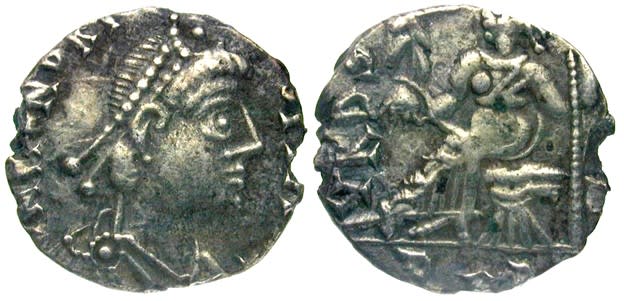
The accession of Olybrius would have effectively placed the Western Empire under Vandal influence.
This was unacceptable both to Emperor Leo I in Constantinople and to the de facto ruler of Italy, the barbarian general Ricimer, who had become accustomed to appointing and removing emperors according to his own interests.
Seeking to break Constantinople’s resistance, Genseric launched a campaign of large-scale terror.
His forces attacked Sicily and Italy and even invaded territories of the Eastern Empire, including Illyricum and the Peloponnese, where the Vandals enslaved large numbers of inhabitants.
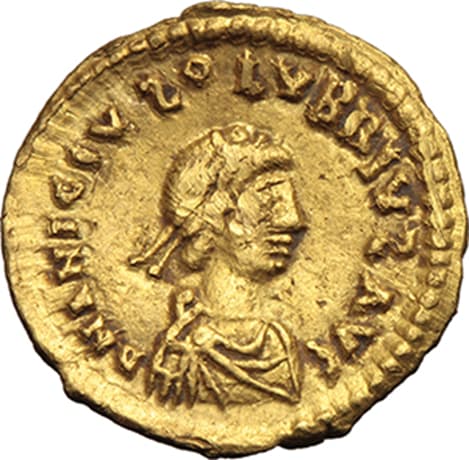
Leo I responded with a brilliant geopolitical maneuver.
In the spring of 467, he sent a large army westward under the command of the Magister Militum of Illyricum, Marcellinus, Anthemius’s former companion from his student days.
At the head of the entire expedition, Leo placed Procopius Anthemius.
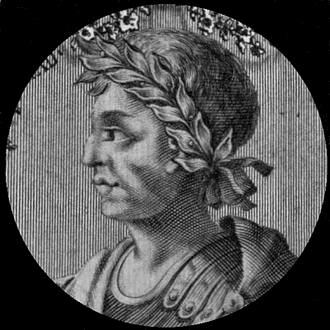
On 12 April 467, at a military camp near Rome, Anthemius was solemnly proclaimed Emperor of the West, with Ricimer’s consent.
With this single move, Leo I achieved several objectives at once: he removed a dangerous rival for his own throne from Constantinople, destroyed Genseric’s plan to place Olybrius on the Western throne, and provided Italy with an emperor backed by an army capable of resisting the Vandals.
The beginning of Anthemius’s reign was marked by an unprecedented improvement in relations between the two halves of the divided Roman world.
Rome and Constantinople once again acted almost as a single political system.
This unity was particularly visible in the traditional appointment of consuls.
In 468, Anthemius received the rare honor of serving as the sole consul of the entire Empire, just as Leo I had done in 466.
A series of prestigious appointments followed, symbolizing the unity between East and West.
In 469, the consuls were Marcian, Anthemius’s son, and Zeno, Leo I’s son-in-law.
In 470, the consulships went to Anthemius’s former philosophical-school companion Messius Phoebus Severus and the eastern military commander Jordanes.
In 471, the consuls were Leo I himself and Caelius Aconius Probianus.
The political alliance was also strengthened through marriage: Anthemius’s son Marcian married Leo’s daughter Leontia.
Attempting to control Ricimer’s volatile temperament, Anthemius made an enormous personal sacrifice.
He gave his daughter Alypia in marriage to the powerful barbarian commander.
The Gallo-Roman aristocrat and poet Sidonius Apollinaris, who arrived in Rome at the end of 467, left enthusiastic descriptions of the magnificent wedding celebrations, during which all social classes of the Eternal City appeared united in celebration.
For a moment, it seemed that the Empire was being reborn.
Yet the Vandal threat hung over Anthemius like the sword of Damocles.
At the end of 467, bad weather ruined his first independent attempt to launch a campaign against Africa.
In 468, however, the two Roman empires combined their forces for the largest joint military operation of the century.
The plan was enormous in scale.
A vast united fleet was to transport Eastern Roman troops, Anthemius’s Western army, and the battle-hardened Illyrian legions of Marcellinus to Africa.
Leo I appointed his brother-in-law Basiliscus commander-in-chief of the entire operation.
The decision proved disastrous.
The expedition ended in catastrophe.
Because of Basiliscus’s incompetence — and perhaps even treachery — the fleet was burned by the Vandals.
The talented Marcellinus was murdered by assassins.
Horrified by the scale of the losses, Leo I hurried to conclude a separate peace with Genseric.
Anthemius was left alone, facing an empty treasury, deprived of his finest commander, and with the hope of recovering Africa — the breadbasket of the Empire — destroyed.
The failure in the south forced the emperor to redirect his attention northward toward rapidly collapsing Gaul.
The situation there was critical.
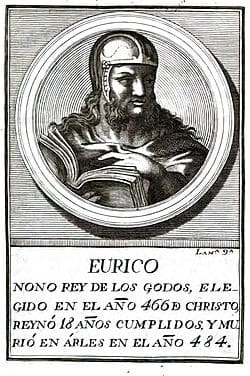
The Visigothic king Euric, sensing Roman weakness, was conquering province after province.
Only Arelate, modern Arles, and Massilia, modern Marseille, remained firmly under Roman control.
The region of Auvergne was almost completely isolated and was heroically defended by Ecdicius, son of the late Emperor Avitus.
Meanwhile, in northern Gaul, the Domain of Soissons had effectively become an independent Roman territory.
Anthemius developed an ambitious strategic plan to attack the Visigoths from two directions.
In 469, he formed a military alliance with Riothamus, king of the Britons who had settled in Armorica, modern Brittany.
The Britons were to advance from the north, while Anthemius’s legions attacked from the south.
At first, the campaign developed successfully.
Riothamus’s troops advanced as far as Bourges.
Then betrayal intervened.
The Praetorian Prefect of Gaul, Arvandus, secretly revealed Anthemius’s plans to King Euric.
The Visigoths were able to regroup and, at the Battle of Déols, overwhelmed the Britons through numerical superiority before the main Roman forces could arrive.
Anthemius refused to give up.
He sent his southern army from Arelate against Euric under the command of his own son, Anthemiolus.
The decision became a personal tragedy for the emperor.
While crossing the Rhodanus, the Rhône River, the Roman army fell into a carefully prepared ambush and was virtually annihilated.
Anthemiolus was captured by the barbarians and ruthlessly executed.
Gaul was effectively lost.
Foreign-policy disasters inevitably produced an internal political explosion.
The Italian elite had never truly regarded Anthemius as one of their own.
To them, he remained an arrogant Greek, an appointee of Constantinople whose excessive independence caused constant irritation.
His sophisticated philosophical education and friendship with Neoplatonists also gave rise to suspicions that he secretly sympathized with paganism.
Trying desperately to strengthen his political position, Anthemius sought support from the senatorial aristocracy, generously granting the title of patrician to prominent representatives of Italy and Gaul.
The greatest threat, however, remained Ricimer.
Despite their dynastic marriage alliance, relations between the emperor and his powerful son-in-law steadily deteriorated.
The point of no return came in 470, when Anthemius accused the senator Romanus, one of Ricimer’s principal allies, of treason and had him executed.
Furious, Ricimer gathered an army — originally assembled for war against the Vandals — abandoned Rome, and withdrew to northern Italy.
After a series of armed confrontations that threatened to tear the country apart, Epiphanius, bishop of Pavia, intervened.
Through his mediation, the two sides concluded a fragile truce intended to last for one year.
At the beginning of 472, the conflict erupted once again, this time provoked by the treachery of the court in Constantinople.
Emperor Leo I sent Olybrius, the long-standing candidate for the Western throne, to Italy, supposedly to mediate between Anthemius and Ricimer.
Afterward, Olybrius was allegedly expected to continue as an ambassador to the Vandals.
In reality, it was an elaborate trap.
Leo secretly sent a second message to Anthemius ordering him to kill Olybrius and eliminate Ricimer.
Ricimer’s spies intercepted the messenger.
After reading the letter, the general immediately declared open war against Anthemius and proclaimed Olybrius emperor.
Ricimer’s army marched on Rome and placed the city under a severe siege.
In this desperate moment, both the Senate and ordinary citizens of Rome stood in defense of their legitimate emperor, Anthemius.
Both sides sought military support from outside Italy.
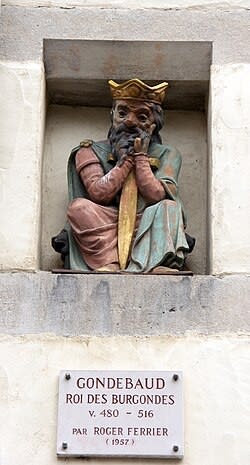
A Gallic army commanded by Gundobad, Ricimer’s nephew, supported Ricimer.
Driven into a corner, Anthemius resorted to an extreme measure.
He appealed for assistance to the Ostrogothic commander Vilimer, reportedly promising him Gaul in exchange for military support.
Vilimer marched rapidly toward Rome, but in the decisive battle his forces were completely defeated by Ricimer’s army.
Realizing that the city was doomed and that no further help would arrive, Anthemius made a desperate attempt to break through the siege.
The sortie ended in bloodshed.
After losing almost all of his remaining loyal supporters, the emperor attempted to seek refuge within the sacred walls of St. Peter’s Basilica.
But to the enraged victors, nothing was sacred.
Inside the church itself, Procopius Anthemius was captured and beheaded.
According to different accounts, the fatal blow was delivered either by Ricimer himself or by Gundobad.
This occurred on 11 July 472.
With the severed head of Anthemius — philosopher, soldier, and emperor — falling upon the cold marble, so too disappeared one of the last hopes of the Western Roman Empire for political revival.


