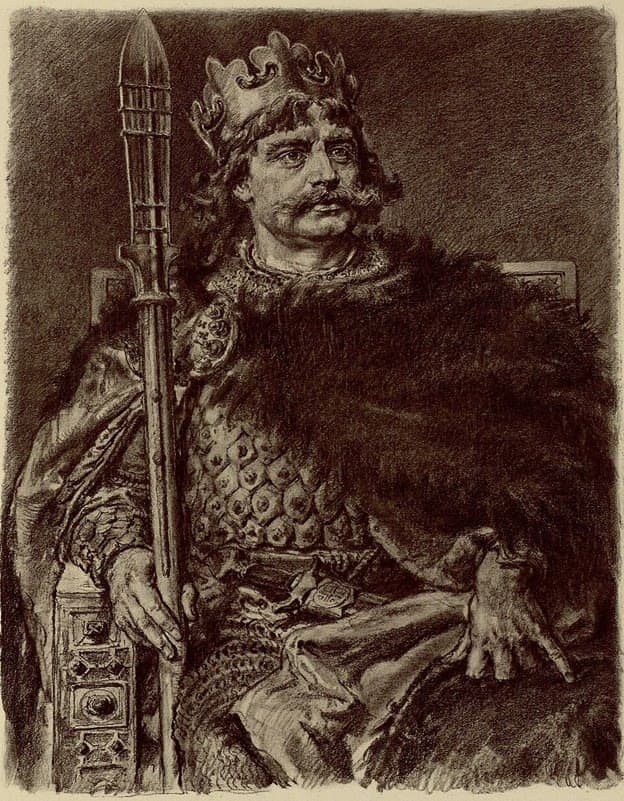

Bolesław was born into the family of Mieszko I and the Bohemian princess Doubravka, although the exact date of his birth remains a matter of historical debate. The Lesser Poland Annals give the year 967, while other sources, drawing on his “Epitaph,” place his birth in 965 or 966. Equally disputed is the question of whether Bolesław was born before or after his father’s official conversion to Christianity. Nevertheless, it is reliably known that he himself was baptized shortly after birth.

In early childhood, Bolesław underwent the sacred ceremony of tonsure, after which a lock of his hair was sent to Rome. This gesture by Mieszko I was intended to place his heir under the protection of the Holy See. The prince’s youth was marked by diplomatic complexities: according to some theories, he spent a significant period at the court of Emperor Otto I, either as an honored guest or as a hostage guaranteeing Poland’s loyalty to the Empire. These years in Germany undoubtedly hardened the character of the future king and gave him a deep understanding of European politics.

After the death of Mieszko I on May 25, 992, the Polish state faced the threat of fragmentation. His father had left the country divided into separate territories, creating fertile ground for internal conflict. Bolesław, however, displaying what the chronicler Thietmar of Merseburg described as “fox-like cunning,” quickly took control of the situation. He expelled his stepmother Oda and his half-brothers from the country, while the aristocrats Odylen and Przybywoj, who supported the opposition, were ordered to be blinded. By the end of 995, Bolesław had become the sole and undisputed ruler of Poland.
Having consolidated his authority at home, he began minting his own coinage, on which he sometimes invoked Saint Wenceslaus, emphasizing his family ties to the Bohemian dynasty. During this period, he actively assisted the Empire in its struggle against the Polabian Slavs, which enabled him to establish a personal relationship with the young and idealistic Emperor Otto III.

A decisive turning point in Poland’s history came through Bolesław’s friendship with Adalbert of Prague, also known as Wojciech, the bishop of Prague. When Adalbert was expelled from Bohemia, Bolesław granted him refuge, and in the spring of 997 he supported his missionary expedition to the pagan Prussians. On April 23, 997, Adalbert was martyred. Bolesław purchased his remains from the Prussians, reportedly paying an amount of gold equal to the weight of the bishop’s body, and solemnly buried him in Gniezno.

Adalbert’s canonization in 999 transformed Gniezno into a major center of pilgrimage for Christians from across Europe. In 1000, Emperor Otto III traveled to Poland to venerate the saint’s relics. This visit, known in history as the Congress of Gniezno, became a major triumph for Bolesław.
The emperor recognized Poland as an equal partner of the Empire, placed his own crown upon Bolesław’s head, and presented him with a replica of the Holy Lance of Saint Maurice. The Archdiocese of Gniezno was also established, granting the Polish Church independence from German ecclesiastical authorities.
The golden age of cooperation with the Empire ended with the death of Otto III in 1002. The new German king, Henry II, did not share his predecessor’s vision of political equality. Taking advantage of the turmoil caused by the succession, Bolesław seized Lusatia, Meissen, and the lands of the Milceni. The conflict intensified after Bolesław briefly seized the Bohemian throne in 1003, proclaimed himself Duke of Bohemia, and blinded his rival Boleslaus III the Red.

A series of prolonged and bloody wars followed in 1004, 1005, 1010, 1015, and 1017. Bolesław proved himself an outstanding strategist, successfully employing tactics designed to exhaust the enemy and relying on the defense of fortified strongholds such as Głogów and Niemcza. Even when German forces advanced as far as the walls of Poznań, Bolesław managed to negotiate favorable truces.
The conflict finally ended with the Peace of Bautzen on January 30, 1018, under which Lusatia and the lands of the Milceni were definitively secured for Poland. To reinforce the peace, Bolesław married Oda, daughter of Margrave Eckard of Meissen.
Having barely concluded the war in the west, Bolesław turned his attention eastward. His goal was to restore his son-in-law, Sviatopolk Vladimirovich, known as Sviatopolk the Accursed, to the throne and to recover the Cherven Cities. In the summer of 1018, a combined army of Poles, Germans, Hungarians, and Pechenegs marched toward Kyiv.

On the Western Bug River, Bolesław decisively defeated the army of Yaroslav the Wise. On August 14, 1018, Polish troops entered Kyiv in triumph. According to legend, Bolesław struck the Golden Gate of Kyiv with his sword, later known as Szczerbiec, as a symbol of victory.
When leaving the city, the prince took with him enormous wealth, numerous captives, and Yaroslav’s sister, Predslava. The most important political outcome of the campaign was the return of the Cherven Cities to Poland.

The final years of Bolesław’s life were overshadowed by internal difficulties, yet they also brought him the highest title of his career. In 1025, shortly before his death, Bolesław I was officially crowned as the first King of Poland. This event confirmed Poland’s status as a fully sovereign kingdom.
Contemporaries described Bolesław as a man of tremendous willpower and physical strength, although he became very corpulent in old age. He was considered intelligent and cunning, possessing an ability to think decades ahead.
Bolesław I the Brave left behind a unified and centralized state with a powerful army and an independent Church. His reign became the foundation upon which the Polish nation was able to endure the many challenges and upheavals of the centuries that followed.


