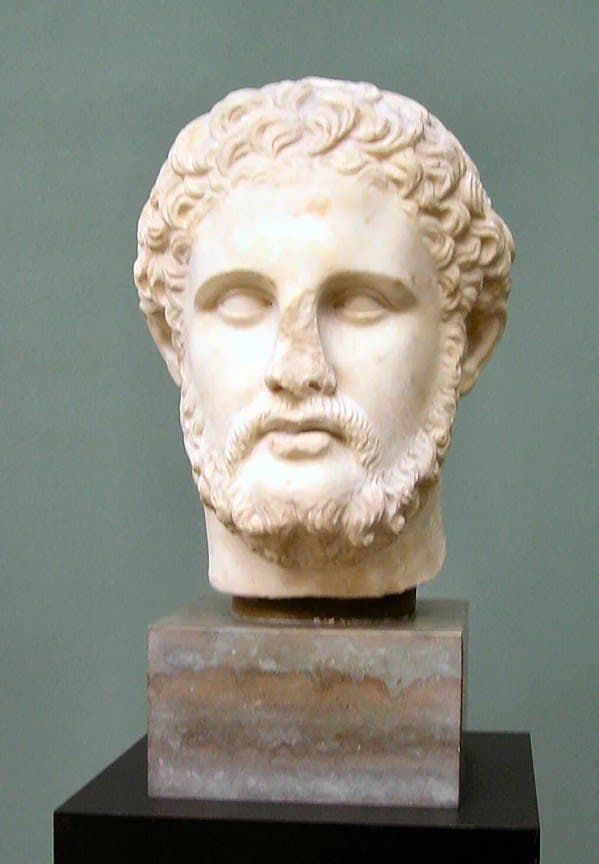
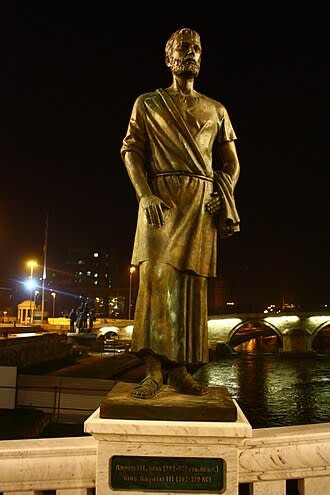
Philip’s story began with the deep roots of the Argead dynasty, which ancient tradition proudly traced back to Hercules himself.
According to legend, Philip’s ancestors — whether Caranus, said to have been a ninth- or eleventh-generation descendant of Hercules, or Perdiccas — migrated from Argos in the Peloponnese to the rugged north, where they laid the foundations of the Macedonian state.
In historiography, this dynasty is also known as the Temenids, emphasizing its connection with Argos.
Philip’s father, Amyntas III, ascended the throne in 394 or 393 BC after emerging victorious from prolonged dynastic struggles.
His marriage to Eurydice I, a woman whose origins have been linked either to the rulers of Lyncestis or even to Illyrian tribes, produced three sons for Macedonia: Alexander, Perdiccas, and Philip himself.
Born in 383 or 382 BC in Pella, which had become the capital shortly before his birth, Philip absorbed the atmosphere of the Macedonian aristocracy from an early age.
His childhood education followed the traditional aristocratic model: horsemanship, weapons training, the study of Homeric epic, athletics, and hunting — all of which helped shape the character of the future king.
Yet the most important part of his education took place far from home.
In 368 BC, when Thebes stood at the height of its power, the young Philip was sent there as a hostage.
The three years he spent in the household of the Theban commander Pammenes — or, according to some accounts, within the circle of Epaminondas himself — became a genuine academy of statecraft for him.
Philip did not merely observe Greek culture. He carefully studied the political structure of the polis and, even more importantly, examined the subtleties of advanced military tactics.
It was there that he came to understand the power of the oblique formation and the importance of close coordination between infantry and cavalry — principles that would later become central to the formidable Macedonian military system.
Plutarch was therefore not entirely without reason in describing him as an “ardent follower of Epaminondas.” The experience Philip gained in Thebes would later become one of the tools with which he reshaped the political map of the Greek world.
After returning home in 365 BC, Philip acted as a loyal supporter of his brother, King Perdiccas III.
He was given control of one of the regions, probably Amphaxitis, where he developed his military skills in practice by defending the frontier against raids by Paeonians and Thracians.
It was here that he began organizing his own military force, which would soon become his principal source of power.
Disaster struck in 360 or 359 BC, when Perdiccas III was killed in a catastrophic battle against the Illyrians, leaving the country in chaos.
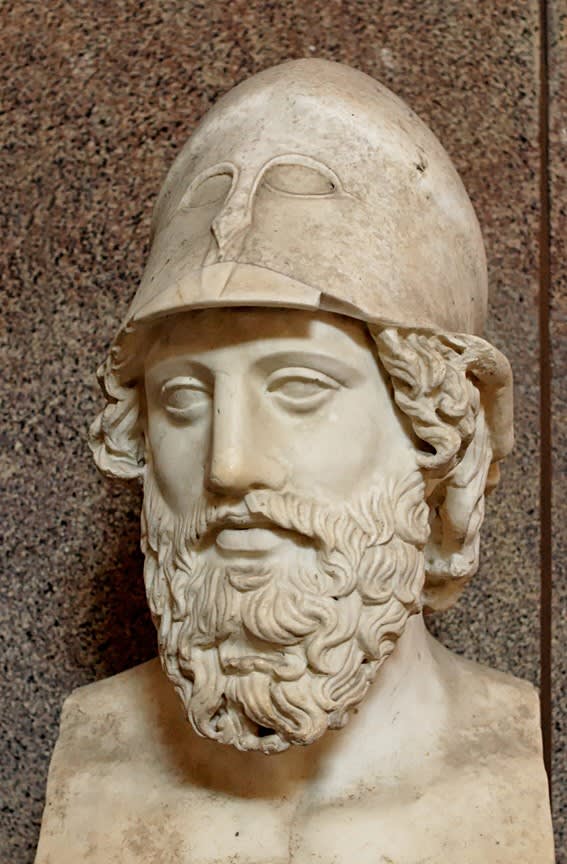
The throne formally belonged to the young Amyntas IV, son of the fallen king, while Macedonia was threatened from every direction by Illyrians, Paeonians, and the rival claimants Argaeus and Pausanias, who were supported by Athens.
At this critical moment, the popular assembly, recognizing the need for a strong leader, entrusted Philip with authority.
Initially he acted as Amyntas’s guardian, but soon, under pressure from circumstances and the population, he was proclaimed king in his own right.
His reign, which lasted approximately twenty-four years, began with a brilliant display of diplomacy.
Philip demonstrated extraordinary flexibility.
He bribed the Paeonians and Thracians, placated Athens with promises to return Amphipolis, and concluded peace with the powerful Illyrian king Bardylis, reinforcing the agreement through marriage to Bardylis’s relative Audata.
After neutralizing internal threats and defeating the mercenaries of the pretender Argaeus, Philip began a complete reform of the Macedonian army.
Already in 358 BC, the reorganized Macedonian force of approximately 10,000 infantrymen and 600 cavalrymen attacked the Illyrians.
In the decisive battle near Lake Lychnitis, Philip’s tactical skill led to the total defeat of Bardylis.
Approximately 7,000 enemy soldiers were killed, and the liberation of Macedonian territory marked the beginning of a new era.
Philip’s next step was expansion toward the east.
In 357 BC, he besieged Amphipolis, a strategically vital city.
Through skillful diplomacy, he persuaded the Athenians not to intervene by promising to hand the city over to them.
However, after capturing Amphipolis and subsequently taking Pydna, Philip simply incorporated both into Macedonia.
The outraged Athenians declared war, but Philip was already one step ahead.
In 356 BC, he captured Crenides and renamed it Philippi.
The gold mines of the region generated an enormous income of around 1,000 talents per year, allowing Philip not only to maintain his army but also to employ bribery extensively as a political instrument.
The first anti-Macedonian coalition formed against him, including Grabus II, Lyppeius, Cetriporis, and Athens.
Philip acted preemptively: while his general Parmenion defeated the Illyrians, the king himself subdued the Thracians and Paeonians.
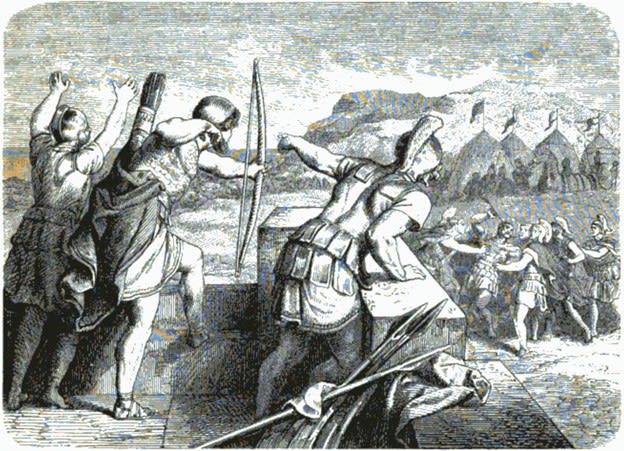
The siege of Methone in 355–354 BC became a personal ordeal for Philip.
It was there that an enemy arrow destroyed his right eye, but the injury only hardened his determination.
The city was razed, and Macedonian control of the coastline of the Thermaic Gulf became complete.
Soon afterward Philip turned his attention to Thessaly, where both a civil war and the Third Sacred War were underway.
His first campaign against the Phocian strategos Onomarchus ended in defeat and retreat. Onomarchus reportedly used stone-throwing artillery with great effectiveness.
Philip, however, returned seeking revenge.
In 353 or 352 BC, one of the greatest battles of the period took place at the Crocus Field.
Thanks to overwhelming superiority in cavalry, Philip decisively defeated the Phocians.
The corpse of Onomarchus was crucified, while Philip was proclaimed archon for life of the Thessalian League, giving him access to some of the finest cavalry in Greece.
The following years were devoted to strengthening Macedonian influence in Thrace and Epirus.
Philip skillfully manipulated the Thracian kings Cersobleptes and Amadocus, weakening some rulers while supporting others.
In Epirus, he established a protectorate, making Arybbas effectively dependent on Macedonia and preparing the way for the accession of Alexander of Epirus.
By 349 BC, Philip decided to destroy Olynthus and the Chalcidian League, which provided refuge to rivals for the Macedonian throne.
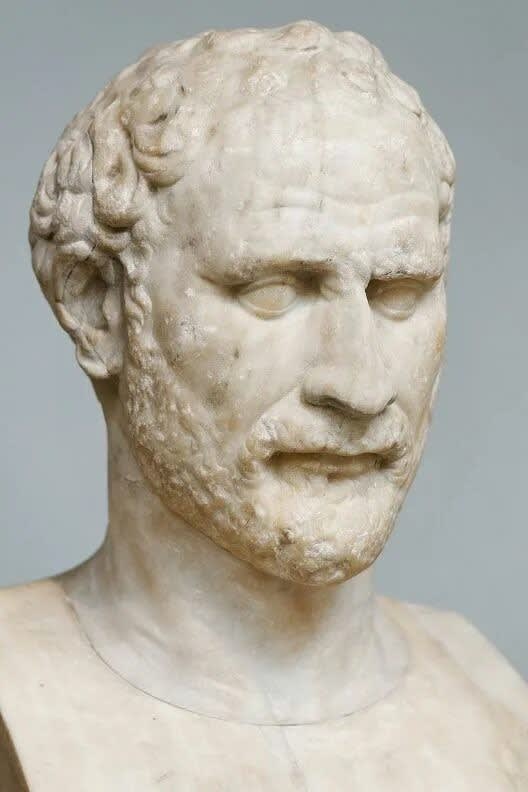
Despite the eloquence of Demosthenes in Athens and Greek attempts to assist Olynthus, Philip systematically captured the cities of Chalcidice.
In 348 BC, after betrayal from within and a prolonged siege, Olynthus fell.
The city was completely destroyed, its inhabitants were sold into slavery, and Philip became the uncontested master of northern Greece.
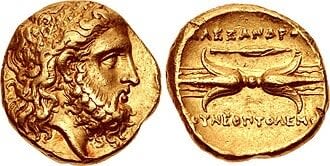
The culmination of this stage was the Peace of Philocrates in 346 BC.
Athens, exhausted by war and deceived by the Macedonian king’s promises, was forced to negotiate.
The embassy included major political figures such as Philocrates, Aeschines, and Demosthenes himself.
Philip received them with deliberate luxury and courtesy while simultaneously continuing to destroy the remaining possessions of Cersobleptes in Thrace.
Ultimately, peace was concluded on Philip’s terms.
He retained all the territories he had conquered, including Amphipolis and the Thracian coastline, effectively forcing Athens to recognize his dominance.
The agreement marked the end of the first act of his great political drama, leaving Macedonia on the verge of complete domination over Greece.
The Peace of Philocrates in 346 BC did not end Philip II’s expansion.
Instead, it prepared the way for his decisive advance into central Greece.
The first victim of the new political reality was Phocis.
Abandoned by Athens, the Phocians were left alone to face Macedonian power.
Their commander Phalaecus, realizing that resistance was hopeless, negotiated safe passage for his 8,000 mercenaries and surrendered Thermopylae without a battle.
This allowed Philip to enter central Greece triumphantly.
There he not only restored order but also achieved an extremely important political victory: he received the two votes formerly held by the Phocians in the Delphic Amphictyonic Council.
From that moment onward, the Macedonian king formally became one of the supreme arbiters of sacred affairs among the Greeks, establishing a legal foundation for his future dominance.
The period between 345 and 343 BC was devoted to consolidating power on Macedonia’s frontiers.
Philip launched a harsh campaign against the Illyrian tribe of the Ardiaei, during which he suffered another serious wound, this time to the lower leg or collarbone.
Despite devastating enemy territory and capturing rich booty, Philip acted prudently and did not attempt to annex the difficult Adriatic coastline.
Instead, he concluded an advantageous peace with King Pleuratus.
At the same time, he completed the political “cleansing” of Thessaly, expelling the last tyrant, Simus, from Larissa and turning the region into a secure Macedonian rear base.
By 342 BC, Philip’s attention shifted to the northwest.
Using dynastic connections, he effectively carried out a coup in Epirus, deposing Arybbas and placing on the throne Alexander of Epirus, brother of Philip’s wife Olympias.
To strengthen his protégé’s position and simultaneously weaken Athenian influence in the region, Philip launched a punitive campaign against the Cassopaeans, destroying three of their cities and transferring their territories to Epirus.
Although the frightened city of Ambracia called upon Athenian and Corinthian forces for assistance, forcing Philip to withdraw temporarily, his objective had been achieved.
Epirus became a loyal Macedonian dependent, while Athenian allies in the region were isolated.
At the same time, in 342–341 BC, Philip delivered the final blow against the Thracian king Cersobleptes, driving him from power and annexing his territories completely.
By 340 BC, Macedonia had reached the strategically vital straits.
Seeking to cut Athens off from its grain supply routes, Philip besieged Perinthus.
The siege became a masterpiece of ancient military engineering.
The Macedonians employed siege towers approximately 37 meters high and subjected the city to continuous bombardment from catapults.
Yet Perinthus, situated on a steep rocky promontory, defended itself with desperate determination.
The situation became more difficult when Persia intervened.
King Artaxerxes III, alarmed by the growth of Macedonian power, ordered his satraps to provide the city with extensive financial support and mercenaries.
Unable to capture Perinthus by assault, Philip divided his forces and besieged Byzantium.
Here too fortune turned against him.
A coalition of Greek cities and the Athenian fleet commanded by Phocion forced the Macedonians to lift the siege.
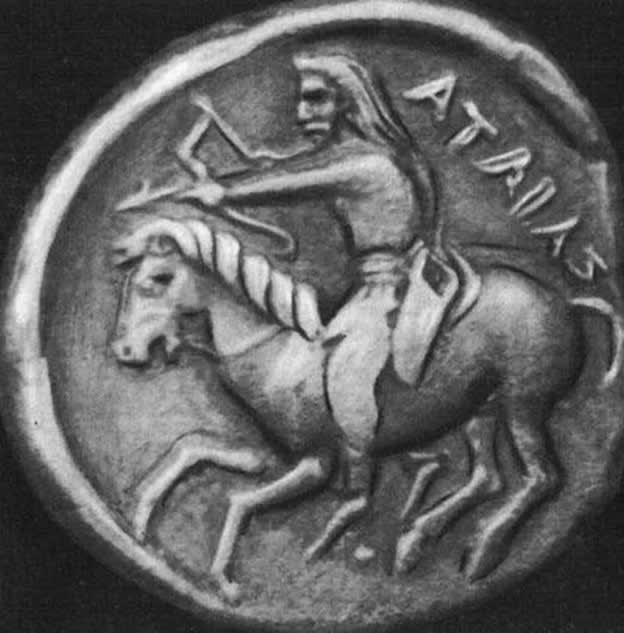
To restore the army’s prestige and replenish the treasury after the failures near the straits, Philip launched a bold campaign against the Scythians in early 339 BC.
Diplomatic maneuvering with the Scythian king Ateas quickly turned into open conflict.
In the decisive battle, probably fought near the city of Tomis, disciplined Macedonian infantry crushed the numerically superior Scythian cavalry.
The ninety-year-old Ateas was killed in battle, and Philip captured enormous booty: 20,000 breeding mares and an equal number of women and children.
However, the triumphant return nearly ended in disaster.
On the journey home, in the valley of the Strymon, the Macedonians were suddenly attacked by the Triballi.
During the bloody fighting, Philip was struck in the thigh by a sarissa.
The blow was so powerful that it pierced his leg and killed his horse.
Believing their king to be dead, the Macedonians retreated, losing much of the Scythian booty, but they succeeded in rescuing the wounded monarch.
Barely recovered from his wounds, Philip once again turned his attention toward Greek affairs at the end of 339 BC.
Appointed strategos of the Delphic Amphictyony, he began a war against Amphissa.
Through a brilliant maneuver, he bypassed the blocked pass at Thermopylae and seized Elatea in Phocis, causing panic in Athens.
Demosthenes accomplished what had seemed nearly impossible: he persuaded Athens’s old rival, Thebes, to form an alliance against Macedonia.
The allies blocked the mountain passes, and for a time Philip was unable to advance into Boeotia.
He then resorted to deception.
Philip staged a retreat supposedly caused by a “rebellion in Thrace” and deliberately allowed the Greeks to intercept a false letter.
When the allies relaxed their vigilance, the Macedonians carried out a night march, captured Amphissa, and opened the road toward Thebes.
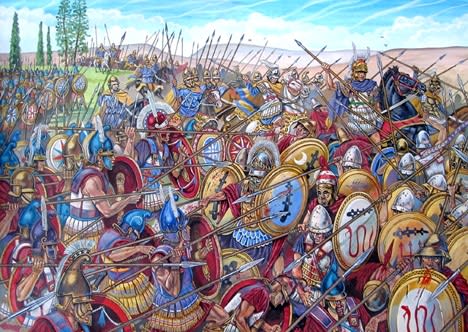
The Battle of Chaeronea, fought in August 338 BC, marked the final act of the independence of classical Greece.
Two armies of roughly 30,000 men each confronted one another on the plain.
Philip, commanding the right wing, employed a tactical withdrawal to lure the Athenians away from their favorable position.
The resulting gap in the Greek line was struck by the heavy cavalry of the left wing under the command of the young Alexander.
The Macedonian cavalry completely destroyed the famous Theban Sacred Band, after which the entire Greek battle line collapsed.
Around 1,000 Athenians were killed and 2,000 captured.
According to legend, after the battle Philip, intoxicated by victory and wine, mocked the prisoners until the Athenian orator Demades shamed him by comparing the king to the Homeric figure Thersites.
Sobered and impressed by the orator’s courage, Philip released the Athenians without ransom.
The war was concluded with the Peace of Demades.
Philip treated Athens with unexpected leniency.
The city retained its autonomy, received the disputed territory of Oropus, and saw its prisoners returned.
In gratitude, the Athenians erected a statue of Philip and granted him citizenship.
Thebes, however, faced the full force of the victor’s anger.
Its dominance over Boeotia was destroyed, and a Macedonian garrison was installed in the Cadmea, the citadel of Thebes.
Philip completed his conquest of Greece with a campaign into the Peloponnese in 338–337 BC.
Cities from Megara to Corinth submitted to him.
The only major power that refused to recognize Macedonian leadership was Sparta.
Philip chose not to waste time on the difficult task of conquering Laconia directly.
Instead, he systematically devastated Spartan territory and transferred border regions to his allies in Argos, Messenia, and Megalopolis.
In this way, Sparta was permanently reduced to the status of a secondary polis, while Philip II became the undisputed arbiter of the Greek world.
The stage was now set for the creation of the League of Corinth and the future invasion of Asia.
To secure the new balance of power, Philip convened a congress of representatives from the Greek city-states at Corinth.
At the end of 338 BC, envoys from almost all of Greece gathered in the ancient city.
Only Sparta, faithful to its austere traditions, ignored the invitation and declared that the proposed peace was nothing more than slavery.
At the congress, the “Common Peace” — Koine Eirene — was proclaimed.
Its purpose was not only to end centuries of warfare between the Greek states but also to freeze the existing social and political order.
Any coups or changes in the constitutional systems of the poleis were declared illegal.
Thus emerged the Hellenic League, better known to us as the League of Corinth, which became an instrument of Macedonian control.
Formally, the highest governing body was the Synedrion, but real authority belonged to Philip as hegemon and strategos autokrator.
In 337 BC, at the first official meeting of the Synedrion, Philip presented an ambitious plan: a pan-Hellenic campaign against Persia.
The official slogans were revenge for the Greek sanctuaries destroyed during Xerxes’s invasion and the liberation of the Greek cities of Asia Minor.
Formally, the alliance consisted of equal states whose members supplied troops according to quotas and paid no tribute.
In practice, however, the Synedrion became little more than an advisory body under the Macedonian king, who personally determined the foreign policy of Greece.
While Philip prepared for the great eastern campaign, a crisis was developing within his own household.
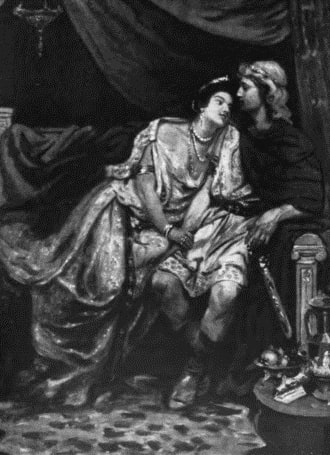
In 337 BC, the king married the young Macedonian aristocrat Cleopatra.
For Philip, the marriage was not merely a matter of personal affection but also a political move designed to strengthen his relationship with the Macedonian nobility.
For his wife Olympias and his son Alexander, however, it represented a direct threat.
Cleopatra was a “full-blooded” Macedonian, and any children born from the marriage might challenge Alexander’s claim to the throne, since his mother was Epirote.
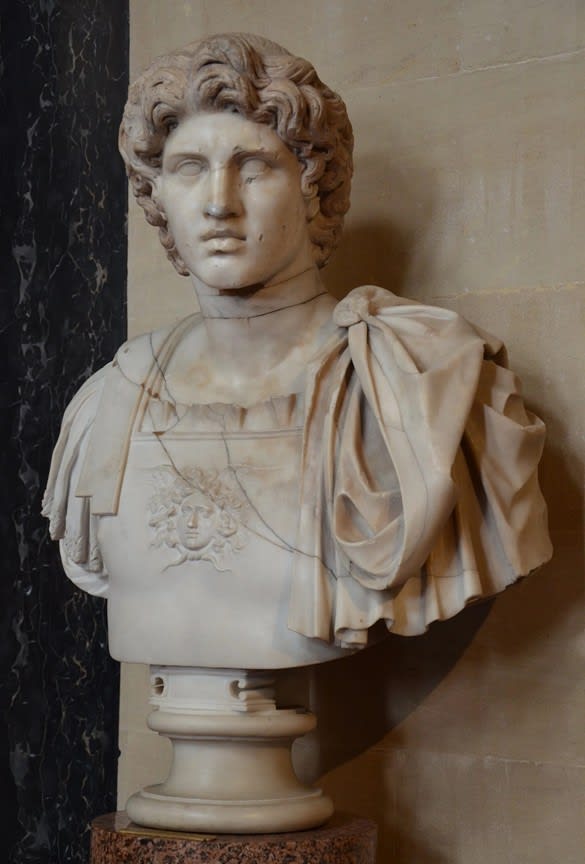
The conflict erupted openly during the wedding banquet.
The bride’s uncle, Attalus, while drunk, called on the Macedonians to pray for the birth of a “legitimate” heir.
The furious Alexander threw a drinking cup at him.
Philip drew his sword and attempted to rush at his son, but, being drunk, slipped and fell.
“Look, men!” Alexander reportedly exclaimed. “This man is preparing to cross from Europe into Asia, yet he cannot even cross from one couch to another!”
After the scandal, Olympias fled to Epirus, while Alexander departed for Illyria.
Later, following Alexander’s unsuccessful attempt to arrange his own marriage to the daughter of the Carian ruler Pixodarus, whom Philip intended to marry to Alexander’s mentally impaired half-brother Arrhidaeus, the king exiled several of Alexander’s closest companions, including Ptolemy and Nearchus, demonstrating his absolute authority.
The final year of Philip’s life was filled with intense activity.
At the beginning of 336 BC, he personally led a campaign against the Illyrians and Triballi, securing Macedonia’s rear before the planned invasion of Asia.
In a battle against Pleurias, king of the Autariatae, Philip narrowly escaped death.
The hypaspist Pausanias reportedly saved him at the cost of his own life.
Meanwhile, the vanguard of the Macedonian army under Parmenion had already crossed the Hellespont.
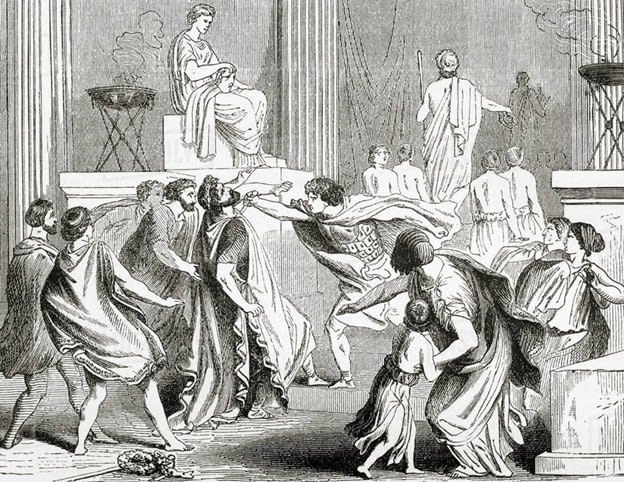
The final tragedy came in July 336 BC at Aegae, during magnificent celebrations marking the wedding of Philip’s daughter to Alexander of Epirus.
Before ambassadors from across Greece, Philip entered the theater dressed in a white cloak and deliberately left his bodyguards behind as a display of confidence and grandeur.
At that moment, one of his attendants, Pausanias, rushed toward the king and plunged a dagger into his chest.
The assassin was immediately pursued and killed by the guards, taking his secrets with him to the grave.
Historians continue to debate the motives behind the murder.
Was it Pausanias’s personal revenge for humiliation at the hands of Attalus?
Were Olympias and Alexander involved?
Or did the conspiracy originate in Persia?
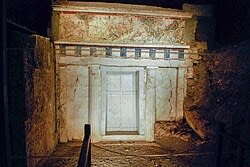
Philip was buried with extraordinary magnificence at Aegae, modern Vergina, where an unplundered royal tomb associated with him was discovered in 1977, revealing magnificent gold objects, armor, and a royal wreath linked with the great architect of Macedonian power.
The Macedonia created by Philip II was a new type of state.
His greatest creation was the army.
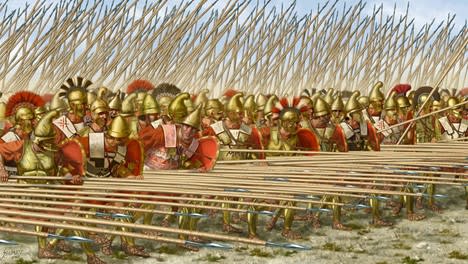
The Macedonian phalanx: Philip armed his infantry with sarissas, enormous pikes up to six meters long. This “forest of spears” made a frontal attack against the Macedonian formation extraordinarily difficult.
The Companion Cavalry: The cavalry became the principal striking force, capable of breaking through gaps in the enemy line while operating in close coordination with the infantry.
Siege warfare: Philip was among the first rulers to employ mechanical catapults and enormous siege towers on a large scale, transforming the capture of fortified cities from a prolonged blockade into a sophisticated engineering operation.
Philip’s domestic policy was aimed at strict centralization.
He brought the hereditary nobility under royal control, transforming it into a service aristocracy represented by the Companions, and created a powerful economic foundation through the exploitation of the gold mines of Mount Pangaeum.
He served simultaneously as supreme judge, religious authority, and builder of cities, transforming Macedonia from a peripheral kingdom into the political center of the Greek world.


