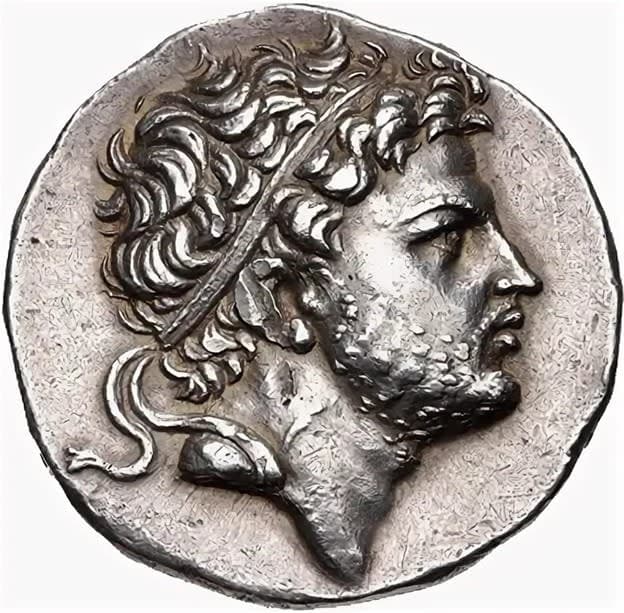
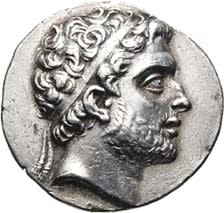
As a fifth-generation descendant of the great Antigonus I Monophthalmus, Perseus found himself from birth at the center of palace intrigues and geopolitical storms. Even his origins were surrounded by dark rumors, eagerly spread by his enemies. At court, it was whispered that he was not in fact the biological son of the formidable King Philip V, but had supposedly been taken as an infant from a woman named Gnathaenia by the king’s wife, who wished to conceal her infertility.
The ancient historiographical tradition, especially the works of Greek authors and Roman chroniclers, treated Perseus with undisguised hostility. Plutarch, in particular, portrayed the monarch as a petty and contemptible man consumed by greed and an unhealthy lust for power. Modern scholars, however, should approach this harsh judgment with considerable skepticism, since it was shaped by the victors — writers who were fundamentally hostile toward an independent Macedonia and who sought to justify Roman expansion.
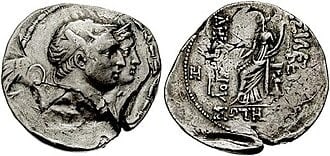
Perseus’s path to sole power was darkened by fratricide. His principal rival was his own brother Demetrius, who for a long time had served as a Macedonian envoy in Rome.
Demetrius enjoyed enormous popularity among Roman senators, which aroused intense jealousy in Perseus and fueled his fear of losing the throne.
Exploiting his father’s political anxieties, Perseus managed to convince Philip V that Demetrius was a Roman puppet and a potential usurper preparing a coup.
Believing these accusations, Philip ordered Demetrius to be poisoned.
Only later did the aging king supposedly realize the horror of what he had done and discover the deception of his elder son. Overwhelmed by grief and remorse, Philip V died soon afterward.
This crime had catastrophic consequences in international politics. Perseus’s involvement in the murder of a prince viewed favorably by Rome permanently deprived him of the Republic’s trust.
No sooner had Perseus ascended the throne after his father’s death in 179 BC than he attempted to smooth relations by reopening diplomatic negotiations with the Roman Senate.
At the same time, however, he energetically completed the extensive military preparations begun under Philip.
The young monarch’s actions were openly provocative and directly challenged Roman interests in the Balkans.
Perseus began actively interfering in the internal affairs of neighboring Greek poleis, sent troops to occupy sacred Delphi, demonstratively expelled Roman envoys from Macedonian territory, and strengthened his position through a politically advantageous dynastic marriage to Laodice V, daughter of a Seleucid ruler.
For Rome, this combination of measures provided the ideal pretext for the final settlement of the “Macedonian question.”
Diplomatic tension eventually erupted into open conflict, entering history as the Third Macedonian War.
The opening stages of the war gave the Macedonians reason for hope.
The young and energetic king successfully repelled the first attacks of the Roman legions, demonstrating considerable tactical skill and winning a series of smaller engagements on both land and sea.
These localized successes, however, could not reverse the relentless power of the Roman military machine.
The decisive moment came in 168 BC on the rocky plains near Pydna, where the Macedonian phalanx met the army of the distinguished Roman commander Lucius Aemilius Paullus in a final great battle.
The engagement ended in a crushing and annihilating defeat for Macedonia.
Realizing the scale of the disaster, the broken Perseus fled in panic first to his capital, Pella, where he hastily gathered his family and what remained of the royal treasury.
From there, he sailed to the sacred island of Samothrace, hoping to find immunity within the ancient sanctuary of the Cabeiri.
Rome, however, had no intention of allowing Perseus to escape.
A Roman fleet under the command of the praetor Gaius Octavius was concentrated off the coast of Samothrace and placed the island under a complete blockade.
With every avenue of escape exhausted, the last Macedonian king was forced to surrender.
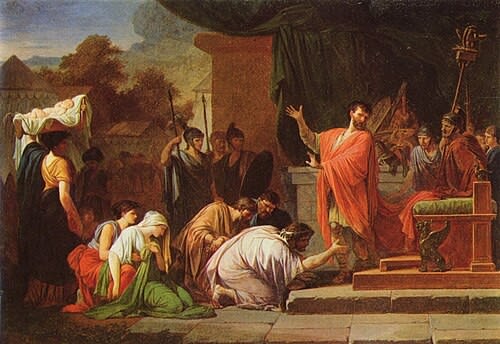
The scene of his capitulation before Lucius Aemilius Paullus became one of the most dramatic episodes of ancient history.
According to Plutarch, when Perseus was brought into the Roman camp, he abandoned all royal dignity, fell at the feet of the victor, and begged for mercy through humiliating tears.
His behavior provoked only contempt and a severe rebuke from the stern Roman commander:
“Why do you act so, wretched man? Why do you free Fortune from the greatest charge against her by proving that your suffering is deserved, and that it was not your present condition but your former prosperity that you did not deserve? Why do you diminish my victory and disgrace my success by revealing a base spirit unworthy of a Roman adversary?”
The weeping Perseus begged for only one thing — that he might be spared the ultimate humiliation of appearing in the Roman triumph.
Aemilius Paullus coldly replied that avoiding this disgrace “depended entirely upon himself,” transparently implying that a true ruler ought to prefer suicide to captivity.
Perseus, however, could not bring himself to take his own life.
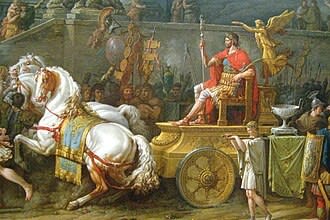
In 167 BC, during the magnificent triumph of Aemilius Paullus, the deposed monarch was led in chains through the streets of Rome alongside his young children, walking before the triumphator’s chariot amid the jeers of the crowd.
Despite his contempt for the prisoner’s cowardice, Aemilius Paullus nevertheless showed a measure of generosity and strongly petitioned the Senate to ease the conditions of the defeated king’s captivity.
According to the historian Livy, the Senate decided to place Perseus and his son Alexander under the supervision of Quintus Cassius in the town of Alba Fucens, approximately one hundred kilometers east of Rome.
The conditions of his imprisonment were initially relatively mild.
The king was deprived neither of his companions nor of his personal savings, silver possessions, or familiar household belongings.
His life in captivity, however, did not last long.
After roughly two years under guard, Perseus died in 166 BC.
Plutarch preserves a chilling anecdote about his death. According to the story, the guards came to hate the captive king because of his difficult and quarrelsome character and conspired to torture him through sleep deprivation.
Whenever the exhausted Perseus closed his eyes, they woke him, continuing until his body finally gave out and he died from extreme physical exhaustion.
He was buried with appropriate honors near the place of his captivity, along the Via Valeria.
Thousands of years later, in June 2005, the Italian Ministry of Culture together with a Macedonian archaeological delegation made a sensational announcement regarding the discovery of a tomb believed to belong to Perseus near the city of L’Aquila — a final material echo of the life of the last Antigonid monarch.
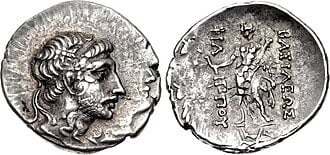
With the defeat of Perseus, the Antigonid state ceased to exist.
The Romans coldly divided the once-great kingdom into four separate republics, isolated from one another and deprived of the right to maintain independent armies or conduct their own foreign policy.
Later, an adventurer named Andriscus, claiming to be Philip, the deceased son of Perseus, managed to raise a major rebellion and throw off Roman domination for roughly a year and a half.
After another inevitable defeat, however, Macedonia permanently lost even the illusion of independence and became an ordinary province of the Roman state.
The fate of the descendants of the last king was equally tragic.
By his marriage to Laodice V, Perseus had a son, Alexander, and a daughter. He also adopted his youngest brother Philip, who died soon after their captivity.
Alexander, the heir to the throne, was still only a child when his father’s grand political project collapsed beneath the blows of the Roman legions.
He endured the humiliation of the Roman triumph, where as a small boy he was forced to walk behind the chariot of Aemilius Paullus, and then shared his father’s years of captivity at Alba Fucens.
Time gradually erased all traces of royal ambition from his life.
After his release, the descendant of the great Antigonus the One-Eyed and of the dynasty that had inherited the world of Alexander the Great found his calling in ordinary work.
He mastered the delicate craft of woodcarving, learned Latin to a high level, and ended his life employed as an ordinary Roman scribe.


