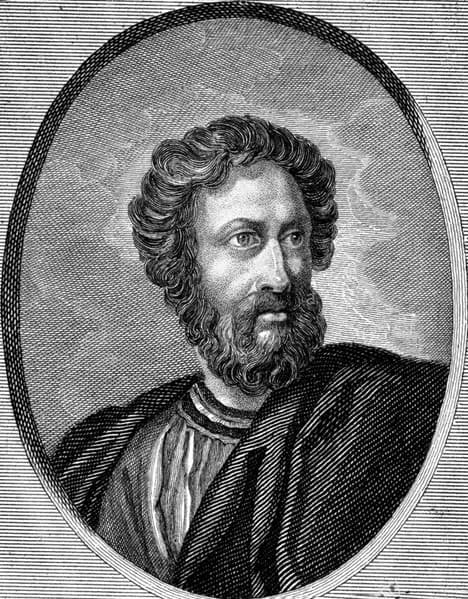

The story of Perdiccas begins in the harsh highlands of Orestis — a mountainous region on the border between Macedonia and Epirus. He was born around 360 BC into the family of a noble aristocrat named Orontes. According to contemporary testimony, the blood of the royal Argead dynasty itself may have flowed in his veins, which largely predetermined his immense ambitions. Alongside him grew his brother Alcetas and his sister Atalante, who would later become loyal — and not always loyal — companions in his political games.
Perdiccas’s first appearance on the great historical stage is shrouded in darkness and blood. In 336 BC, he was already serving in the corps of the king’s bodyguards, the somatophylakes, under Philip II. It was Perdiccas who witnessed the young Pausanias drive a dagger into the king’s heart during a wedding celebration. What followed resembled a scene from a thriller: Pausanias rushed toward the horses, but Perdiccas, together with Leonnatus and Attalus, caught up with him and pierced him with their spears. The killer’s death on the spot gave rise to many rumors. Historians, including L. R. Vershinin, reasonably ask: was this hasty execution not an attempt to “cover the tracks”? Perhaps Perdiccas knew about the organizers of the conspiracy — or even helped them — and Pausanias’s death was necessary so that the true masterminds would remain in the shadows. In any case, under Alexander, who ascended the throne, Perdiccas’s career rose rapidly.


The young king Alexander quickly recognized Perdiccas’s talents. In 335 BC, Perdiccas was already commanding the taxeis of the Orestians and Lyncestians in the difficult campaign against the Illyrian chieftains Cleitus and Glaucias. But the real test came during the siege of Thebes. Here Perdiccas’s image splits in the mirrors of ancient chronicles. Ptolemy, through Arrian, portrays him as an impatient warrior who rushed into the attack without orders as soon as he saw a breach in the defenses, thereby forcing Alexander to commit the main forces. Ptolemy, who later became Perdiccas’s enemy, clearly wanted to present him as the culprit behind the massacre and destruction of the great city.

However, Diodorus and modern historians such as N. Hammond see a different picture. Perdiccas was not reckless — he was decisive. His taxis was the first to break into the city; the commander himself was seriously wounded, but it was precisely this breakthrough that secured victory. An irrational desire for glory or the cold calculation of a commander — the result was the same: Thebes fell, and Perdiccas secured his status as one of the king’s most trusted men.
Just before the departure for Asia, the famous dialogue took place. Alexander was distributing property to his friends, and when Perdiccas asked what the king was leaving for himself, Alexander answered: “Hopes.” Perdiccas’s reply — “Then I too wish to have a share in them” — became the motto of his entire later life. He rejected gold for the right to build a new empire.

In the great campaign to the East, Perdiccas became the “steel fist” of the Macedonian phalanx. At the Battle of the Granicus in 334 BC, his taxis stood in the very center, holding back the assault of the Persian cavalry. Later came the failure at Myndus, when the assault collapsed because of betrayal inside the city, but this only spurred the commander on. At the Battle of Issus in 333 BC, he was again at the spearhead of the attack, coordinating the actions of the heavy infantry.
During the exhausting siege of Tyre in 332 BC, Alexander temporarily left Perdiccas and Craterus in command of the army. It was a rare moment of weakness: the Tyrians managed to burn the Macedonians’ siege mole, taking advantage of the king’s absence. But this failure did not shake Alexander’s trust. Already at the Battle of Gaugamela in 331 BC, Perdiccas fought on the right flank and again shed blood — he was wounded in the thick of battle. In the same year, he officially replaced Menes as a somatophylax, becoming one of the king’s seven personal guards and advisers.

Perdiccas was beside Alexander in the darkest moments. He accompanied him during the capture of the Persian Gates; he sat on the council that condemned Philotas to death at Phrada. In 328, at Maracanda, it was Perdiccas who tried to tear the weapon from the hands of a drunken Alexander when the king swung at Cleitus the Black. Unfortunately, even Perdiccas’s strength was not enough to prevent the tragedy. His influence grew: while Alexander conquered the Sogdian rocks and distant India, Perdiccas received command of separate corps, carried out punitive expeditions, and took part in the most difficult sieges, such as the assault on the Rock of Chorienes.
On June 10, 323 BC, the world trembled: Alexander the Great died in Babylon. On his deathbed, the king, having already lost his voice, removed his signet ring from his finger and handed it to Perdiccas. This gesture made him not merely a successor, but the guardian of the empire.


However, Babylon instantly turned into a nest of snakes. The infantry, led by Meleager, demanded that the king’s mentally impaired brother, Arrhidaeus, be crowned. The nobility and cavalry, led by Perdiccas, proposed waiting until the pregnant Roxana gave birth to an heir. A struggle for power began, nearly ending in civil war within the palace walls. Perdiccas showed himself to be a brilliant manipulator: he accepted a compromise, agreeing to the joint rule of Arrhidaeus, Philip III, and Roxana’s future son, while he himself took the position of regent.

Soon, using his influence over Arrhidaeus, Perdiccas coldly eliminated his rival — Meleager was killed. Having become the sole regent, he carried out the famous division of the satrapies at Babylon. His strategy was simple: send the most ambitious Diadochi — Ptolemy, Antigonus, Lysimachus — as far as possible from one another and from the central authority, so that they would become bogged down in governing their provinces while he controlled the treasury and the army.
Despite Perdiccas’s energy, the centrifugal forces proved stronger. His attempts to strengthen power by force only united his enemies. When he ordered Leonnatus and Antigonus to help Eumenes, the only commander loyal to him, seize Cappadocia, they simply ignored the command. Perdiccas had to personally lead the army to conquer those lands in 322 BC.

The situation was complicated by marriage intrigues. Perdiccas was married to Nicaea, daughter of Antipater, the powerful governor of Macedonia. But when Olympias, Alexander’s mother, offered him the hand of the king’s sister Cleopatra, Perdiccas could not resist the temptation to become a legitimate member of the royal family. His divorce from Nicaea was a declaration of war on Antipater. A coalition formed against the regent: Antipater, Craterus, Antigonus, and Ptolemy.
Understanding that Egypt was the key to control over the Mediterranean, and that Ptolemy was the most dangerous strategist, Perdiccas in 321 BC — according to other sources, in 320 — led the main army toward the Nile.
The Egyptian campaign proved fatal for Perdiccas. His despotic character, cruelty in punishments, and disregard for the needs of ordinary soldiers began to bear bitter fruit. The soldiers did not want to fight against the popular Ptolemy, who, moreover, had cunningly stolen Alexander’s body and transported it to Alexandria.
The climax came during the crossing of the Nile near Memphis. Perdiccas chose the wrong place and the wrong time. The powerful current and deep channel turned the operation into a slaughter. Before the eyes of the entire army, more than two thousand soldiers drowned or were torn apart by crocodiles. This was the final straw. The army, exhausted by its commander’s ambitions, mutinied.
In July 321 BC, a group of conspirators from among the senior officers — including Peithon, Seleucus, and Antigenes — burst into the regent’s tent. The man who had passed through thousands of battles and held in his hands the seal of the greatest empire in the world was killed by his own comrades. With his death, the unity of Alexander’s realm finally collapsed, giving way to the age of bloody wars of the Diadochi, in which every one of the “participants in the hopes” tried to tear off his own piece of the inheritance.



