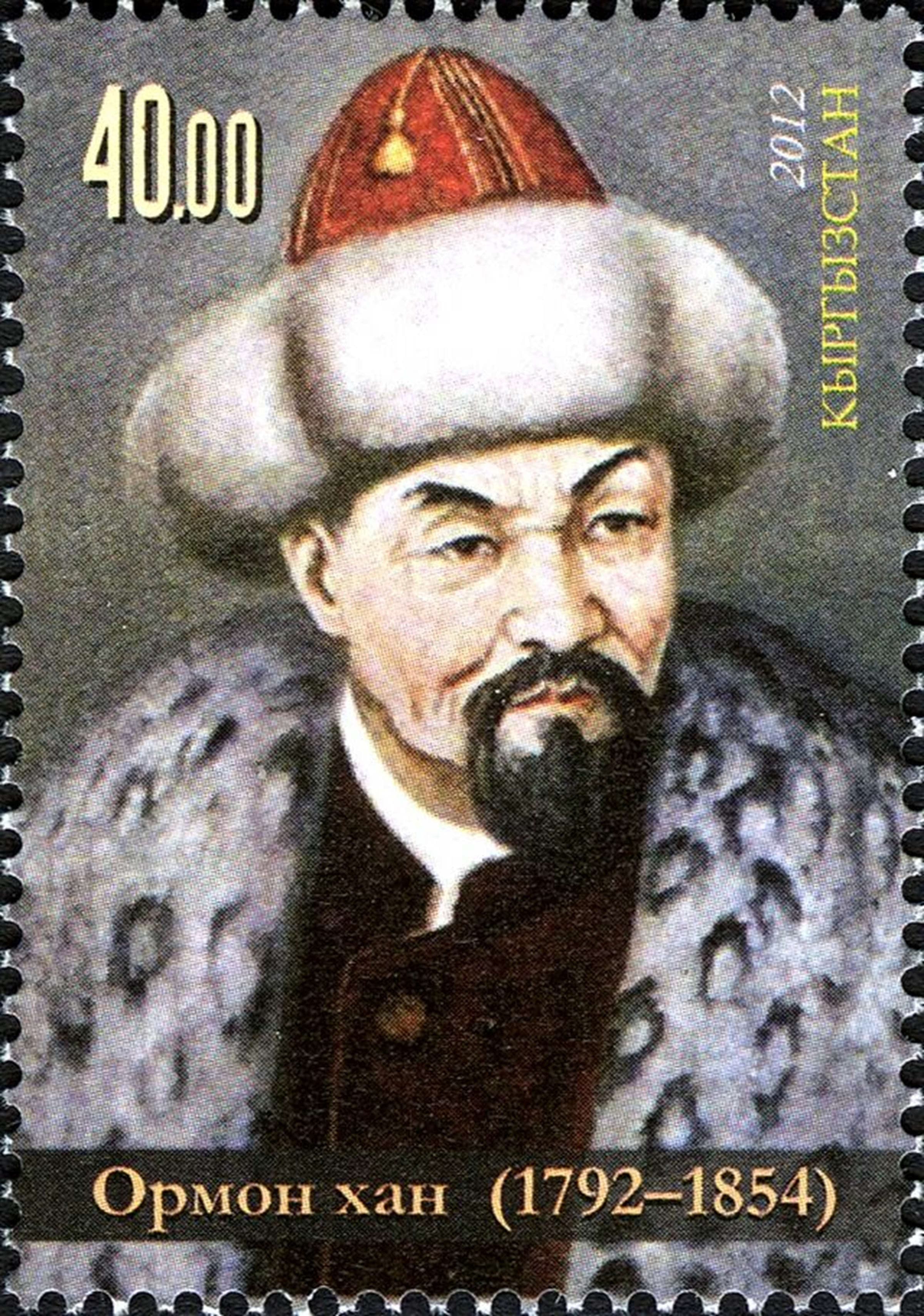

Ormon was born in 1792 into the Sarybagysh tribe. In his youth he was captured by the Sayak manap Medet, but after six months he managed to escape. In the early 19th century, as a young and ambitious manap (clan leader) of the Sarybagysh, he took an active part in internecine struggles. Ormon succeeded in forging an alliance with the Sayak lineages Kurmankozho and Kulzhygach, who were seeking protection from raids by the Bugu tribe. He migrated with part of his people from the Chu Valley to the Kochkor Valley, where his influence spread to Naryn, Jumgal, Kochkor, and At-Bashi. Ormon not only halted the Bugu raids, but also brought them under his authority, capturing their famed commander Balbay batyr.
By the early 1840s, Ormon-manap then about thirty ruled the Sarybagysh and Sayak tribes and sought to unite other northern Kyrgyz tribes such as the Solto, Cherik, Chonbagysh, and Kushchu. His authority rose sharply after a string of crushing defeats he inflicted on Kokand and Qing forces, which had previously pressured Kyrgyz lands.
By this time the Kokand Khanate, though it had recognized Ormon as ruler, was weakened by internal palace coups and external conflicts with the Bukhara Khanate and the Qing Empire. This created favorable conditions for realizing the idea of an independent Kyrgyz state.
In the summer of 1842, at Kutmaldy on the western shore of Issyk-Kul, Ormon convened a great kurultai (assembly of notables), which brought together the Kyrgyz elite as well as envoys of the Kokand Khanate. There Ormon-manap raised the need to unite the Kyrgyz in the face of external threats and Kokand oppression. The participants unanimously supported unity and, at the proposal of the influential manaps Jantai and Kachyke, elected Ormon as khan of all the Kyrgyz.
In the enthronement ceremony, following ancient rite, Ormon was seated on a white felt rug; a white mare was sacrificed; and a skullcap (tebetey) with a red crown was placed upon his head as a sign of khanly authority. The kurultai ratified the symbols and laws of the new khanate, including a banner (tuu), a seal (meer), a governmental structure, and a legal code prescribing strict penalties. A special “Decree” proclaimed that only one person—Ormon Khan—had the right to wear a cap with a red crown.


After the proclamation of the khanate, Ormon Khan launched an active campaign against Kokand. Between 1842 and 1844 his forces captured or destroyed all Kokand fortresses in the Chu, Talas, Naryn, and Issyk-Kul regions, including Pishpek and Tokmak. These actions made it clear that Ormon Khan no longer regarded himself as a vassal of Kokand.

The next serious challenge was war with the Kazakh khan Kenesary Kasymov, who also sought to unite the Kazakhs against the Russian Empire. Defeated by Russian troops, Kenesary invaded Kyrgyz lands in Semirechye in 1845–1846. After Kyrgyz manaps refused to recognize his authority, he began raiding, burning auls, and killing civilians. Faced with a common threat, the Kyrgyz tribes rallied around Ormon Khan. In April 1847, at the decisive Battle of Maitobe, Ormon Khan’s troops utterly routed Kenesary’s army. Kenesary and 32 of his sultans were captured and, after several months of confinement, executed.

This victory brought Ormon tremendous prestige and recognition. The Russian government for which Kenesary had been an implacable foe approved of his defeat and rewarded Ormon Khan and other Kyrgyz leaders with gold medals and robes of honor.
In foreign policy, Ormon Khan pursued an independent course. In 1847 his 10,000-strong force crushed a 4,000-strong Qing detachment, strengthening his position on the eastern frontier. However, his attempts to extend influence over the lands of the Senior Zhuz brought him into conflict with the Russian Empire. In 1852, Russian authorities deemed his actions a threat to their interests and, under pressure from their troops, forced Ormon Khan to withdraw to his own domains.
In 1854 Ormon Khan was captured amid internal strife. He was kept for a time as an honored prisoner by Borombai biy, who even intended to release him, but his long-standing foe, Balbay batyr, killed him. With Ormon Khan’s death in 1854, the Kyrgyz Khanate never fully consolidated ceased to exist. A few years later, in 1860, Russian troops seized the fortresses of Pishpek and Tokmak, extending their power over the lands of the northern Kyrgyz tribes.


