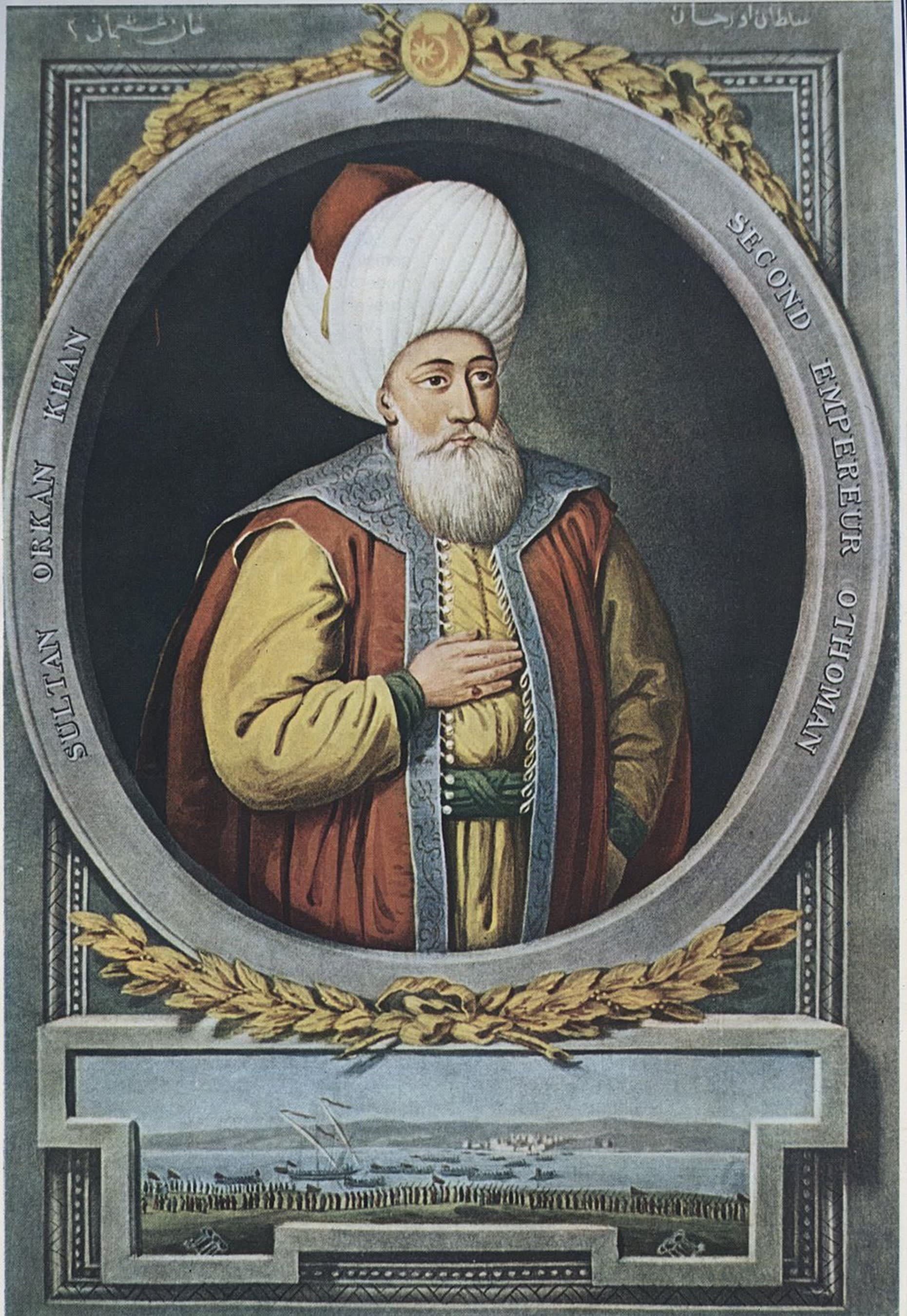
The exact year of Orhan’s birth is unknown, but he appears to have been the younger and most martial son of Osman. Contrary to Turkic custom—where the youngest son stayed with his parents—Orhan from an early age took part in his father’s campaigns, while his brother Alaeddin remained in the rear and, after their father’s death, renounced the throne in Orhan’s favor and became the first grand vizier in Ottoman history.
While his father was still alive, Orhan directed the years-long siege of the key Byzantine stronghold of Bursa, which fell in 1326. Under the terms of capitulation, the Ottoman troops did not sack the city, and instead received a ransom of 30,000 gold coins. After taking Bursa, Orhan immediately made it his capital, turning it into a major cultural center with splendid mosques and an Islamic academy.


Orhan understood that further conquests required army reform. He created an infantry corps and began the practice of employing youthful captives converted to Islam— a forerunner of the famous Janissary corps, fully developed under his son Murad. By the time of his rule, Orhan’s army numbered some 25,000 trained soldiers.
The culmination of his military successes was the Battle of Pelekanon in 1329. Orhan defeated the army of the Byzantine emperor Andronikos III, skillfully using ambush tactics. This victory proved a turning point in Ottoman–Byzantine relations and opened the way to further expansion. In 1331 Nicaea (İznik) surrendered to him, and in 1337 Nicomedia (İzmit), which became the first shipyard and harbor of the nascent Turkish fleet.

By the mid-fourteenth century the Ottoman beylik had grown so strong that its ruler could intervene in Byzantine affairs. In the civil war of 1341–1347, Orhan backed the future emperor John VI Kantakouzenos, supplying him with troops. As a token of alliance, Orhan married John VI’s daughter, Theodora.
In 1353 Orhan’s son Süleyman Pasha obtained the fortress of Çimpe on the Gallipoli Peninsula, and after a severe earthquake seized the neighboring fortress of Gallipoli as well. This territory became the first Ottoman land in Europe and a bridgehead for further conquests in the Balkans. Orhan also pursued active diplomacy, concluding an alliance with Genoa in 1352 against Byzantium.


In his later years Orhan faced personal tragedies: his son Halil was abducted by pirates and had to be ransomed for a vast sum, and his eldest son and heir, Süleyman Pasha, died in 1357.
Orhan Gazi died on March 1, 1362. By his death the Ottoman state had become a formidable power, holding significant territories in both Anatolia and Europe. His reign was marked not only by brilliant military victories but also by administrative and military reforms that laid the groundwork for the future Ottoman Empire. His successor was his son Murad I, who carried forward his father’s work, expanding Ottoman rule on the European continent.


