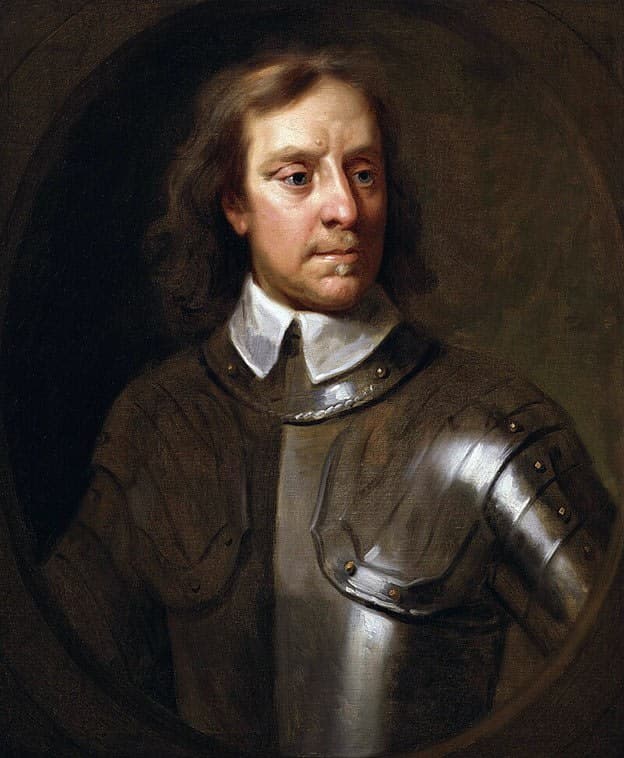

Oliver Cromwell was born on 25 April 1599 in Huntingdon into the family of a modest Puritan landowner. His family had Welsh roots and had grown wealthy in Henry VIII’s time through the confiscation of monastic lands. Oliver’s great-great-grandmother was the elder sister of Thomas Cromwell, Henry VIII’s chief adviser.

Cromwell was educated at the University of Cambridge, known for its Puritan outlook. Under the influence of his schoolmaster, the strict Puritan Thomas Beard, Oliver embraced religious ideas that shaped his character. In 1620 he married Elizabeth Bourchier and lived the life of a typical country squire. In these years he managed his estates, earning from royalists the scornful nickname “the Brewer.”
In 1628 Cromwell was elected to parliament for the first time, but King Charles I soon dissolved it. Cromwell then ran into financial difficulties and even considered emigrating to America. In 1636 he received an inheritance that allowed his return to politics. In 1640 he was again elected to the Long Parliament and spoke out vigorously against the king’s abuses.
At the outbreak of the English Civil War in 1642, Cromwell who had no prior military experience took command of a small troop of cavalry. His talent as a commander quickly became evident: he reorganized his men into the famous “Ironsides” cavalry, which became the core of the New Model Army. Cromwell valued discipline and godliness over noble birth.


His military successes were impressive. In 1643 he won several victories over the royalists. His generalship came fully into view in 1644 at the Battle of Marston Moor, where he routed the king’s cavalry, bringing the north of England under parliamentary control. In 1645, at the Battle of Naseby, Cromwell’s army dealt the royalists a decisive defeat, effectively ending the First Civil War.

After victory, Cromwell faced internal divisions. He skillfully maneuvered between the Presbyterian majority in parliament and the radical Levellers, who demanded democratic reforms. But when King Charles I escaped captivity in 1647 and sparked the Second Civil War, Cromwell seeing this as betrayal took resolute action.
In 1648 Cromwell’s army crushed the rising in Scotland and defeated the Scottish royalists at the Battle of Preston. This convinced him that Charles I must be punished. After Pride’s Purge, which expelled moderate members from parliament, a court was created that found the king guilty. On 30 January 1649 Charles I was executed an unprecedented event in English history. Cromwell called the execution a “cruel necessity.”
In the years that followed, Cromwell brutally suppressed uprisings in Ireland and Scotland, bringing all three kingdoms under the republic’s control. His conquest of Ireland was marked by particular severity, leading to the confiscation of local lands and their redistribution to English officers and soldiers.
In 1653, frustrated by parliament’s delays, Cromwell dissolved it with the words, “I will put an end to your prating.” He established a personal dictatorship known as the Protectorate and took the title Lord Protector. Though offered the crown, he refused it, yet made his power hereditary. As Lord Protector he pursued a hard domestic policy, dividing the country into military districts and streamlining tax collection.


In foreign policy Cromwell achieved significant successes. In 1654 he defeated the Dutch England’s chief maritime rival strengthening English sea power. He made peace with Denmark, Sweden, and France, and his fleet fought pirates effectively.
Cromwell was respected for his incorruptibility and resolve. He died on 3 September 1658 of malaria and typhoid fever. His son Richard became Lord Protector but could not hold power. After his resignation, the Stuart monarchy was restored in 1660 with Charles II’s accession. Cromwell’s body was exhumed and subjected to a posthumous execution, and his head was displayed publicly.


