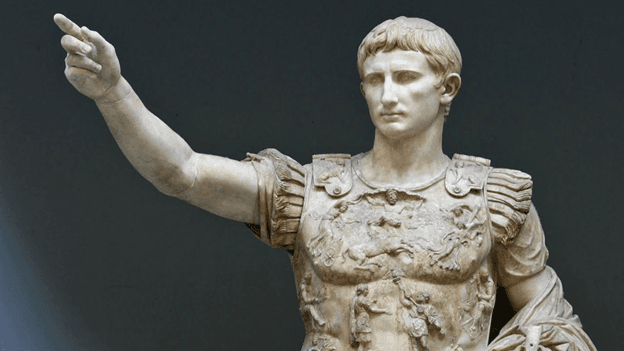

Octavian Augustus, one of the most influential figures in the history of the Roman Empire, was born on 23 September 63 BCE. The exact place of his birth is still debated. Most sources indicate Rome, on the Palatine Hill, in a quarter known as “At the Ox Heads,” while the historians Suetonius and Cassius Dio claim he was born in the town of Velitrae.
His birth name was Gaius Octavius. Unlike many noble Romans, his family had no cognomen, the third part of a Roman name. Around 60 BCE he received the cognomen “Furinus” in honor of his father’s victory over Spartacus’s slaves near the town of Furiæ.
Octavius’s father, governor of the province of Macedonia, died in 59 or 58 BCE without reaching the consulship. His mother Atia kin to Gaius Julius Caesar made an advantageous marriage to the consul Lucius Marcius Philippus, who became the young Octavius’s stepfather.

Octavius received a fine education. His teachers included philosophers and rhetoricians, reflecting his privileged standing. In childhood he met Marcus Vipsanius Agrippa, his future closest associate.

Octavius was still a boy when civil war broke out in the Roman Republic in 49 BCE. In 47 BCE, through Caesar’s patronage, he received his first posts a seat in the college of pontiffs and the office of urban prefect. In 46 BCE he took part in Caesar’s triumphal celebrations for the African victories. He rode in a place of honor just behind the dictator’s chariot and was rewarded on a par with actual campaign participants. From then on Octavius was a constant companion of Caesar, and many Romans began to seek his patronage.
In 45 BCE Caesar drew up a will adopting Octavius and naming him principal heir. Its contents, however, remained unknown until Caesar’s assassination on 15 March 44 BCE. Whether Octavius knew of the will is debated, but it is clear that after Caesar’s death vast opportunities opened before the youth. Although power in the Republic was not hereditary, Octavian obtained control of Caesar’s immense fortune and, more importantly, the loyalty of his legions and veterans.
When news of Caesar’s murder reached Octavian in Apollonia, the soldiers urged him to lead the legions and march on Rome to avenge the dictator. Octavian chose a more cautious course and went to Italy without an army. After learning the will’s contents, he formally accepted the inheritance and took the name Gaius Julius Caesar Octavianus.


To fulfill the dictator’s wishes and win the people’s favor, he sold his family property to distribute 300 sesterces to every Roman citizen, as promised in the will. In July he staged lavish games in Caesar’s honor, during which a bright comet appeared. He declared it the soul of the deified Caesar and used the event to bolster his popularity.
Meanwhile his chief rival, Mark Antony, did not take the young Octavian seriously, yet gradually lost standing among veterans and commoners. He refused to hand over Caesar’s treasury to Octavian, forcing the latter to sell his own property.

Dissatisfied with Antony’s policy, Octavian went to southern Italy and began raising his own army, attracting veterans and legionaries with cash and promises. He succeeded in winning over two legions formerly under Antony. But when he entered Rome with his troops, the soldiers were unwilling to fight Antony, still popular among the Caesarians.
After Antony besieged Decimus Brutus at Mutina, the Senate distrustful of Antony prepared for war. The senators decided to use Octavian, granting him propraetorian authority so he could move against Antony. In return, Octavian agreed to hand over his best troops to them.
In April 43 BCE, at Forum Gallorum, Antony’s forces defeated the army of the consul Pansa, who died of his wounds; but the troops of the second consul, Hirtius, routed Antony. Thereafter Octavian and Hirtius attacked Antony near Mutina and forced him to flee. During the battle Hirtius was mortally wounded, and Octavian came under suspicion of having had him killed.
After the victory over Antony, the Senate no longer needed Octavian. It refused to pay his troops their rewards and demanded he turn over the legions. Octavian disobeyed, and the two legions he was to surrender refused to serve under Decimus Brutus and stayed with him.
Despite his youth, after Mutina Octavian declared his intention to become consul, but the Senate refused, citing his age. Even so, he received the honorary title “imperator” (victorious commander), though he was denied a triumph in Rome.
At this time Antony won over the forces of the governors of all the western provinces, declaring his intent to avenge Caesar’s death. Octavian’s soldiers many veterans of the dictator pressed him to reconcile with Antony, swearing never again to fight fellow Caesarians. They feared the Senate might revoke the promised bonuses and land grants. Octavian and Antony made peace, brought together by common hatred of the republicans and distrust of the Senate.
In August 43 BCE, after talks with the Senate failed, Octavian marched on Rome with eight legions. The city surrendered without a fight, and Octavian seized the state treasury to pay his soldiers. On 19 August he was elected consul together with his uncle Quintus Pedius. He then completed his formal adoption by Caesar. Soon the Lex Pedia was passed, condemning Caesar’s killers in absentia and confiscating their property.
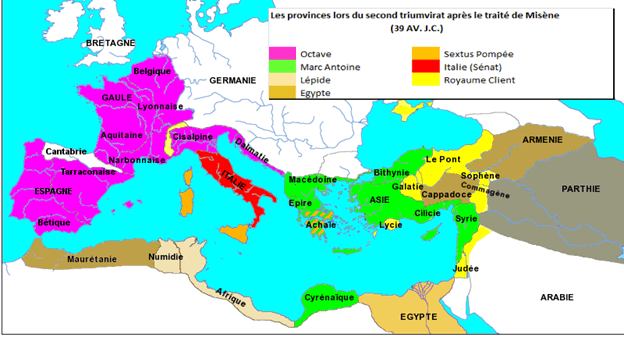
In October 43 BCE Octavian, Antony, and Lepidus met on an island in the river near Bononia (modern Bologna) and established the Second Triumvirate. Unlike the first, this alliance was official and legally enacted for five years (Lex Titia). Formally the triumvirate was created “to restore the Republic,” and all the western provinces were divided among the three.
One of the triumvirate’s first and darkest measures was the proscriptions—mass executions of political opponents. The property of those executed about 300 senators and 2,000 equestrians was confiscated. First on the list was the famous orator Cicero, underscoring the new regime’s ruthlessness. The proscriptions did not yield the expected financial results, but they eliminated opposition and funded future wars.

Leaving Lepidus in Italy, Antony and Octavian crossed the Adriatic to Macedonia to fight the armies of Brutus and Cassius the assassins of Caesar who called themselves “Liberators.” Altogether the triumviral forces numbered about 100,000 infantry and 13,000 cavalries, while the republicans had fewer troops but superior cavalry and command of the sea.
In September 42 BCE the armies met near Philippi. In the first battle Antony successfully attacked the enemy’s left and captured Cassius’s camp, while Brutus at the same time defeated Octavian’s forces. Unaware of Brutus’s success, Cassius, having lost to Antony, committed suicide. A few weeks later, with the republican camp short of supplies, Brutus offered a decisive battle. Thanks to Antony’s skill, the triumvirs won; Brutus took his own life.
Octavian’s role in both battles was minimal: he missed the first due to illness, and his participation in the second, rumor said, was slight. After the victory, Antony and Octavian redivided the provinces: Antony received the East; Octavian the West, including Spain. He was also tasked with confiscating land in Italy for the veterans.

Back in Italy, Octavian set about settling the veterans on land. This caused mass discontent among locals, as lands were confiscated from 18 Italian towns. The situation was aggravated by a naval blockade organized by Sextus Pompey, entrenched on Sicily.
Taking advantage of the unrest, Lucius Antonius Mark Antony’s brother and his wife Fulvia denounced Octavian. They claimed that Antony would restore the Republic upon his return. In the summer of 41 BCE Lucius seized Rome but was besieged by Octavian’s forces at Perusia (modern Perugia). After a long siege Lucius surrendered. Octavian spared him and Fulvia, but the city was plundered and burned, and much of its elite was executed.
This war led to a renewed conflict between Octavian and Mark Antony. Antony returned from Greece and blockaded the port of Brundisium. The soldiers, unwilling to spark another civil war, forced negotiations. The Peace of Brundisium again divided the provinces: Antony took the East, Octavian the West, and Lepidus retained Africa. To cement the alliance, Antony married Octavian’s sister, Octavia.

The land redistribution in Italy after Philippi disrupted agriculture and caused severe food shortages. Matters were worsened by the naval blockade imposed by Sextus Pompey, who controlled Sicily. Promising freedom to slaves, Sextus drew huge numbers of fugitives to his army, further complicating Octavian’s position, especially as he lacked a proper fleet.
Early in 39 BCE, driven to despair by hunger, the people of Rome pelted the triumvirs with stones, demanding peace talks. Octavian had to yield. To show his seriousness, he even contracted a political marriage with Scribonia, a relative of Sextus Pompey.

At a meeting at Misenum the triumvirs made concessions. They amnestied those proscribed who had fled to Sicily, granted freedom to fugitive slaves, and even handed Sextus control of Sicily, Corsica, Sardinia, and the Peloponnese. In return Sextus agreed to lift the blockade and restore grain shipments to Italy.
The peace proved short-lived. Despite the agreement, Octavian continued building a fleet. Soon one of Sextus’s commanders, Menodorus, defected, surrendering Sardinia and Corsica to him—touching off renewed war. In 37 BCE Octavian and Antony met at Tarentum and agreed to extend the triumvirate’s powers for five more years. As part of the deal Antony gave Octavian 120 ships; Octavian was to supply 20,000 soldiers but only partially fulfilled his part.
After Tarentum, Octavian prepared a new fleet under his ally Agrippa. They built larger ships and equipped them with new weapons to gain an edge at sea.
The plan for invading Sicily called for simultaneous attacks from three directions—Tarentum, Africa, and Puteoli. A storm upset Octavian’s plans, but part of his forces under Lepidus did land on Sicily.
On 3 September 36 BCE, at the Battle of Naulochus, Agrippa’s fleet won a decisive victory over Sextus Pompey’s ships. Sextus fled east; his ally Lepidus tried to claim Sicily as his province, but was betrayed by his soldiers and removed from power by Octavian, though his life was spared.

After the victory Octavian did not keep his promise to free Sextus Pompey’s slaves. He returned 30,000 slaves to their former masters and ordered about six thousand executed. To head off a fresh veterans’ revolt, he began settling them not only in Italy but also in the western provinces. For this victory the Senate awarded him a triumph and sacrosanctity, previously reserved for tribunes of the plebs.
With Sextus Pompey defeated, Octavian prepared for the inevitable war with Mark Antony. He continued building up the navy and in 35 BCE led an invasion of Illyricum—both to boost his standing as a commander and to train the troops. The war strengthened his reputation, and he began publicly accusing Antony of betraying Rome’s interests.
Octavian exploited propaganda, charging that Antony had fallen under the sway of the Egyptian queen Cleopatra. He spread tales of Antony gifting eastern provinces to please Cleopatra and abandoning his Roman wife in favor of a foreigner.

The conflict sharpened in 32 BCE, when the triumvirs’ powers expired. Seeing the situation slip away, Antony moved his forces to Greece. Octavian, gaining possession of Antony’s will, read it aloud in the Senate: Antony bequeathed part of his estate to Cleopatra’s children and asked to be buried in Egypt. This proved decisive; the Senate declared war not on Antony but on Cleopatra.
To fund the war, Octavian imposed emergency taxes. He also compelled the entire population of the western provinces to swear a personal oath of loyalty to him.
On 2 September 31 BCE, in the naval Battle of Actium, Octavian’s fleet under Agrippa won a decisive victory. Cleopatra and Antony fled to Egypt, and their soldiers began defecting en masse to Octavian.
Octavian marched his forces to Egypt. As he approached Alexandria, Antony’s legions went over to him. Antony took his own life; Cleopatra followed a week later. Octavian ordered the execution of Caesarion, Cleopatra’s son believed to be Caesar’s and Antony’s eldest son as well.
Returning to Rome, Octavian celebrated a triple triumph for victories in Illyricum, at Actium, and in Egypt symbolizing his final and absolute supremacy.


After defeating Antony and Cleopatra, Octavian Augustus concentrated all power in his hands. He did not, however, proclaim himself king or dictator like Caesar. Instead, he created a new form of rule known as the principate (from princeps, “first among equals”).
The foundations of the principate were laid by reforms of 27–23 BCE. On 13 January 27 BCE, in a carefully staged appearance, Octavian announced his readiness to relinquish all extraordinary powers. The Senate refused the resignation and granted him authority over the most important provinces and Egypt for ten years. On 16 January the Senate conferred on him the honorific “Augustus” (from Latin augustus, “consecrated, venerable”), with religious overtones that set him apart from other citizens.
In 23 BCE Octavian finalized his powers. He resigned the consulship but received imperium maius—supreme provincial authority, allowing him to intervene even in senatorial provinces. He also obtained lifelong tribunician power (tribunicia potestas), giving him the right to propose legislation and veto any law. The combination became the core of his rule.
Though Octavian styled himself “first among equals,” he held enormous power. He controlled the army completely, and his personal auctoritas outstripped that of any other Roman statesman.
A key problem of the principate was the lack of a clear mechanism for succession. Octavian, who had no natural sons, had to determine an heir.
His first and most obvious candidate was his nephew and son-in-law Marcellus, who died unexpectedly in 23 BCE. Octavian then advanced his closest ally, Marcus Vipsanius Agrippa, marrying him to his daughter Julia and granting wide powers. But Agrippa whom Octavian planned as regent for his grandsons died in 12 BCE.
After Agrippa’s death Octavian turned to the stepsons from his marriage to Livia Drusilla Tiberius and Drusus. Tiberius was a talented general but difficult in character. In 6 BCE he abruptly withdrew from politics and went to Rhodes, creating a serious problem for Augustus.

After the deaths of his grandsons Gaius and Lucius Caesar prime candidates for the throne Octavian had to return to Tiberius. In 4 CE he adopted Tiberius and his grandson Agrippa Postumus, but soon exiled Agrippa. Thus, by the end of Octavian’s reign Tiberius was the only clear heir. Thanks to this preparation, after Augustus’s death in 14 CE power passed peacefully to Tiberius, though brief mutinies broke out in some legions.
Octavian understood that to preserve his power he had to maintain the appearance of republican tradition. He did not abolish the Senate; indeed, he endowed it with new, albeit largely formal, legislative and judicial roles. Real power, however, remained with the princeps, and the Senate became a consultative body.
He carried out reforms to reduce the bloated Senate from over 1,000 members to 600, expelling many opponents, raising the property qualification, and, as princeps senatus, gaining the right to speak first.
Despite reforms, senatorial influence over foreign policy, the army, and finance declined sharply. The emperor controlled the army, and senators could not command troops. Though there was covert opposition—anonymous pamphlets and even plots most senators gradually accepted Octavian’s one-man rule, and dissent was harshly suppressed.
Despite establishing sole rule, Octavian kept the external trappings of the republican order, including elections of magistrates. He allowed the people and the plebs to meet and vote, but their choices never ran counter to his will.
Octavian nominated his supporters and, when necessary, removed undesirables from the ballot. From 5 CE, voting effectively became a mere formality: the people simply ratified candidates proposed by the emperor. Some historians argue competition for office persisted, as strict anti-bribery laws from this period suggest.
To secure the desired electoral outcomes, Octavian had several levers. First, his authority was immense thanks to ending the civil wars and restoring peace. He carefully oversaw the capital’s grain supply to avert food riots. Second, he regularly staged generous cash distributions, gladiatorial games, and other spectacles. Finally, he relied on military force: his personal guard and the Praetorian Guard were in and around Rome, and in case of unrest he could quickly summon reinforcements from naval bases.
As a result, the Popular Assembly never opposed the princeps’s will.
Octavian Augustus’s foreign policy aimed to strengthen the Roman Empire, though historians still debate its character. The emperor himself is not considered a gifted battlefield commander. After defeating Antony, he personally led only one campaign, in Cantabria (Spain) in 26–24 BCE, which illness forced him to abandon. Thereafter he entrusted major operations to trusted men, including his stepsons Tiberius and Drusus.
After Spain, expansion turned northward. The Romans conquered the Alps, securing a direct route from Italy to Gaul and Germania. From 12 BCE Drusus pushed Roman arms as far as the Elbe. In the Balkans Tiberius completed the conquest along the right bank of the Danube, annexing Pannonia.


In the early 1st century CE expansion ran into serious problems. In 6 CE the Great Illyrian Revolt broke out; Tiberius subdued it only by 9 CE. That same year the Germanic leader Arminius ambushed Publius Quinctilius Varus’s army in the Teutoburg Forest, annihilating three legions. The defeat shocked Augustus, who, Suetonius says, cried in despair: “Quinctilius Varus, give me back my legions!”

In the East Octavian pursued a more cautious policy of diplomacy and trade. He avoided a full-scale war with Parthia, Rome’s strongest rival. In 20 BCE he secured the return of the standards captured from Crassus a diplomatic success widely trumpeted in Roman propaganda. In 10 BCE the Parthian king Phraates IV even sent his sons to Rome as hostages to secure his throne. Octavian also opened direct contacts with China, receiving envoys from the Han dynasty.
Octavian carried out sweeping military reforms, turning the citizen levy into a regular professional army. He disbanded most of the legions kept on foot after the civil wars and set a uniform 20-year term of service. Legionaries now received regular pay. In 6 CE he established the aerarium militare, a special military treasury to fund veterans’ pensions, financed by new taxes.
He also created a permanent navy with bases at Misenum and Ravenna, and the Praetorian Guard an elite body of imperial guardsmen.
In provincial administration Augustus divided provinces into imperial (under his control) and senatorial. He instituted the office of legate to govern imperial provinces in his name. Egypt, as the emperor’s “personal possession,” was administered by a prefect of equestrian rank. Octavian conducted provincial censuses for taxation and traveled extensively to forestall revolts and display his authority.


A key instrument of Romanization was founding veteran colonies beyond Italy. Settlements such as Caesaraugusta (Zaragoza) and Augusta Emerita (Mérida) spread Roman culture and strengthened local economies.
Augustus’s reign brought major changes to the monetary system. He instituted systematic minting of gold aurei, facilitating large transactions. He also introduced sesterces and dupondii made of orichalcum (brass). These measures eased the cash shortage lingering since the civil wars, though they caused a temporary price spike.

Under the emperor, minting was centralized; the largest mint was at Lugdunum (modern Lyon). Coins often bore Augustus’s profile, with reverses showing scenes from his life, portraits of relatives, and symbols turning coinage into a key instrument of state propaganda.
Octavian reformed taxation, abandoning publicani (tax-farmers) in the imperial provinces. He transferred tax collection to local communities, making it more transparent. For the first time, a regular land tax and poll tax were levied. He also created a separate treasury, the fiscus, for revenues from his provinces, alongside the state aerarium controlled by the Senate.
As a result, the empire’s economy grew markedly. The conquest of Egypt and secure seas fostered foreign trade, especially with India. Inter-provincial trade flourished, aided by new roads and restored cities. Italy experienced a genuine boom as its goods were exported widely; but there was a downside free smallholders declined, since grain cultivation was unprofitable due to Rome’s constant grain doles.
Octavian Augustus attached great importance to reviving Roman public morals and traditional values, which many believed had decayed during the civil wars. His policy aimed to strengthen family life, marriage, and curb luxury.
In 18–17 BCE he enacted laws requiring men and women of the upper orders to marry and have children; penalties for noncompliance included restrictions on inheritances. He also passed a severe adultery law imposing heavy fines and exile on lovers; under it, a husband could kill his wife’s lover if he was a slave or gladiator.
The emperor also issued sumptuary laws: limits on feast expenditures and restrictions on costly materials in clothing and building.
He sought to restore old slave-owning norms, making manumission harder to protect “Roman blood” and address unemployment among freedmen. For example, he banned manumitting slaves under 30 and limited the number a single owner could free.
These policies were unpopular. Romans found loopholes; poets such as Ovid openly mocked them. The emperor himself whose family fell short of moral exemplariness faced criticism, yet pressed on, believing the reforms essential for state stability.
Religious policy was central to his program to “restore the Republic.” He strove to revive traditional Roman cults believed to have declined.
Octavian repaired or rebuilt 82 temples and shrines in Rome. In 12 BCE, after Lepidus’s death, he himself became pontifex maximus and restored the important priesthood of flamen Dialis, vacant for nearly 75 years. In 2 BCE he dedicated the Temple of Mars Ultor on his forum, where the Senate would henceforth meet to discuss war and peace.


He vigorously promoted the ideal of ending wars and establishing peace Pax Augusta. In its honor the Ara Pacis (Altar of Peace) was erected in Rome, and during his reign the doors of the Temple of Janus were shut three times, symbolizing total peace.
Octavian regarded Apollo as his patron god and popularized his cult, setting himself in contrast to Antony, associated with Dionysus.
In his lifetime the imperial cult began to take shape, rooted in the veneration of Gaius Julius Caesar. In 42 BCE the Senate deified Caesar, allowing Octavian to style himself divi filius “son of a god.”
At first Augustus’s cult was cautious: he was not worshiped as a god proper; offerings to his genius (guardian spirit) were bloodless. His name, however, was inserted into all official prayers and oaths. From 8 BCE the month Sextilis was renamed August; in 2 BCE the Senate granted him the title pater patriae, “Father of the Fatherland.”
Even so, Octavian was careful to refuse honors due only to gods, lest he share his adoptive father’s fate: for instance, he did not allow his statue to be set up in the Pantheon among the images of the gods.
Veneration of Octavian during his life varied across the empire. In the West he received only altars, while in the East especially Egypt, where he succeeded the Ptolemies his cult was stronger: he was called Zeus the Liberator, temples were built, and cities were renamed in his honor.
On 17 September 14 CE, a month after his death, the Senate officially deified him as divus Augustus. A temple was begun in his honor, and his cult became part of the state religion.
Octavian Augustus devoted great effort to beautifying Rome. He boasted of having “found Rome of brick and left it of marble.” He divided the city into 14 districts, built his imperial palace, a new forum, the Altar of Peace, and his mausoleum in the Campus Martius. Building served two aims: adorning the capital and combating unemployment.
His friend Agrippa contributed greatly, constructing new aqueducts, baths, and public gardens. After Agrippa’s death Octavian created a special commission of senators to supervise public works.

To maintain order in Rome and fight fires, Octavian established a regular fire brigade and set limits on the maximum height of new apartment buildings.
In private life, Octavian married several times. His first wife was Clodia Pulchra, Mark Antony’s stepdaughter; the marriage was quickly dissolved. His second wife was Scribonia, by whom he had his only child, a daughter, Julia. His longest and happiest marriage was with Livia Drusilla, who bore him two stepsons Tiberius and Drusus. Lacking natural sons, Octavian adopted the sons of Julia and Agrippa, but after their deaths he made his stepson Tiberius his successor.

Octavian Augustus died on 19 August 14 CE in Nola at the age of 75. According to Suetonius, his last words to his friends were: “Have I played the comedy of life well?” In his final instructions he addressed his wife, Livia.
The emperor’s body was brought to Rome and cremated in the Campus Martius. The urn with his ashes was placed in the mausoleum he had built in his lifetime.

By his will, his principal heirs were his adopted son Tiberius and his wife Livia. Another adopted son, Agrippa Postumus, was struck from the will entirely; his daughter and granddaughter were forbidden burial in his mausoleum. Attached to the will were important documents: a report on the state of the empire and his autobiography, known as the Res Gestae Divi Augusti (“Deeds of the Divine Augustus”).
Octavian Augustus learned from his adoptive father Caesar’s fate and consolidated one-man rule with extreme caution. He did not become dictator or king; rather, he used republican institutions to legalize his dominant position. This new form of government the principate proved resilient, lasting until the establishment of the absolute monarchy of the Dominate.
His greatest achievement over a long life was ending the civil wars and establishing the long peace the Pax Romana. This led to flourishing trade, agriculture, and the economy. Octavian successfully made Rome a world power with a developing bureaucratic apparatus.
Later, after the reign of the emperor Trajan, senators wished every new ruler to be “luckier than Augustus and better than Trajan” a testament to Augustus’s achievements and place in history.


