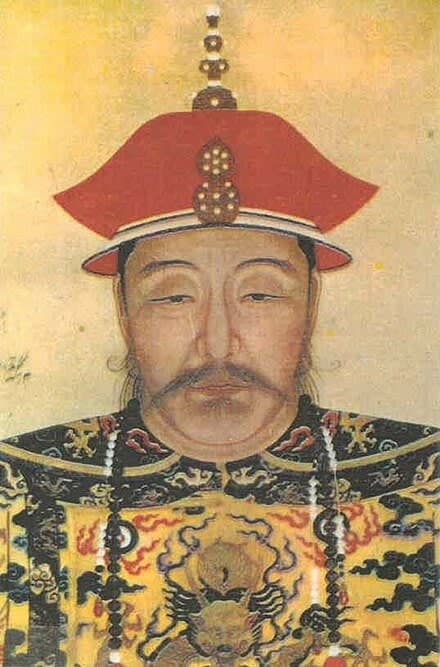

Nurhaci, one of the greatest figures in East Asian history, came from the Jurchen clan of the Tong family. His ancestors had migrated to southern Manchuria from the region of Mount Paektu in the first half of the 15th century, fleeing the advance of Korean troops. Although Nurhaci’s family belonged to the princely elite, their holdings were modest he was one of six princes ruling small fortress-towns in the valley of the Suksuhe-bira River.
However, Nurhaci harbored far more ambitious plans. He proclaimed his lineage to be the “Golden Clan” (Aisin Gioro), thereby emphasizing his connection to the ruling dynasty of the Jurchen Jin Empire, which had governed northern China and Inner Mongolia from 1115 to 1234. The word Jin in Chinese means “gold,” which inspired the name of Nurhaci’s clan. His family laid claim to the ancestral lands in the Suksuhe-bira valley the nucleus of what would later become the Manchu state.

Nurhaci’s rise to power began with a personal tragedy. In 1582, his father Taksi and grandfather Giocangga, both princes, were killed by Chinese soldiers during an intertribal war. According to one version, their deaths were caused by Nikan Wailan, the ruler of the nearby town of Turun, who according to traditional Chinese historiography turned them against the Ming authorities.
Nurhaci swore vengeance. With a detachment of only thirteen armored warriors, he set out against Nikan Wailan. The Chinese authorities in Liaodong initially paid little attention to this “petty vendetta,” dismissing Nurhaci as a mere adventurer. This mistake cost Nikan Wailan his life: he was left without allies and was captured and executed in 1584.
From that moment, Nurhaci proved himself a talented commander and a skillful politician. He began uniting the scattered Jurchen tribes. Through generous gifts, lavish feasts, and strategic marriages, he attracted the allegiance of local chieftains. Tribes, along with their families, slaves, and warriors, migrated to his territory. Thus, he formed a viable tribal confederation that quickly evolved into an early class-based society with a strong military organization.
Between 1585 and 1589, Nurhaci subdued neighboring tribes, integrating them into Manchuria’s population. He then moved to conquer the tribal unions of the Changbaishan and Hulun regions. Over two decades, the Manchu warriors carried out around twenty military campaigns.

To strengthen his position, Nurhaci made a visit to Beijing, where he was presented to Emperor Wanli. The Chinese frontier authorities, closely monitoring his growing power, awarded him the honorary title “General of the Tiger and Dragon” and granted him a salary. This recognition from the Ming Empire significantly enhanced Nurhaci’s prestige among his followers.
In 1589, he declared himself wang (prince), and in 1596, wang of the state of Jianzhou. His eastern Mongol allies, in 1606, conferred upon him the title of Kundulen Khan.
One of Nurhaci’s greatest achievements was the creation of a powerful military machine based on the banner system. Five companies made a regiment, and five regiments a corps or banner (gusa). In 1601, he formed four banners composed of Jurchens. In 1615, Nurhaci created four more corps, bringing the total to eight the famed “Eight Banners,” each identified by a distinct color.
In 1616, Nurhaci proclaimed himself the monarch of a new state. Taking the title of khan, he announced the revival of the ancient Jurchen Jin state, destroyed by the Mongols in 1234, under a new name Aisin Gurun (“Golden State”). Chinese historians later called it “Later Jin” (Hou Jin). Nurhaci also proclaimed the reign title Tianming (“Mandate of Heaven”), declaring himself the Son of Heaven. The capital of his state was established at Xingjing. By 1619, thanks to his diplomatic and military successes, most Jurchen tribes were united under his authority.


The strengthening of Manchuria along China’s borders inevitably led to conflict with the Ming Empire. In 1618, Nurhaci issued the manifesto “The Seven Grievances,” accusing the Chinese of crimes against his people. That same year, his 20,000-strong army invaded Liaodong, capturing and destroying several fortresses and cities. About half a million people were taken captive and resettled in Manchuria.

The Ming Empire responded by assembling a 200,000-strong army, but the incompetence of its generals played into Nurhaci’s hands. The Chinese forces were divided into four corps that advanced separately, allowing Nurhaci’s 50,000-man army to defeat three of them in the famous Battle of Sarhu-alin. The Korean corps sent to assist the Chinese was forced to surrender.
In 1621, the Manchus invaded Liaodong, storming the cities of Shenyang (renamed Mukden) and Liaoyang. The conquered region became the main base for further campaigns. Nurhaci moved his capital from Xingjing to Mukden in 1625.
However, in February 1626, his expansion faced a serious setback. The Manchu forces failed to capture the Chinese fortress of Ningyuan. The city’s defense was commanded by the Jesuit Adam Schall von Bell, who used European cannons the first successful use of such artillery against the Manchus. During the battle, Nurhaci was severely wounded. In retaliation for the defeat, the Manchus captured Jiuhuadao Island, destroying the Chinese fleet and supply depots.


Despite ongoing military campaigns, Nurhaci continued to subjugate independent Jurchen tribes. In September 1626, he died, presumably from the effects of his wound and the psychological blow suffered at Ningyuan. Nurhaci did not appoint a successor, and his kinsmen elected his eighth son, Huang Taiji (Abahai), as the new khan and emperor.


