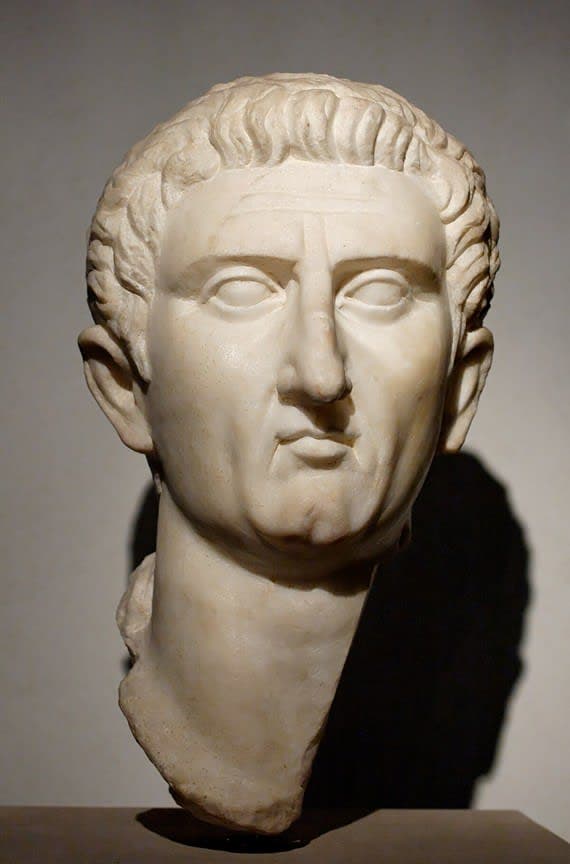

Marcus Cocceius Nerva belonged to a noble, though not especially ancient, family that entered the Roman aristocracy in the Imperial era. His forebears were notable jurists and politicians, and his family was closely tied to the Julio-Claudian dynasty. Nerva himself was born in the town of Narnia on November 8, probably in 35 CE.
Little is known about his early career, but in 65 he distinguished himself by helping Nero uncover the Pisonian conspiracy. For his service he received triumphal insignia and a statue in the Forum an extraordinary honor. He became a friend of Nero and also of Vespasian, who may have asked Nerva to look after his younger son, Domitian, when Vespasian left to wage war in Judea.
Nerva witnessed the “Year of the Four Emperors” (69), though his role remains unclear. He served as consul in 71 alongside Vespasian an exceptional distinction. In 91 he was consul again, this time with Domitian, probably as a reward for loyalty during Saturninus’s revolt. In 93, however, Domitian because of an unfavorable horoscope accused him of conspiracy and exiled him.
On September 18, 96, Domitian was assassinated. The Senate convened in emergency session and proclaimed Nerva the new emperor. His advanced age and lack of sons made him an ideal compromise figure for the Senate. As a friend of Vespasian, he inspired confidence, and his selection helped avert another civil war. It is possible he knew of the plot in advance.


Nerva solemnly vowed not to execute senators, and he kept his word. He ended prosecutions for lèse-majesté, granted amnesty to those convicted, and restored confiscated property to its owners. He also punished the informers who had flourished under Domitian. In response, the Senate decreed damnatio memoriae against Domitian: his statues were destroyed and his name erased from public records.
To win the support of the people and the army, Nerva adopted a series of popular measures. He increased cash distributions (congiaria) to the urban plebs and likely raised the soldiers’ donatives. He introduced several social programs, including free land grants to the poor and the creation of alimentary funds for needy children. He abolished the unjust Jewish tax and reduced the overall tax burden. To cover expenses he cut state spending, canceled certain festivals, and auctioned off Domitian’s property.

Despite these popular steps, Nerva’s power was fragile. He lacked support in the army and among the praetorian guard, which remained loyal to Domitian. In 97 the praetorians, led by the prefect Casperius Aelianus, revolted, besieged the palace, and demanded the surrender of Domitian’s assassins. Nerva had to give way. The killers, including the former praetorian prefect Titus Petronius Secundus, were executed.
The revolt showed Nerva could not hold power alone. He needed an heir respected by the army. Rejecting his own relatives, he chose Marcus Ulpius Trajan, governor of Upper Germany popular with the troops, commander of one of the empire’s strongest armies, and relatively young.
On October 25, 97, Nerva formally adopted Trajan. He granted him the title “Caesar,” made him co-ruler, and designated him successor. With this choice Nerva secured the empire’s stability and inaugurated the new Antonine dynasty.
Nerva died of a fever on January 25, 98. By decree of the Senate he was deified. The transfer of power to Trajan took place without incident.


