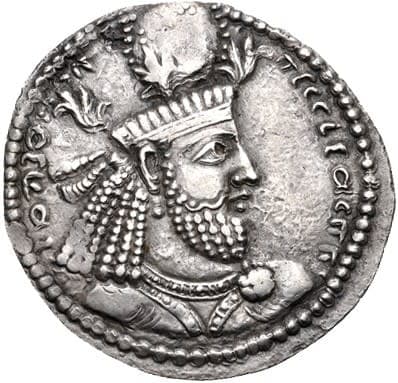

Narseh, whose name probably means “male praise,” was the son of Shapur I and one of the most influential Sasanian princes of his time. During his father’s lifetime he governed a vast territory that included the Indus, Sakastan, and Turan, which testifies to Shapur’s trust in his abilities. Later, around 276, he became the “Great King” of Armenia, a key kingdom that served as the “key” to the Roman provinces.

However, Narseh was deprived in the matter of succession to the throne. In the Sasanian Empire there was no clear rule of succession, although Zoroastrian custom favored the eldest in the line. After the death of Shapur I, his son Hormizd-Ardashir came to power. Then the throne passed to Bahram I, and after his death, bypassing Narseh’s rights, the shahanshah became the young Bahram II. This injustice led to a deep crisis of power. Narseh received Armenia as a kind of compensation, but in the end, this allowed him to concentrate a large army in his hands.

In 293, after the death of Bahram II, his supporters again attempted to bypass Narseh by raising his son, Bahram III, to the throne. This was the last straw. Narseh, who was already over fifty, decided to act. His actions are described in detail in the inscription at Paikuli, where he himself explains the reasons for his revolt. He condemned the vizier Vahunam for having, without the consent of the nobility, raised the minor Bahram III to the throne, and also accused him of killing those who disagreed with this decision.
Narseh moved from Armenia into Mesopotamia “in the name of Ahura Mazda, and all the gods, and Anahita, the Lady.” He quickly secured the support of the army and the greater part of the nobility. Even the high priest Kartir, who had previously supported Bahram II, went over to Narseh’s side. The vizier Vahunam, seeing the universal betrayal, turned for help to the king of Mesene, but it was already too late. Aturfarnbag was seized and executed, and Vahunam fled. The young Bahram III was also executed by decision of the new shahanshah’s council.
After his victory, Narseh proclaimed himself shahanshah. On an investiture relief at Naqsh-e Rustam he is depicted receiving the ring of power from a female figure, probably the goddess Anahita. It is noteworthy that Narseh “usurped” the relief of Bahram I, adding to it his own inscription and the figure of a vanquished enemy, who was most likely Bahram III, which symbolized his triumph.


With Narseh’s accession, the “party of Kartir” lost its influence. The new shah, being a righteous Zoroastrian, nevertheless understood that the power of the priesthood had to be limited. He openly met with the head of the Manichaeans, showing that the persecutions of non-believers, of which Kartir had been so proud, would no longer be carried out by the state.
At the beginning of Narseh’s reign relations with Rome were friendly. Roman envoys were present at his coronation, and the countries declared peace. However, in 296 war resumed. The reasons were complex: Rome sought to regain lost territories, and Narseh apparently decided to deliver a preemptive strike to secure his dominions.
In the spring of 297 Narseh won a brilliant victory over the Roman Caesar Galerius in a battle between Callinicum and Carrhae. The defeated Galerius was forced to flee, and the Roman emperor Diocletian, as punishment, made him walk on foot behind his chariot despite his imperial vesture.

However, in 298 fortune turned away from Narseh. Galerius, having reinforced his army with new legions, invaded Persia through mountainous Armenia, where the Persian cavalry could not act effectively. He suddenly attacked Narseh’s camp near Satala and dealt a crushing defeat. Narseh was wounded and fled, but his wife, sisters, and children were taken captive.
This defeat forced Narseh to accept the humiliating Treaty of Nisibin with Rome. Under its terms Iran ceded five provinces to Rome, recognized Rome’s right to appoint rulers in Iberia, and established strict control over trade, concentrating it in Nisibin. In exchange Narseh’s family was returned to him.
Victory over Narseh allowed Rome to strengthen its borders and restore its influence in Armenia, where the Romans restored Tiridates III to the throne, who subsequently made Christianity the state religion.

According to one version, in 301 Narseh, being already of advanced age, abdicated the throne under pressure from the aristocracy, dissatisfied with his defeat. He transferred power to his son Hormizd II. Although Narseh suffered defeat in the war with Rome, it would be unfair to blame him alone. He came to power in a state torn by internecine strife, and the short time he was on the throne did not allow him to correct all the accumulated problems.
Narseh remained in history as a king who by force regained the throne, limited the power of the Zoroastrian priesthood, and was forced to conclude a harsh peace treaty with Rome, yet at the same time demonstrated the strength and greatness of the Sasanian state.


