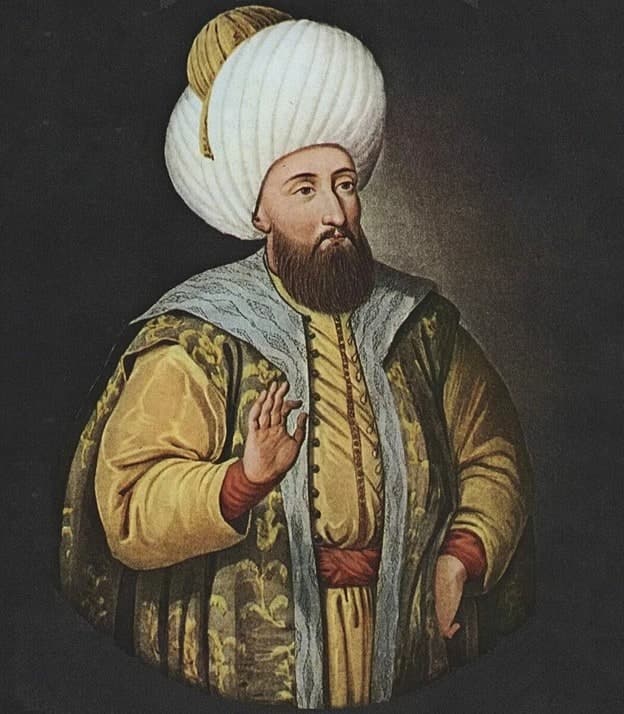

Murad was born in 1404 in Amasya and, at the age of twelve, was appointed sanjak-bey by his father Mehmed I experience that proved valuable in governance. After Mehmed I’s death in 1421, the seventeen-year-old Murad ascended the throne, immediately facing serious challenges.

The Byzantine emperor Manuel II, who had previously held Murad’s uncle Mustafa Çelebi in captivity, released him to use as a puppet to weaken the Ottoman state. Styling himself sultan, Mustafa won the backing of many uç-beys (frontier lords) and seized a large part of Rumelia. Murad, acting shrewdly, won over Mustafa’s key supporters, including his vizier Cüneyd, and in 1422 defeated and executed the pretender.
Murad then laid siege to Constantinople to avenge Byzantine intrigues, but had to lift it because of another revolt. His younger brother Küçük Mustafa, supported by the Karamanids, rose in Anatolia. Murad returned swiftly, crushed the rebellion, and executed his brother in 1423.
With internal foes subdued, Murad II set about restoring Ottoman authority over lands lost after the Battle of Ankara. By 1425 he had reasserted control over nearly all the Anatolian beyliks; the sole holdout was his brother-in-law, the Karamanid ruler İbrahim Bey, whom Murad eventually forced to accept vassalage after prolonged wars.
Murad also campaigned successfully in the Balkans, subduing most of Serbia by 1439 and capturing key strongholds, including Thessaloniki in 1430 after an eight-year siege—an act that provoked war with Venice.


European successes especially those of the Hungarian commander John Hunyadi, who inflicted several heavy defeats on the Ottomans led to the Peace of Szeged in 1444, by which Murad restored Serbia and released hostages in exchange for peace.

In 1444, believing peace secure, Murad unexpectedly abdicated in favor of his twelve-year-old son Mehmed II and retired to Manisa. But the peace collapsed: papal legate Giuliano Cesarini declared any treaty with “infidels” void, and the Hungarian king Władysław III launched a new crusade.
At this critical moment, at the urging of the vizier Çandarlı Halil Pasha, Murad returned. On 10 November 1444, at the Battle of Varna, the Ottoman army under his command won a brilliant victory, routing the crusaders and killing Władysław III.


Despite the triumph, Murad again left the throne to his son, but court intrigue and unrest in the army forced him to return for good. In his final years he focused on Balkan wars, winning another great victory over Hunyadi at the Second Battle of Kosovo in 1448.

Murad also waged a difficult, protracted campaign against the Albanian leader Skanderbeg, who had risen against Ottoman rule in 1443. The Ottoman campaign against Skanderbeg failed, and he continued to resist for nearly two decades.

Murad II died in Edirne on 2 February 1451, likely from an epileptic seizure, and was buried in Bursa. His reign—filled with wars and intrigue—not only restored the empire after the catastrophe at Ankara but also strengthened its military might. He left to his son Mehmed II, the future conqueror of Constantinople, a stable, powerful state ready for new conquests.


