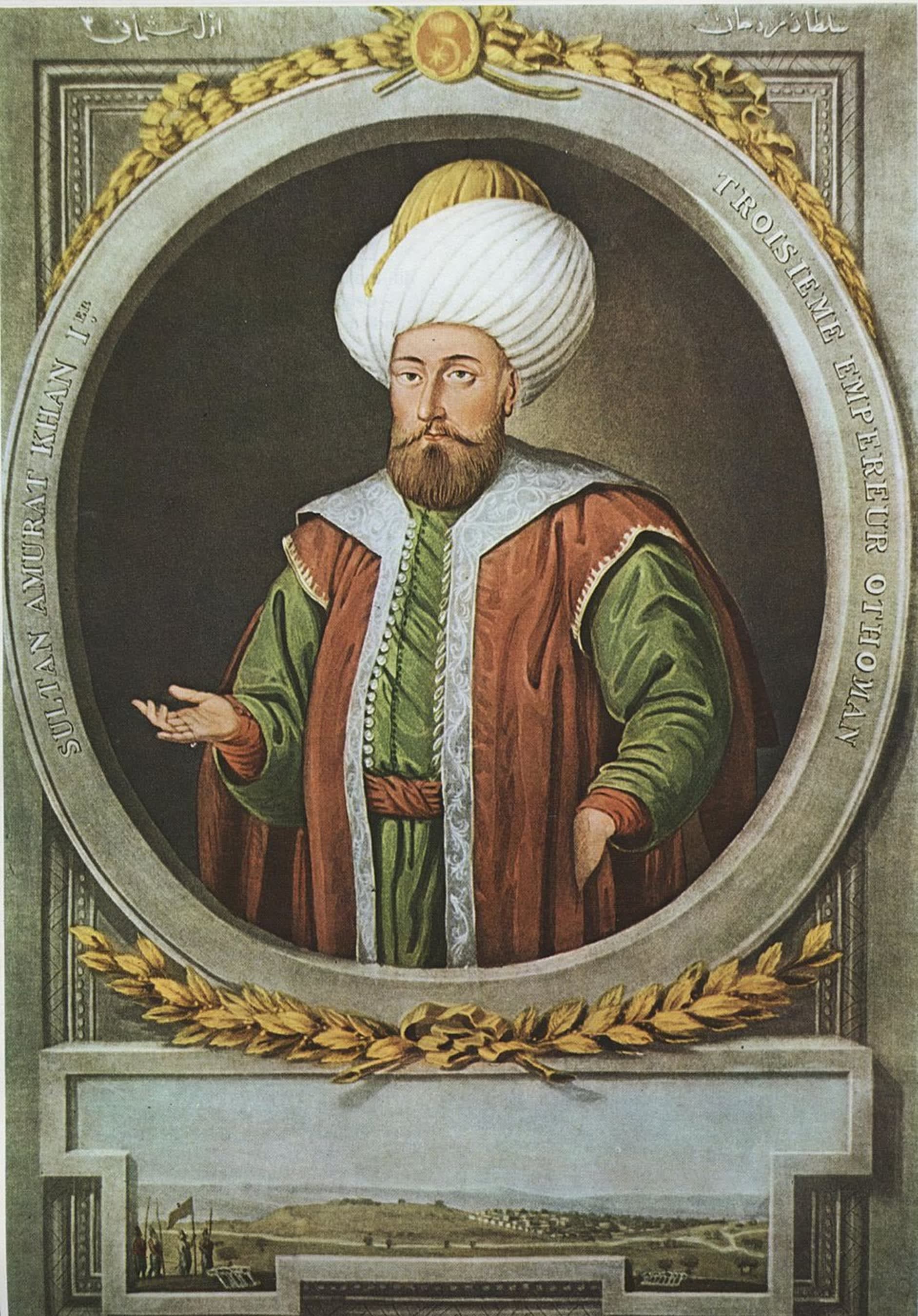

Murad was the son of the second Ottoman ruler, Orhan, and his concubine Nilüfer Hatun. Although traditional Ottoman historiography calls her a Byzantine Greek, daughter of the tekfur (governor) of Yarhisar, modern historians consider this a legend and believe she was a concubine of Orhan.
From a young age Murad took an active part in military affairs, receiving the sanjak of Bursa to govern under the guidance of the seasoned tutor Lala Shahin Pasha. After the death of his elder brother Süleyman Pasha in 1357, Murad became the chief heir to the throne. In 1362, after Orhan’s death, Murad, who was in Rumelia, was able to take the throne quickly, suppressing revolts by his brothers and the Anatolian beys.
Murad I’s reign was marked by rapid conquests in Europe. He concentrated his forces in the Balkans, where in 1361 he took Adrianople and made it the new Ottoman capital. His success was due not only to military skill but also to the disunity of the Balkan states. In 1371, at the Battle of the Maritsa River, the Ottoman army routed the combined forces of Serbs, Bosnians, and Hungarians. This victory opened the way into western Thrace and Macedonia, and many Balkan rulers were forced to become Murad’s vassals.


Not everything went smoothly. In 1373 Murad’s own son Savcı Bey rebelled, joining forces with the Byzantine heir Andronikos IV. Murad personally crushed the revolt, had Savcı blinded, and executed him. Murad skillfully exploited internal conflicts within Byzantium—now supporting Emperor John V, now his son Andronikos—to weaken the empire and obtain new territories, including the strategically vital Gallipoli.

Murad I was not only a great warrior but also an outstanding statesman. He created institutions that became the foundation of Ottoman administration and military power. Under Murad the groundwork was laid for a permanent professional infantry the Janissaries. This army, composed of non-Muslim youths recruited through the devshirme system, became an elite corps and the first standing army in Europe.
By the end of his reign Murad had strengthened his position in Anatolia by marrying his son Bayezid to the daughter of the ruler of the Germiyanoğulları beylik and by delivering a crushing defeat to his son-in-law Alaeddin Karamanoğlu. In 1389 Murad personally led the army against a coalition of Serbian and Bosnian rulers at the Battle of Kosovo Polje. Although the Ottoman army won a decisive victory, Murad I himself was killed in the battle. According to the most famous legend, he was slain by the Serbian knight Miloš Obilić, who entered his tent disguised as a defector.


After his death the throne passed to his son Bayezid I, known as “the Thunderbolt,” who continued his father’s work, expanding the empire’s borders and consolidating power. Murad I was buried in a mausoleum in Bursa. His reign marked the era in which the Ottoman state firmly established itself as a great power.


