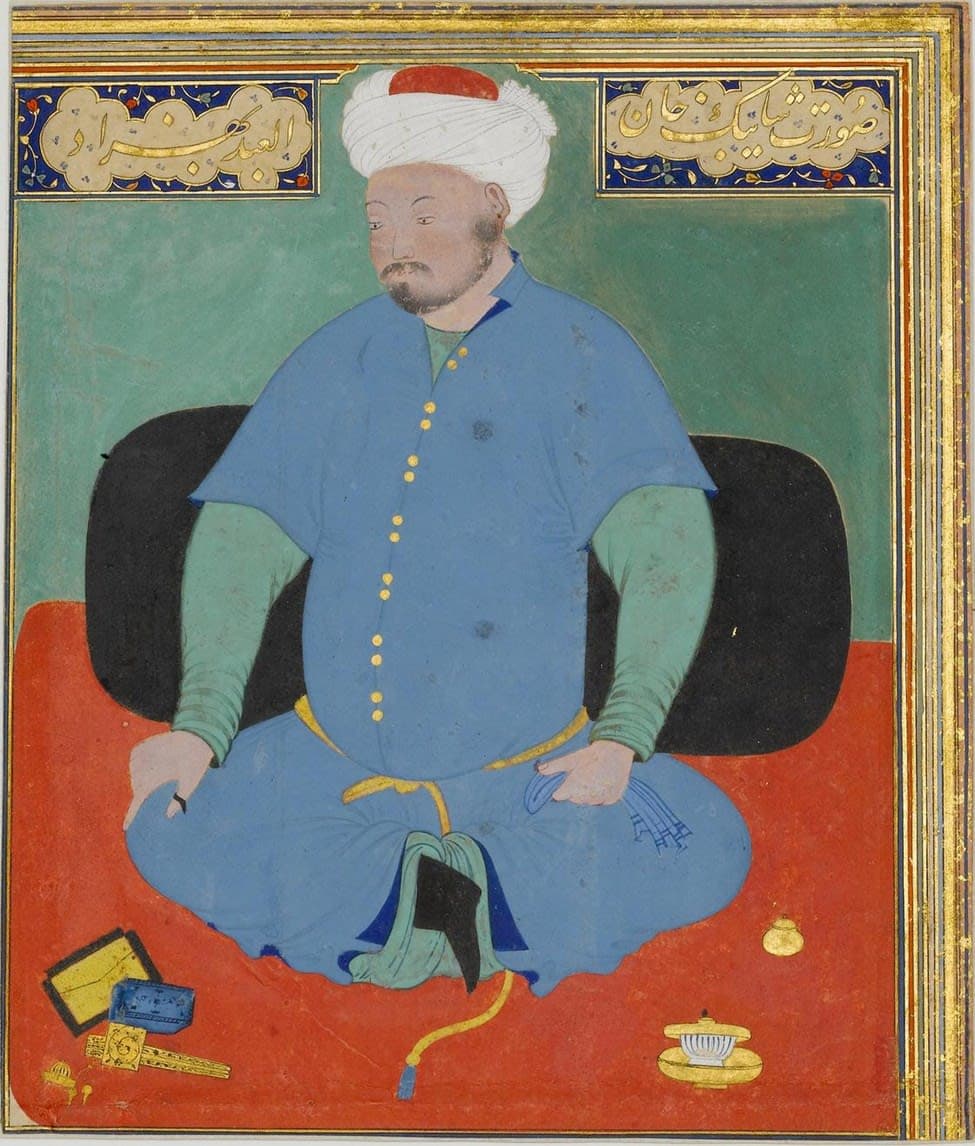

Muhammad Shaybani was born in 1451. He was the grandson of Abu’l-Khayr Khan, founder of the Uzbek Khanate, and the son of Shah Budagh Khan. His mother was Ak-Qozi Biyim. Shaybani Khan received a solid education, studying at the Bukhara madrasas under well-known Sufi shaykhs such as Muhammad Khitayi and Jamal al-Din Azizon. According to tradition, one of his mentors, Shaykh Mansur, foretold for him a great future as a ruler and advised him to begin his conquests from the peripheries of the stateьadvice he later followed.

After his father’s early death, he and his brother Mahmud-Sultan were raised by their grandfather Abu’l-Khayr Khan. When their grandfather died in 1468, the Uzbek Khanate fell into political instability. At this time Shaybani Khan began his political activity, seeking to bring the cities along the Syr Darya back under his control. He was forced to wander the steppe in search of allies and fought his enemies, including the Kazakh khans Kerei and Janibek. In 1471 he was defeated by Kazakh sultans and fled.

Shaybani Khan was a man of great will, intelligence, and courage. He struggled constantly for power in the steppes of the Desht-i Qipchaq. He managed to secure the support of the Nogai biy Musa, who wished to set him up as khan in order to weaken the Kazakh sultans’ power. This alliance, however, did not bring him success.
In 1472, while in Astrakhan, Shaybani Khan raided the domains of Ahmed, khan of the Great Horde, who at that time was campaigning against the Russian lands. The attack forced Ahmed to break off his march on Rus’ and return to the Volga region, indirectly aiding the Russians in their eventual overthrow of the yoke.

In 1488 Shaybani Khan seized Turkistan, which became his principal base for campaigns into Transoxiana (Māwarannahr). In the years that followed he fought the Timurids with success, exploiting their internal strife. In 1485 he captured the cities of Sighnaq, Arkuq, and Uzgend. By the 1490s he had entered the service of the Tashkent ruler Sultan Mahmud Khan, which helped him strengthen his position.
In 1499 Shaybani Khan, having gathered a loyal army, marched south. He intervened in the Timurid succession struggles and began seizing their territories. In 1501 he finally took Samarkand and made it the capital of his state. He proclaimed himself “the imam of his time and the merciful caliph,” asserting his role as both temporal and spiritual leader. In 1503 his envoys arrived at the Ming emperor’s court, attesting to his wide diplomatic reach.
In 1507 Shaybani Khan captured Herat, the capital of Khurasan, and overthrew Timurid rule. He united under his authority vast territories stretching from the banks of the Syr Darya to Kandahar and from the Caspian Sea to the borders of China. In 1508 he carried out a monetary reform, standardizing coinage and strengthening the economy.

Shaybani Khan was not only a military leader but also a patron of learning and the arts. He wrote poetry in Turkic under the pen name “Shibani,” and his dīvān (collection of poems) is preserved in Istanbul. He also authored the philosophical-religious work Bahr al-Hudā (“Sea of Guidance”) and the historical composition Tavārīkh-i Guzīda-yi Nuṣrat-nāma. He gathered talented poets and scholars at his court including Kamal al-Din Bina’i, Muhammad Salih, and Fazlallah ibn Ruzbihan who had fled religious persecution in Iran.
Shaybani Khan was also active in urban development and irrigation. He built a bridge over the Zerafshan River, a fortress in Qarshi, and mosques and madrasas in Turkistan and Samarkand. His madrasa in Samarkand demolished in the Soviet era was a major center of learning where the khan himself took part in scholarly disputations.
In 1510 Shaybani Khan faced a new threat from the Safavid shah Ismail I, who had declared Shi‘ism the state religion and begun persecuting Sunnis. Taking advantage of Shaybani’s setbacks in fighting the Hazaras, Shah Ismail invaded Khurasan. With his main forces in Transoxiana, Shaybani Khan was compelled to withdraw to Merv.
Shah Ismail besieged Merv but could not take the city. He resorted to stratagem, feigning retreat to lure the khan into battle. According to tradition, Shaybani’s wife, Moghul-Khanum, shamed him, saying: “And you, being an Uzbek, fear the Qizilbash!” Yielding to the provocation, Shaybani Khan marched out with a small force of about five thousand men, fell into an ambush, and on December 2, 1510, was routed and killed at the Battle of Merv.


Shah Ismail ordered Muhammad Shaybani’s head cut off and, legend has it, had his skull fashioned into a wine cup. Shaybani Khan’s headless body was buried in Samarkand. His mausoleum was destroyed in the twentieth century, and the tombstone is preserved in the Hermitage Museum. After his death, power in Transoxiana and Khurasan passed to Shah Ismail and Babur, but in 1512 his nephew Ubaydullah Khan restored Shibanid rule in the region.


