
In the 13th century, the state of Goryeo on the Korean Peninsula, weakened by a series of Mongol invasions from 1231 to 1281, eventually signed a treaty and became a vassal of the Mongol Empire. At the same time, Japan was under the rule of military regents (shikken) from the Hōjō clan, who, although governing on behalf of the Kamakura shogunate, had in fact concentrated all power in their own hands. They made decisions in private meetings, ignoring traditional councils.
Meanwhile, the Mongols, having consolidated their position in Korea, turned their gaze toward Japan. In 1265, Kublai Khan, proclaimed Great Khan in 1260, accepted his Korean advisor’s suggestion to bring Japan into vassalage. He sent envoys to Japan, but their mission failed. After five months spent in Japan without being received, they returned empty-handed. Suspecting deception from Goryeo, Kublai sent another envoy in 1268. Accompanied by a Korean envoy, he brought a letter in which Kublai, calling himself the ruler of “all under Heaven by the will of Heaven,” demanded that Japan establish friendly relations, threatening war otherwise.

The letter stated: “Since time immemorial, rulers of small states whose borders are close have always sought to maintain friendly relations with one another, showing mutual respect and trust… We believe that Your Highness and your subjects are aware of this… Who would want to resort to arms? By this letter I submit this question to Your Highness for consideration.”
The letter was perceived as a harbinger of invasion. The Kamakura shogunate, contrary to the wishes of the imperial court, refused to respond. In early 1269, a new mission arrived on Tsushima Island, but it too received no reply. The last embassy, sent in late 1270 and arriving in 1271, was likewise ignored. In 1273, one of the envoys, Zhao Liangbi, returned to China reporting to Kublai that the Japanese were warlike and an invasion would be useless.
Japan, preparing for the inevitable, began strengthening defenses on Kyushu. Shinto shrines and Buddhist temples were ordered to pray for victory.
In April 1274, Kublai Khan ordered the mobilization of 15,000 Mongol, Han, and Jurchen warriors. Korean commander Kim Pangyeon gathered 30,500 men to build 900 ships. Korea was responsible for providing labor, materials, and funding, which caused much protest. Construction was completed by July 5, 1274, but departure was delayed three months due to the death of King Wonjong of Goryeo on July 23.
The Mongol fleet, consisting of 15,000 soldiers, 6,000–8,000 Koreans, and 7,000 Korean sailors, was to attack Tsushima, then Iki, and finally land in Hakata Bay. The Japanese force, estimated at 4,000–6,000 men, was ready to resist the invaders.
On November 2, 1274, the Mongol fleet departed Korea. Two days later they landed on Tsushima Island. Deputy governor Sō Sukekuni, with only 80 mounted samurai, put up desperate resistance. His unit was quickly defeated and he was killed. According to the Sō Shi Kafu, one samurai, Sukesada, single-handedly killed 25 enemy soldiers. After the battle, the Mongols burned most buildings and slaughtered the inhabitants, taking control of the island.
On November 13, the fleet left Tsushima and attacked Iki Island. Governor Taira no Kagetaka, with a force of 100 samurai, also resisted fiercely, then retreated into his castle. Knowing defeat was inevitable, he tried to send his daughter with a message to the mainland, but she was killed by Mongol archers. Kagetaka made one last sortie before committing suicide with his family.
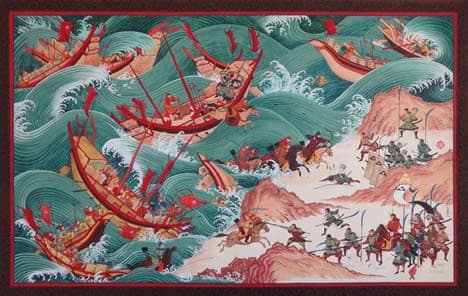
On November 19, the Yuan fleet landed in Hakata Bay. On November 20, the Battle of Bun’ei began. The Japanese samurai were bewildered by Mongol tactics. Instead of traditional single combats, the Mongols advanced in tight formations, using shields and gunpowder bombs that frightened Japanese horses. As a Japanese historian wrote: “Our soldiers were terrified to death by the deafening explosions; their eyes were blinded, and their ears went deaf.” The battle lasted only one day. The Japanese retreated, but the Mongols did not press the attack. One Yuan commander, Liu Fuxiang, was wounded, leading to disputes among the generals. They decided to withdraw to their ships to avoid a night ambush.
That night, a sudden storm, later known in Japanese history as kamikaze (“divine wind”), struck the fleet. According to the History of Yuan, “a strong storm arose, and many warships were smashed against the rocks and destroyed.” Of the 30,000 men in the invasion force, 13,500 did not return. The Japanese executed all survivors they found, sparing only Chinese sailors, whom they considered forced participants.
Japan took the first invasion as a serious lesson. The Kamakura shogunate ordered the construction of forts and a two-meter-high stone wall in Hakata Bay to prevent another landing.
Kublai Khan did not intend to give up. In September 1275, he sent five emissaries, who were beheaded by order of regent Hōjō Tokimune. Their graves still exist at Jōryū-ji. In July 1279, another five envoys were executed in Hakata.
In autumn 1280, Kublai began planning a second invasion. After conquering the Song dynasty, he could now use its resources. For the new campaign, more than 1,500 ships were requisitioned and up to 142,000 soldiers and sailors gathered.
On May 22, 1281, the Eastern Route Army departed Korea. On June 9 they attacked Tsushima, and on June 14 Iki. The Japanese were defeated, and Shōni Suketoki was killed in battle.

The Eastern Route Army, without waiting for the southern fleet, split and attacked Hakata Bay. On June 25, three hundred ships attacked Nagato Province but were repelled. The rest assaulted Hakata, where they faced the massive defensive wall and were driven back.
Unable to land, the Mongols occupied the islands of Shika and Noko, from which they planned raids on Hakata. But the Japanese, using small boats, launched daring night raids. The Hachiman Gudokun records that the samurai Kusano Jirō boarded a Mongol ship, set it on fire, and beheaded 21 enemies. As a result of such counterattacks, the Mongols were forced to retreat to Hirado Island.
After two weeks of stalemate, on August 15, 1281, a powerful typhoon struck the Mongol fleet anchored offshore. Korean and southern Chinese sailors tried to seek shelter in Imari Bay, where they were destroyed by the storm. Thousands of soldiers drowned. Commander Fan Wenhu fled on the best ships, abandoning more than 100,000 troops to their fate. The Japanese killed all Mongols, Koreans, and northern Chinese they found, sparing only southern Chinese.
This defeat was catastrophic for the Mongol Empire, which lost most of its fleet. Korea, responsible for building the ships, also lost its naval strength. In Japan, although the invasions were repelled, the Kamakura shogunate was unable to reward the samurai who had fought in the war, which ultimately weakened its authority.


