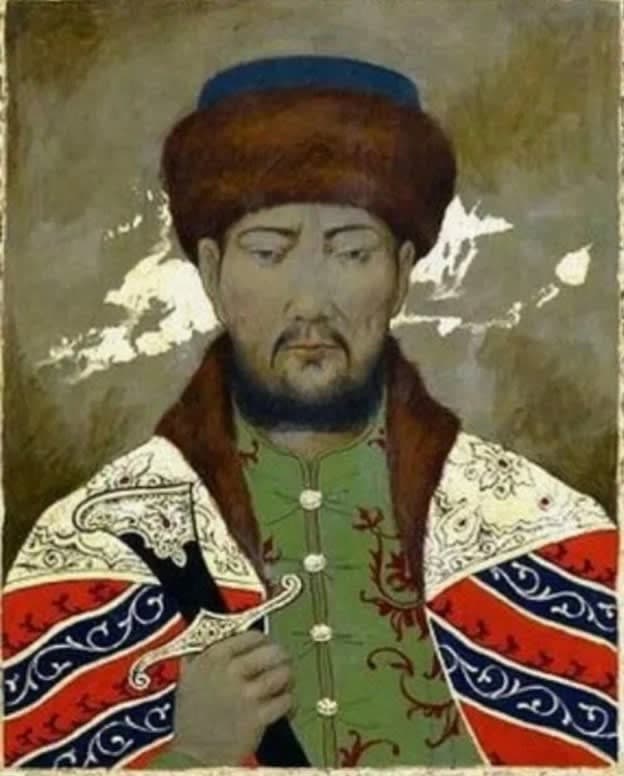

Mengli I Giray, the sixth son of the first Crimean khan, Hacı I Giray, was among the most influential rulers in the history of the Crimean Khanate. After his father’s death in August 1466, the throne was taken by his elder brother, Nur Devlet. Backed by the Crimean nobility, Mengli Giray began to fight for power.
In 1467 he overthrew Nur Devlet but was soon himself forced into exile. He found refuge in the Genoese colony of Caffa, where he secured the support of the local authorities and Crimean beys. In 1468 Mengli Giray was formally elected khan in Caffa, and in 1469 he finally managed to seize the khan’s capital of Qırq Yer, once again expelling Nur Devlet. Having taken power, Mengli Giray concluded an alliance with the Genoese and with the Principality of Theodoro, directed against the Ottoman Empire.
However, in 1475 Sultan Mehmed II Fatih launched a large-scale conquest of Crimea. The Ottoman fleet under Gedik Ahmed Pasha captured Genoese Caffa and other fortresses, and then the capital of the Principality of Theodoro, Mangup. Mengli Giray was taken prisoner and sent to Istanbul, where he spent three years. The Turks placed his elder brother Nur Devlet on the throne as their vassal.

In the spring of 1478 Mehmed Fatih released Mengli Giray from captivity and restored him to the throne, but now as a vassal of the Ottoman Empire. Mengli Giray’s chief foreign-policy goal became the struggle against the Great Horde, which regarded itself as the heir to the Golden Horde and posed a constant threat to Crimea. A natural ally in this struggle was Grand Prince Ivan III Vasilyevich of Moscow, who likewise sought to free himself from Horde domination.

In 1480, fulfilling the terms of their alliance, Mengli Giray campaigned into Podolia, forcing the Lithuanian ruler Casimir Jagiellon to refrain from aiding the Great Horde’s khan, Akhmat, during his campaign against Moscow. This episode, known as the “Stand on the Ugra River,” brought the Horde’s overlordship over the Russian state to an end.
The struggle against the Great Horde continued with mixed fortunes. In 1486 Horde forces attacked Crimea, but Mengli Giray repelled them and recovered all the seized booty. In 1502 he assembled a vast army and marched against the last khan of the Great Horde, Sheikh Ahmed. On 15 June, Mengli Giray routed his forces and, with the symbolic burning of Sarai, brought the Golden Horde’s existence to an end. This event was one of the greatest triumphs in the history of the Crimean Khanate.
After the defeat of the Horde, relations with Moscow—now lacking a common enemy—began to deteriorate. Mengli Giray, formerly a loyal ally, launched devastating raids into Russian, Lithuanian, and Polish lands. For many years his sons, including the future khan Mehmed I Giray, led these expeditions, ravaging Kyiv, Minsk, Lviv, and other cities.
In addition to his military activities, Mengli I Giray engaged in state-building. He instituted the office of kalga, the second person in the state, and in the capital settlement of Salaçıq he built the Devlet-Saray palace complex and a mausoleum, where his father was buried and where he himself was later laid to rest.

Mengli I Giray died on 17 April 1515 at the age of 70. His reign became a golden age for the Crimean Khanate, which under his leadership grew into a powerful state and established itself as one of the key players in Eastern Europe.


