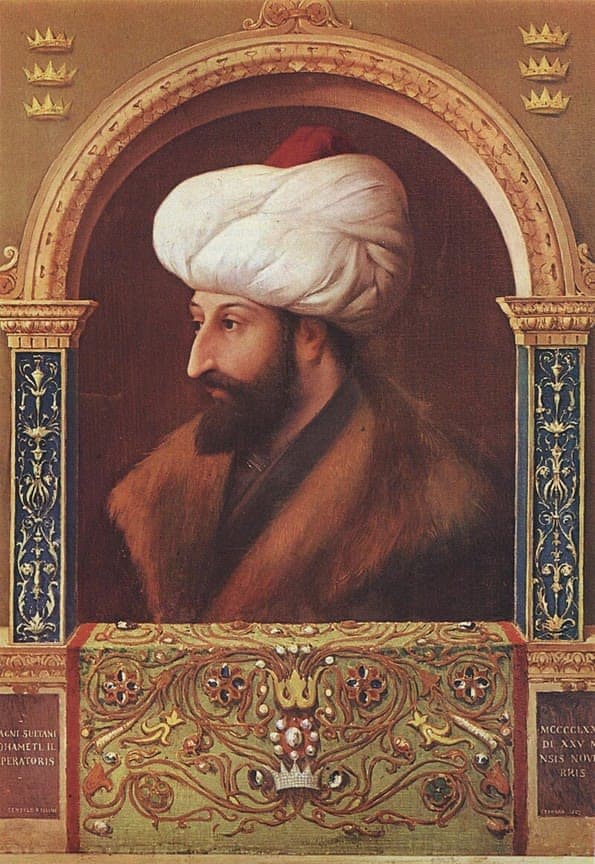

Mehmed was born in Edirne in 1432 to Sultan Murad II and his concubine Hüma Hatun. From a young age he was immersed in politics and court intrigue. In 1434 he was sent to Amasya, initially under the guardianship of his elder brother Ahmed, and later became sanjak-bey himself after Ahmed’s sudden death. In 1443, when his last surviving older brother Alaeddin Ali died, Mehmed was left the sole heir.
In 1444, after a peace treaty with the crusaders, his father Murad II unexpectedly abdicated, and the twelve-year-old Mehmed became sultan for the first time. His rule, however, was brief and unstable. Taking advantage of the boy sultan’s youth, European rulers—urged on by papal legate Giuliano Cesarini—broke the treaty and renewed the war. Unable to master the crisis, Mehmed had to summon his father back to the throne. Murad II defeated the crusaders at the Battle of Varna, and Mehmed returned to the governorship of Manisa, where under his father’s eye he joined campaigns and gained experience. In 1450 Murad married him to Sitti Hatun, daughter of the ruler of the Dulkadir beylik, but Mehmed felt no attachment to her and left her in Edirne after he re-ascended the throne.


In 1451, after his father’s death, Mehmed II mounted the throne a second time, and his chief goal became the capture of Constantinople—the last remnant of the Byzantine Empire. Unlike previous sultans, he was obsessed with the idea and set about executing a carefully prepared plan. He first secured his own power by eliminating potential rivals; his half-brother Ahmed was drowned in a bath.
To prepare for the siege, Mehmed showed strategic genius. He ordered the fortress of Rumelihisar to be built on the European shore of the Bosporus; together with the existing Anatolian Fortress, it allowed him to seal off Constantinople by sea. Passage through the strait became impossible for Byzantine ships, and the city fell under naval blockade.
In April 1453 an Ottoman army of up to 80,000 men approached the city. A key element of its equipment was the giant cannon “Basilica,” cast by the Hungarian engineer Urban, capable of hurling shot weighing over 500 kg. The city’s defense—only 7–8 thousand men—was led by the Byzantine emperor Constantine XI and the Genoese condottiere Giovanni Giustiniani.

The siege lasted nearly two months. The Ottomans relentlessly battered the walls; each night the townspeople turned out to repair the breaches. One of Mehmed’s most brilliant moves was to haul dozens of ships overland into the Golden Horn, skirting Genoese Galata. This let him bypass the great chain guarding the harbor entrance and attack from a new, less fortified side.

On May 29, 1453, the final assault began. Despite heroic resistance, the Ottomans broke through at several points. In fierce fighting the last Byzantine emperor fell, and the city was taken. The capture of Constantinople marked the end of the Byzantine Empire.

As sultan of Istanbul, Mehmed II pressed on with expansion, turning the Ottoman realm into a formidable world power. He completed the conquest of Serbia in 1459, annexed the Morea in 1460, and in 1463 seized Bosnia, executing its king, Stephen Tomašević. From 1466 to 1478 he waged a grueling war against the Albanian leader Skanderbeg, who mounted fierce resistance. He fought Venice for years over its trading interests; peace in 1479 saw Venice recognize Ottoman gains on islands and along the coast.

In Anatolia Mehmed finally eliminated the Karamanids, the last major Turkic rival in Asia Minor. In 1473, at the Battle of Otlukbeli, he defeated Uzun Hasan, the powerful ruler of the Aq Qoyunlu, solidifying Ottoman control of all Anatolia. In 1475 his commander Gedik Ahmed Pasha captured the Genoese possessions in Crimea, making the Crimean Khanate an Ottoman vassal. And in 1480 Gedik Ahmed Pasha landed in Italy and took Otranto, causing panic in Europe.
Mehmed II was not only a conqueror but also a prudent statesman. He drew on Byzantine administrative experience, bringing Islamized Greeks and Slavs into government. He reformed the army, arming the Janissaries with firearms and turning them into an elite corps.
The sultan was a great patron of learning and the arts. He amassed a rich palace library, supported poets, and wrote verse himself. He granted Christians freedom of worship, enabling them to return to Istanbul after the conquest. By his order the Topkapı Palace and the Grand Bazaar were built, and he took a personal hand in architectural and building projects that transformed Istanbul into a new imperial center.


Mehmed II died on May 3, 1481, probably from poisoning or gout. He was buried in a mausoleum at the Fatih Mosque in Istanbul. His legacy is not only a vast empire but also a durable system of governance that allowed the Ottoman Empire to endure for centuries. Thanks to his resolve, military genius, and foresight, Mehmed II stands as one of history’s greatest rulers—one who forever changed the world map.


