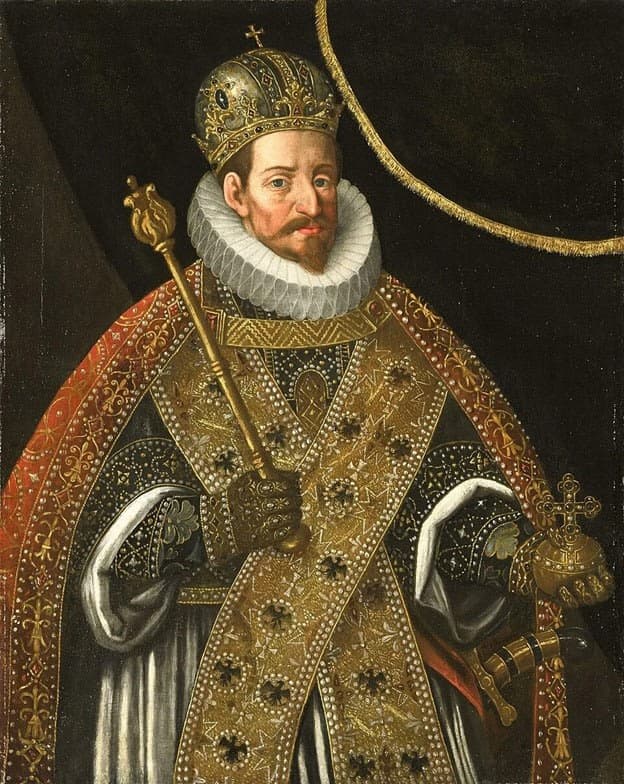

Born in the brilliant Austrian capital of Vienna, Matthias entered the world as the third son of the powerful Emperor Maximilian II and his wife Maria of Spain.
From the very beginning, Matthias was destined to become part of the vast dynastic network of the House of Habsburg.
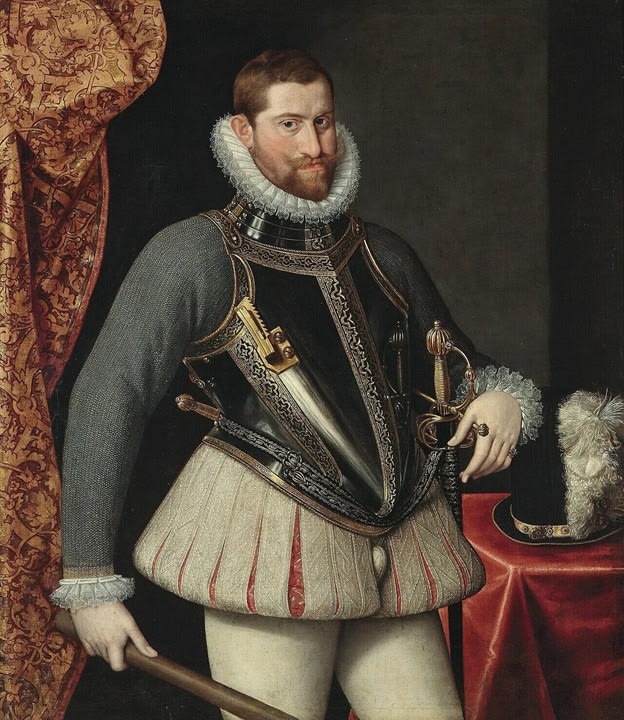
The numerous children of the imperial couple were remarkable for the titles and destinies that awaited them.
Alongside his elder brother Rudolf, heir to the throne and future Emperor Rudolf II, Matthias grew up with his brothers Ernest, Maximilian, who would become Grand Master of the Teutonic Order in 1585, Albert, future Archbishop of Toledo and governor of the Netherlands, and Wenceslaus, who was destined to become Grand Prior of the Order of Malta in Castile.
Matthias also had six sisters whose marriages strengthened the influence of the dynasty.
His sister Anna became the wife of King Philip II of Spain, while Elisabeth ascended the French throne alongside King Charles IX.

When Maximilian II died, Matthias’s familiar world collapsed.
Under the rules of dynastic succession, the family’s vast possessions and property passed into the hands of the eldest brother, Rudolf.
The remaining sons found themselves in a dependent position.
As a form of compensation, they received financial pensions and appointments to ecclesiastical or governmental offices.
Matthias, however, was an ambitious young prince and had no desire to accept the role of a secondary member of the dynasty.
His first opportunity to establish himself came in 1578.
The States General of the rebellious provinces of the Netherlands, searching for a compromise political figure, invited Matthias to the rebellious Seventeen Provinces and offered him the prestigious office of Governor-General.
The groundwork had already been laid in 1576 during the Imperial Diet of Regensburg, where Matthias had met Gauthier van der Gracht, an envoy of the Netherlandish provinces.
Representatives of a relatively moderate political faction, including the influential Philip III de Croÿ, Duke of Aarschot, secretly reached an agreement with Matthias regarding his appointment.
It was an extraordinarily bold move.
The arrangement was made against the direct wishes of Matthias’s uncle, the powerful King Philip II of Spain, who was the hereditary ruler of those territories, and without the knowledge of Matthias’s reigning brother, Emperor Rudolf II.
Matthias accepted the proposal and traveled to the Netherlands.
Philip II, as expected, refused to recognize the legality of his appointment.
While holding the office, Matthias demonstrated a preference for compromise and succeeded in establishing principles of religious peace across much of the territory of the United Provinces.
His efforts were not wasted.
Their results were directly reflected in the historic Article 13 of the Union of Utrecht of 1579.
According to this provision, the highly sensitive question of religious freedom would no longer be settled by a central authority but instead at the local level.
Matthias nominally retained his position as governor of the rebellious provinces until the decisive year of 1581, when they formally deposed Philip II and proclaimed their complete independence.
Realizing that his role in the north had come to an end, Matthias returned to his native Austria.
After returning in 1583, the archduke settled in Linz, surrounding himself with a small but loyal court.
During these years, he desperately sought a political position worthy of his status.
He made several unsuccessful attempts to secure election to the bishoprics of Münster, Liège, and Speyer.
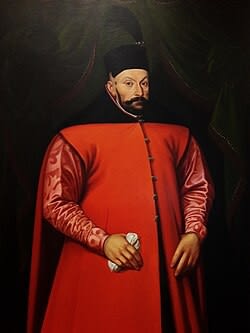
In 1586, complicated negotiations over the possibility of succeeding to the Polish throne after the death of King Stephen Báthory proved equally unsuccessful.
Matthias also actively pursued the regency of Tyrol and Further Austria.
It should be noted, however, that in 1595 he eventually succeeded his uncle, Archduke Ferdinand II of Austria, as heir to Further Austria.

The archduke’s real opportunity finally came in 1593.
When his brother Ernest was appointed Governor-General of the Spanish Netherlands, traveling there to begin exercising actual authority in 1594, Matthias finally received the long-awaited government of Austria.
Power, however, brought a heavy burden.
Almost immediately, Matthias was forced to confront an active and increasingly bitter struggle by the Protestant estates, which sought to defend their religious rights.
The situation within the country deteriorated rapidly.
The Long Turkish War required continuous recruitment of troops and the imposition of exceptionally heavy taxation.
Popular desperation eventually erupted into bloodshed.
In 1595 and again in 1597, peasants in Upper and Lower Austria launched mass uprisings.
They hoped to attract the emperor’s attention and initiate negotiations, but Matthias responded harshly, suppressing the peasant revolts with mercenary armies and considerable bloodshed.

After the brutal suppression of these revolts, Matthias’s worldview and religious policy changed dramatically.
Whereas Protestants had previously been present at his court, he now adopted a severe and uncompromising policy of Counter-Reformation.
From 1599 onward, Melchior Klesl, Bishop and Administrator of Wiener Neustadt, became his chancellor and principal adviser.
Klesl was a convinced and passionate supporter of the Catholic Counter-Reformation.
Matthias had already entrusted him with the nominal role of commander-in-chief during the difficult war against the Ottomans in 1594–1595 and again in 1598–1600, and also appointed him as his personal representative to the Hungarian Diet.

While Matthias consolidated his authority, the entire Habsburg dynasty watched with growing alarm as the psychological condition of the aging Emperor Rudolf II deteriorated.
After the death of their brother Ernest in 1595, Matthias became the eldest of the surviving archdukes.
Beginning in 1599, he repeatedly but unsuccessfully attempted to persuade the childless Rudolf to settle the question of succession officially.
The emperor, increasingly consumed by melancholy and paranoia, categorically rejected all such demands.
The political crisis reached its climax in 1604, coinciding with the uprising of Stephen Bocskai in Hungary.
At first Matthias proceeded cautiously, attempting to avoid open conflict with his powerful brother.
His chancellor, Bishop Klesl, however, persistently encouraged the archduke to lead an open confrontation, which would later become known in history as the “Brothers’ Quarrel.”
A decisive step had already been taken in November 1600 in the Austrian town of Schottwien.
Archdukes Matthias, Maximilian, and Ferdinand secretly concluded an agreement to coordinate their actions against the increasingly unstable monarch.
Several years later, on April 25, 1606, a historic document was signed in which the brothers openly declared Rudolf incapable of governing.
They formally recognized Matthias as head of the dynasty and began systematically removing the emperor from the mechanisms of government.
By this stage, Matthias was already behaving as an independent sovereign.
It was Matthias, rather than Rudolf, who brought the war with the Ottoman Empire to an end by concluding the decisive Peace of Zsitvatorok.
In the same year, 1606, he also demonstrated considerable diplomatic flexibility by ending the conflict in Hungary.
He granted the Hungarians freedom of religion and guaranteed Transylvania the important future right to elect its own princes independently.
At the time, Transylvania was effectively an autonomous part of Hungary while formally remaining under Ottoman suzerainty, during the unusual period of Ottoman history known as the “Sultanate of Women.”


When unrest again broke out in Hungary and rapidly spread into parts of Austria and Moravia, Matthias skillfully exploited the growing opposition in his struggle against Rudolf.
In 1608, at Pressburg, he openly joined the rebellious Hungarian Diet and the estates of Upper and Lower Austria.
Soon afterward, he also secured political support in Moravia.
In April 1608, Matthias marched toward Prague at the head of loyal troops and laid siege to the imperial capital.
Although he failed to win over the influential Bohemian estates completely, military pressure achieved its objective.
Rudolf was broken and forced to begin negotiations.
In June 1608, he signed a humiliating peace settlement.
The Habsburg lands were divided.
Rudolf nominally retained only Bohemia, Silesia, and Lusatia, while Matthias acquired the richest and most strategically important territories: Hungary, Austria, and Moravia.
The transfer of power, however, produced new complications and triggered the famous “homage dispute.”
Feeling victorious, Matthias attempted to reverse the traditional sequence of political obligations.
He refused to confirm the estates’ ancient privileges before they first rendered homage to him — the solemn oath of loyalty to their ruler.
The local nobility was outraged.
Since most of the estates in Austria and Moravia were Protestant, they immediately united in an influential political association known as the Horner Confederation, or Horner Bund.
They displayed remarkable determination and refused to swear allegiance to Matthias until he was legally forced to guarantee their religious freedoms.
The Confederation proved so influential that it continued to exist until the tragic beginning of the Thirty Years’ War.
Matthias’s authority continued to grow.
On May 23, 1611, he was solemnly crowned King of Bohemia.
Later that same year, on December 4, he entered into a lawful marriage with his cousin Archduchess Anna of Austria, also known as Anna of Tyrol, daughter of his uncle Ferdinand II.
The marriage, however, remained childless.
No legitimate heir survived to adulthood, although rumors and later chronicles attributed an illegitimate son to the emperor by an unidentified woman, supposedly known as Matthias of Austria.

Finally, when the sick and exhausted Rudolf died on January 20, 1612, Matthias was elected Holy Roman Emperor.
Beginning in 1612, the imperial court and the principal administrative institutions were gradually transferred from Rudolf’s mystical residence in Prague back to Vienna.
Matthias was a very different type of ruler from his brother Rudolf.
The new emperor displayed far less interest in fine art, magic, and alchemy.
As a result, many of the famous artists associated with Rudolf’s Prague court soon left imperial service.
Matthias nevertheless maintained warm and close relations with the distinguished painter Lucas van Valckenborch.
Out of respect for the status of his deceased brother, Matthias even commissioned a magnificent sceptre and orb specifically for Rudolf II’s personal crown.
His reign also left an architectural and historical mark upon Vienna.
His wife, Empress Anna, founded the famous Capuchin Church and the Imperial Crypt, which would later become the principal burial place of the Habsburg dynasty.
A famous Viennese legend is also associated with Matthias.
According to tradition, while hunting he discovered a remarkable spring on the site where Schönbrunn Palace now stands.
The astonished emperor is said to have exclaimed:
“Look, what a beautiful spring!”
In German, schön means “beautiful” and Brunn or Brunnen means “spring” or “well,” supposedly giving the area its famous name.


After ascending to the highest throne in Europe, Matthias continued to rely upon his loyal associate Klesl, whose influence over state affairs became almost unlimited.
The chancellor devoted himself to achieving a fragile compromise between the Catholic and Protestant states of the Holy Roman Empire, hoping to preserve the unity of the realm.
Such a conciliatory policy suited Matthias.
During his struggle with Rudolf, he had already been forced to grant religious concessions in Austria, Moravia, and Hungary in order to maintain political support.
At the same time, the emperor was capable of acting harshly when necessary.
For example, he imprisoned the formidable Georg Keglević, commander-in-chief, general, Vice-Ban of Croatia, Slavonia, and Dalmatia, and, from 1602, a baron in Transylvania, although Matthias later released him.
This moderate political course, however, encountered fierce resistance from the radical wing of the Habsburg dynasty.
The uncompromising Catholic members of the family rallied around the emperor’s brother, Archduke Maximilian.
His primary objective was to secure the succession for the deeply committed and militantly Catholic Archduke Ferdinand, the future Emperor Ferdinand II.

Tension within the Empire continued to rise.
The Bohemian Protestants, increasingly fearful that their religious freedoms would be attacked, strongly opposed Catholic officials appointed by Matthias.
The election in June 1617 of Archduke Ferdinand, whom they deeply distrusted, as King of Bohemia provoked an explosive reaction.
The simmering conflict eventually reached its climax in a major revolt by the Bohemian Protestant estates.
The vortex of these tragic events forced the increasingly weakened Matthias to order the imprisonment of his loyal chancellor Klesl and formally change political direction.
By this point, however, Matthias was already an aging and sick man.
Physically incapable of stopping them, he watched as the aggressive supporters of Maximilian gradually took complete control over the affairs of government.
Emperor Matthias died of natural causes on March 20, 1619, at the age of sixty-two.
He left the Holy Roman Empire on the threshold of one of the bloodiest wars in European history.
His successor was Ferdinand, who by the time of Matthias’s death already held the crowns of Bohemia and Hungary.
The burial of the imperial couple became a separate chapter of Habsburg history.
Because the great Imperial Crypt beneath the Capuchin Church, founded by Anna, had not yet been completed at the time of their deaths, Anna, who died in 1618, and Matthias were initially laid to rest temporarily within the Queen’s Monastery of St. Mary.
Only years later, in 1633, were their remains ceremonially transferred to the Imperial Crypt.



