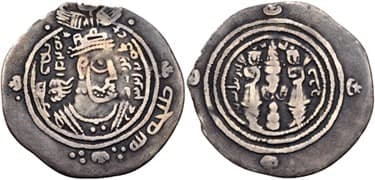

Marwān was born in 623 (according to other accounts, in 626) into one of the most influential families of Mecca. His father, al-Ḥakam ibn Abī al-ʿĀṣ, belonged to the Umayya clan the apex of the Qurayshite aristocracy. Although the Quraysh long opposed the new faith, Marwān’s family accepted Islam in 630 after the conquest of Mecca. The future caliph personally knew the Prophet Muhammad, which gives historians grounds to count him among the ṣaḥāba (Companions). His mother, Āmina bint ʿAlqama, came from the Kināna clan, further strengthening his ties to the tribal elite of the Ḥijāz.
Marwān’s true political ascent began under the third caliph his kinsman ʿUthmān ibn ʿAffān (644–656). Marwān distinguished himself as a capable warrior in campaigns against the Byzantines in Carthage, where he seized enormous spoils that became the foundation of his immense wealth. Soon afterward he assumed the post of kātib (secretary) to the caliph and likely served as an overseer of the treasury.

Historians note that Marwān wielded enormous influence over the aging ʿUthmān. He was accused of nepotism and of pushing controversial decisions that ultimately turned the elites of Kufa and Egypt against the caliph. The most fateful episode was the intercepted letter seized by Egyptian rebels ordering their execution, allegedly issued in ʿUthmān’s name. Many believe Marwān himself authored the letter. In June 656, when the caliph’s house was besieged, Marwān defended his patron to the last with sword in hand and was severely wounded in the neck, surviving only thanks to the aid of the healer Fāṭima bint Aws.
After ʿUthmān’s murder, Marwān became one of the chief ideologues of vengeance. In December 656, during the Battle of the Camel, he fought on ʿĀʾisha’s side against ʿAlī ibn Abī Ṭālib. In the heat of battle, Marwān committed an act that underscored his resolve: he personally killed Ṭalḥa ibn ʿUbaydallāh with an arrow his own ally, whom he nevertheless considered complicit in inciting opposition to ʿUthmān.

After ʿAlī’s victory, Marwān displayed remarkable flexibility: he pledged allegiance to the new caliph, received a pardon, but soon fled to Syria to join Muʿāwiya. There he took part in the Battle of Ṣiffīn (657), which definitively entrenched the community’s split.
During the era of Muʿāwiya I (from 661), Marwān held the governorships of Bahrain and—twice Medina. Although Medina had lost its status as capital, it remained a cultural and religious center. Marwān chafed at his role as a “provincial ruler,” watching with jealousy the successes of his cousin in Damascus.

Muʿāwiya, for his part, treated Marwān warily, seeing in him and in his numerous Abū al-ʿĀṣ clan a threat to the Sufyānid line. This rivalry led Muʿāwiya to adopt his half-brother Ziyād ibn Abīhi to counterbalance Marwān’s ambitions. Nevertheless, in 670 Marwān rendered an important service to the dynasty by preventing Ḥasan ibn ʿAlī from being buried beside the Prophet an act that could have strengthened the position of the ʿAlids.
The death of Muʿāwiya I in 680 and the subsequent reign of Yazīd I plunged the Caliphate into chaos. As the leading Umayyad figure in the Ḥijāz, Marwān demanded harsh measures against Ḥusayn and Ibn al-Zubayr. After Ḥusayn’s death at Karbalāʾ and the uprising in Medina in 683, Marwān was expelled from the city by Ibn al-Zubayr’s forces and fled to Syria.

At the beginning of 684, after the sudden death of the young Muʿāwiya II, the Umayyads stood on the brink of extinction. Marwān was ready to recognize Ibn al-Zubayr, but ʿUbaydallāh ibn Ziyād persuaded him to put forward his own candidacy. At the great tribal council in Jābiya in June 684, Marwān demonstrated masterful intrigue. He convinced the chiefs that the Caliphate needed an experienced, mature leader rather than the young Khālid (Yazīd’s son).
On June 22, 684, Marwān was proclaimed caliph. This marked a victory for the Yamānī (southern/Yemenite) tribal bloc over the Qaysites, who supported Ibn al-Zubayr.

Marwān’s reign was short but extraordinarily productive. In August 684, at the Battle of Marj Rāhiṭ, he utterly defeated the Qaysite army, securing Syria. By the spring of 685, he expelled the Zubayrid governor from Fusṭāṭ (Egypt) and installed his son ʿAbd al-ʿAzīz as provincial governor.
Marwān I died in the spring of 685 (April or May). A legendary account claims that his wife Fākhita strangled him in his sleep-in revenge for an insult, but modern historians tend to believe he fell victim to the plague that was ravaging Syria.
Marwān’s chief political achievement before his death was the repudiation of the Jābiya agreements. He designated his sons ʿAbd al-Malik and ʿAbd al-ʿAzīz as successors, thereby definitively establishing the principle of direct hereditary succession to power.


