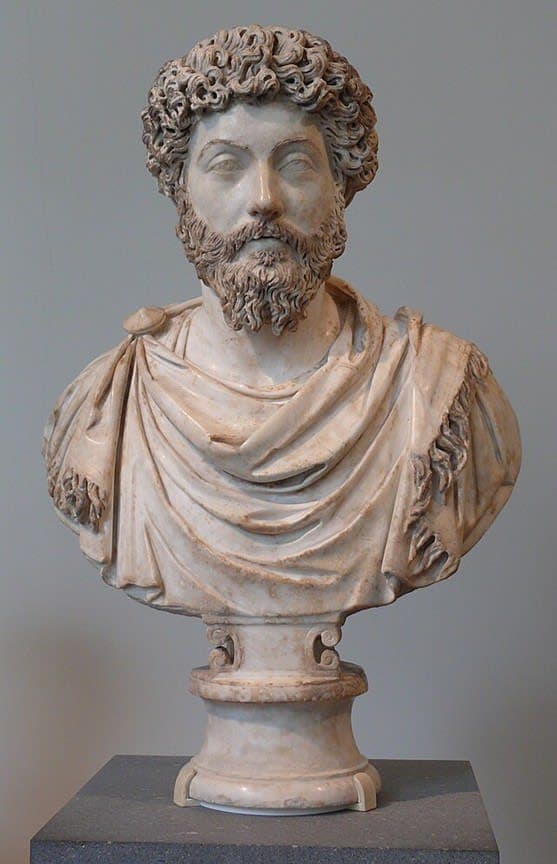
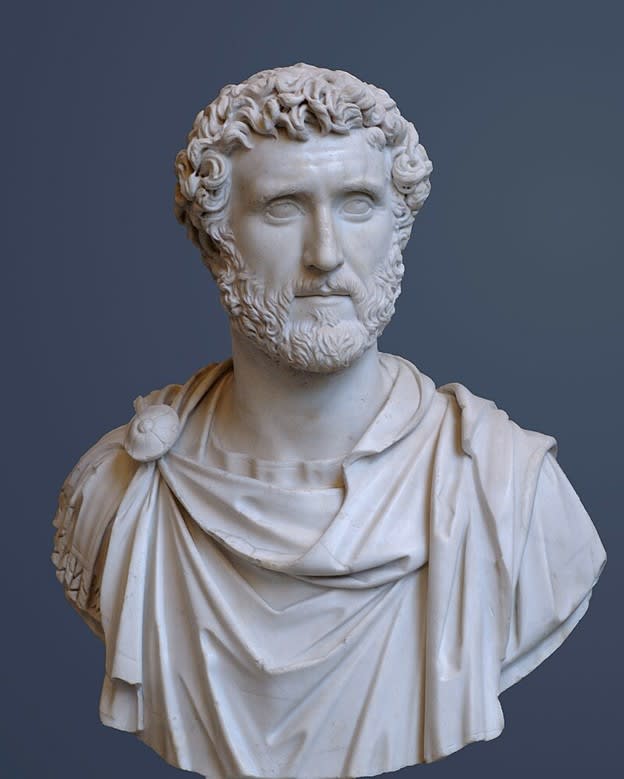
The future emperor Marcus Aurelius belonged to a senatorial family of Spanish origin. His great-grandfather, Annius Verus, moved to Rome from Baetica and under Emperor Vespasian was enrolled among the patricians. His grandfather, also named Marcus Annius Verus, held the consulship three times and married Rupilia Faustina, a great-niece of Trajan.
Marcus Annius Verus later known to history as Marcus Aurelius was born in Rome on April 26, 121 CE. He was adopted at a young age, and in 139, after the death of his adoptive father, he was adopted by Emperor Antoninus Pius. Thus, he became Marcus Aelius Aurelius Verus Caesar.

Marcus Aurelius received an excellent education. Even during Hadrian’s lifetime, he had been slated for the quaestorship. In 138 he assumed that office and began his administrative career. In the same year he was betrothed to his cousin, Annia Galeria Faustina, the daughter of Antoninus Pius. They had twelve children, but only six survived to adulthood, including the future emperor Commodus.

In 140 Marcus Aurelius was appointed consul and proclaimed Caesar. In 145 he became consul for the second time. At the age of twenty-five he turned to philosophy; his chief teacher was the Stoic Quintus Junius Rusticus.
On January 1, 161, Marcus Aurelius entered his third consulship. In March of that year Antoninus Pius died, and Marcus Aurelius began a joint rule with his adoptive brother Lucius Verus. Their co-reign continued until Lucius’s death in 169, after which Marcus Aurelius ruled alone.
He inherited an empire in a state of continual warfare. Immediately after Antoninus Pius’s death, the Parthians invaded Roman territory and inflicted two defeats on Rome; peace was concluded in 166, by which Northern Mesopotamia passed to Rome.
That same year Germanic tribes invaded the Roman lands along the Danube; the Marcomanni advanced as far as northern Italy. Marcus Aurelius and Lucius Verus led a campaign against the barbarians. During the war against the Germans and Sarmatians, unrest also broke out in Egypt.


In 178 Marcus Aurelius led another campaign against the Germans and achieved major successes. But in 180 an epidemic of plague (probably smallpox) broke out in his army, and on March 17, 180, Marcus Aurelius died of the disease at Vindobona (modern Vienna).
Marcus Aurelius consistently emphasized his respect for the Senate and paid great attention to the administration of justice. In Athens he established four chairs of philosophy for the Academic, Peripatetic, Stoic, and Epicurean schools placing the professors on the state payroll.
He left philosophical notes written in Greek, known collectively as To Himself better known today as the Meditations. As a representative of late Stoicism, he focused chiefly on ethics. He held that a person consists of three elements: body, soul (pneuma), and reason (nous), and that reason is the primary and guiding element.
Marcus Aurelius believed that to attain happiness one must bring one’s reason into harmony with universal nature.
After his death Marcus Aurelius was deified. In ancient historical tradition his reign is counted as a “golden age.” He was dubbed “the philosopher on the throne” and is remembered as one of the greatest Roman emperors.


