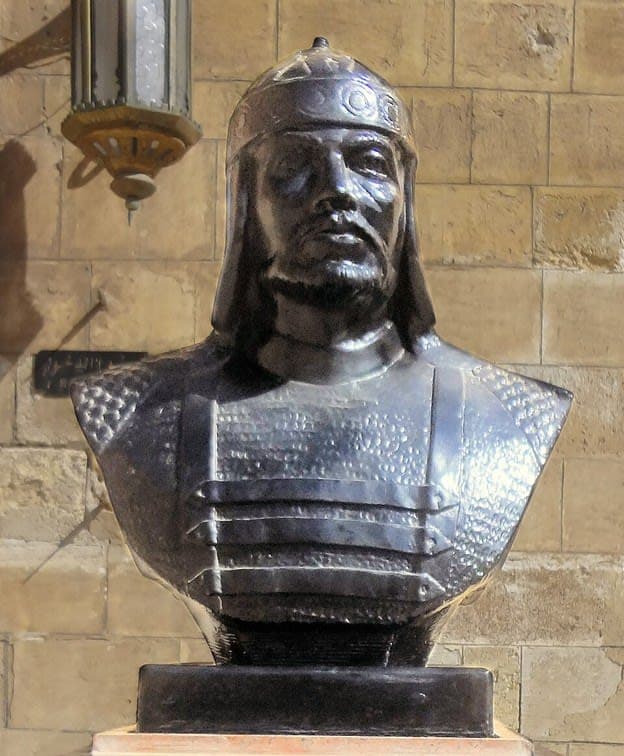
The story of the great sultan begins in the Dasht-i Kipchak — the “Cuman Steppe,” stretching between the Volga and the Yaik (Ural) rivers. Historians have debated his exact происхождение for centuries. According to the most widely accepted version, recorded by the 14th-century Egyptian chronicler al-‘Ayni, Baybars was an ethnic Kipchak. Al-Nuwayri specifies that he belonged to the Toksoba or Dortoba clan, while modern scholars such as S. A. Amanzholov mention the Burjoglu clan. There are also alternative theories: V. V. Ushnitsky links him to the Central Asian Tatars, while in Crimea people firmly believe that the sultan’s homeland was the Crimean steppe — not without reason, for after becoming ruler, Baybars sent rich gifts to Solkhat (Old Crimea) and ordered a mosque to be built there, the ruins of which survive to this day.


Baybars’s fate took a dramatic turn in his youth, when he was captured by the Mongols and sold into slavery. In Damascus, the merchant al-‘Imad al-Da’igh bought him for 800 dirhams, but soon discovered that the young man had a blemish in one eye. Considering this a bad sign or a defect, the merchant annulled the purchase. His new owner became the mamluk emir ‘Ala al-Din Aytigin al-Bunduqdari. It was from him that Baybars received the first addition to his name — al-Bunduqdari. The young slave was sent to the Nile island of Rawda for harsh military training, where he immediately stood out among the others. His military talents were so obvious that when his master fell from favor, Baybars was not sold at the market but instead transferred into the personal guard of the Egyptian sultan al-Salih Ayyub. By 1246, he was already commanding one of the units of the elite guard.

Baybars’s star as a military commander rose in 1250. In the battles of al-Mansurah and Fariskur, he dealt a crushing blow to the Seventh Crusade. King Louis IX of France, later known as Saint Louis, was taken prisoner, and the mamluks realized that they were now the real power in Egypt. When the new sultan Turan Shah began showing arrogance toward the mamluk military caste, Baybars did not hesitate. On May 2, 1250, he led a group of emirs that killed the sultan, bringing the Ayyubid dynasty in Egypt to an end. Thus began the era of mamluk rule under Shajar al-Durr and Emir Aybak.
However, the road to the throne was thorny. Internal strife and Sultan Aybak’s fear of the growing influence of military commanders led to the treacherous murder in 1255 of Baybars’s patron, Emir Aktay. Baybars, together with the future sultan Qalawun, fled to Syria. He wandered and served local rulers until a mortal threat loomed over the Islamic world: the Mongol invasion of Hulagu Khan. In November 1259, power in Egypt was seized by Qutuz, who understood that without Baybars the Mongols could not be stopped. He called the exile back, granting him the town of Qalyub and oases in the Libyan Desert.
In 1260, the Mongols, having destroyed the Abbasid Caliphate of Baghdad, demanded the capitulation of Egypt. Qutuz and Baybars answered by executing the envoys. The decisive clash took place on September 3, 1260, at Ayn Jalut. Baybars brilliantly played the role of the “bait”: he employed the tactic of feigned retreat, luring the Mongol corps of Kitbuqa into an ambush. The mamluks struck from three sides, the Mongol army was annihilated, and the myth of Mongol invincibility was shattered.


Yet the triumph was overshadowed by resentment. Baybars expected to receive Aleppo as his governorship, but Qutuz refused him. A thirst for revenge and ambition led to a new conspiracy. On October 24, 1260, during the return march to Cairo, Baybars approached the sultan, ostensibly to kiss his hand in gratitude for a gift, and struck him a mortal blow with a sword. The emirs immediately proclaimed Baybars the new sultan. Upon entering Cairo, he showed generosity toward his origins: he elevated his first master Aytigin, making him governor of Damascus.
Having become sultan, Baybars embarked on unprecedented foreign-policy activity. He understood that Egypt needed allies, and he found them in the Golden Horde and its ruler Berke Khan. In 1262, he even proposed that Berke embrace Islam, creating a powerful alliance against the Ilkhans of Iran. At the same time, Baybars began the systematic destruction of the Crusader states.

His military campaigns were annual and ruthless: in 1265, Caesarea and Arsuf fell. In 1266, Safed, the seemingly impregnable Templar stronghold, was taken. That same year, Baybars crushed the Armenian Kingdom of Cilicia at the Battle of Mari, capturing Prince Leo. The year 1268 was his most successful. Jaffa and Beaufort Castle fell. But the greatest achievement was the capture of Antioch on May 14. The city, which had been a bastion of Christianity in the East for 170 years, fell in just two days. The spoils were so immense that money was measured by cups. It was then that Baybars wrote his famous mocking letter to Count Bohemond, savoring the details of the destruction.
“This letter contains good news for you... At this moment you are not in Antioch... Otherwise, you would now be dead, captured, or wounded... To save one’s life — that is what the living rejoice in when faced with death.”
In 1271, he captured the residence of the Teutonic Order in the Near East — Montfort Castle — as well as the legendary Krak des Chevaliers, using military cunning with a forged letter. By 1273, Baybars had finally broken the power of the Assassins in the mountains of Syria, bringing them under his control.

In the final years of his life, Baybars continued his expansion: in 1276 he subjugated Nubia, and in 1277 he won his last great victory over the Mongols and their vassals at the Battle of Elbistan.
Death overtook the “Victorious King” on July 1, 1277, in Damascus. The circumstances are shrouded in mystery: a popular legend claims that he accidentally drank poison from a bowl of kumis intended for his enemy. However, the historian al-Maqrizi writes of a mundane but deadly illness for that era — dysentery or severe diarrhea — which exhausted the sultan over the course of two weeks. To avoid panic in the army, the ruler’s death was concealed, his body being carried in closed litter until the army reached Cairo.

Baybars left behind not only the ruins of enemy fortresses, but also a flourishing state. He created one of the finest postal systems of the Middle Ages, the barid, which made it possible to deliver news from Cairo to Damascus in just four days.
He built canals and bridges, patronized scholars such as the physician and biologist Ibn al-Nafis, and even established a “cat garden” in Cairo, providing animals with food and shelter. His life became the basis of the epic romance Sirat al-Zahir Baybars, and he himself became a national hero both in the Arab world and in Kazakhstan.


