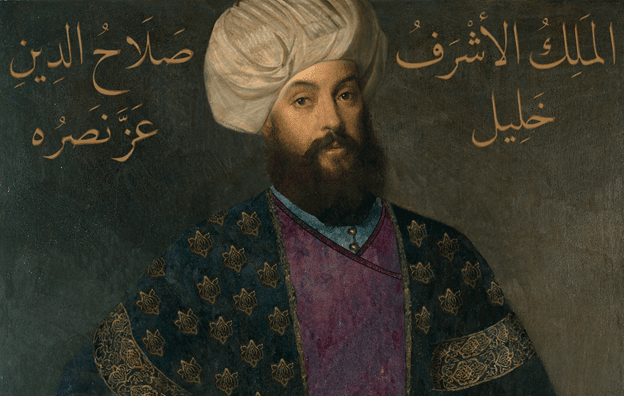

Al-Ashraf Khalil was born in Cairo, into the family of the great Sultan Qalawun. His path to power was not easy: for a long time, his elder brother al-Salih Ali was considered the heir, and only his sudden death in 1288 opened the road to the throne for Khalil. However, Sultan Qalawun harbored a strange distrust of his son. Until the very end, he refused to sign the official document confirming Khalil’s right to the throne. The master of ceremonies and judge Fath al-Din Abd al-Zahir preserved the sultan’s words for history: “I cannot allow Khalil to rule over the Muslims.”
But fate decided otherwise. Seeing the blank space left unfilled in the decree, Khalil uttered a prophetic phrase: “The sultan denied it to me, but God granted me this right.” After his father’s death in November 1290, Khalil began his reign with a harsh purge of the opposition. He arrested the vice-sultan Turuntay and the emir Kitbugha (the latter was later pardoned), placing his own men in key positions: Baydara al-Mansuri and the loyal vizier Ibn al-Salus, a former merchant from Damascus. Having secured his rear, he turned his gaze to what his father had not managed to finish — Acre.

At that time, Acre was not merely a city, but the impregnable capital of the remnants of the Kingdom of Jerusalem, protected by a double line of walls and twelve powerful towers. Khalil approached the matter with mathematical precision and colossal scale. He ignored the gifts and pleas of the Crusader delegation led by Philip of Mainboeuf, throwing the envoys into prison.
The sultan gathered under his banners the forces of all Egypt and four Syrian armies (from Damascus, Hama, Tripoli, and al-Karak). Khalil’s siege train was the finest of its age: enormous catapults called al-Mansuri (“The Victorious”) and lighter mangonels nicknamed “the black bulls” were meant to grind the city’s walls to dust.
On April 5, 1291, the ring closed. Khalil pitched his red pavilion (dihliz) on a hill by the seashore. The 43 days of siege became hell for the defenders. Sorties by the Templars and Hospitallers under cover of night ended in failure — the knights became entangled in the ropes of the Muslim tents and died under a hail of arrows. Even the arrival of King Henry II of Cyprus with reinforcements did not change the situation.
At dawn on May 18, 1291, the general assault began. Under the thunder of drums loaded onto 300 camels, the Mamluks stormed the “Accursed Tower.” The Templar Grand Master Guillaume de Beaujeu fell in battle, and King Henry fled on galleys. The city turned into a field of slaughter. The last stronghold — the Templar citadel — held out until May 28. When the sultan’s men entered it for negotiations, discipline broke down, a fight erupted, and the Templars killed those who had entered. In response, Khalil ordered the citadel to be stormed. Its walls collapsed, burying beneath them both the last Knights of the Temple and the sultan’s soldiers.
The fall of Acre triggered a domino effect. Realizing that resisting Khalil was impossible, the Crusaders began abandoning their centuries-old possessions:
On May 19, 1291, Tyre was occupied without a fight — a city even Salah al-Din had failed to take. On July 14, 1291, Sidon fell after Grand Master Theobald Gaudin fled with the treasury to Cyprus. On July 31, 1291, the Mamluks entered Beirut and Haifa. In August 1291, Tartus was captured.
The Crusaders retained only the tiny island of Ruad (which would not fall until 1302). In 1292, Khalil campaigned against the Armenian fortress of Qal‘at al-Rum, renaming it the “Castle of the Muslims.” Cilician Armenia was forced to sue for peace, ceding the cities of Marash and Behesni to the sultan. Khalil’s triumph was absolute — he completed the work that had begun a hundred years before him.


However, military victories blinded the sultan. Khalil began to display an arrogance that was not forgiven in the Mamluk milieu. He started replacing the old Turkic guard with Circassians, spoke rudely to the emirs, and signed decrees only with the brief initials “KH,” ignoring traditional court etiquette. His favorite, Ibn al-Salus, who had no military background, provoked the fury of the vice-sultan Baydara.
The denouement came in December 1293 during a falcon hunt at Kom Turugah. A quarrel over taxes collected in Alexandria became the final straw. Khalil publicly insulted Baydara. Baydara, joining forces with Emir Lajin and other conspirators, attacked the sultan on December 14.
Al-Ashraf Khalil was killed. Baydara attempted to proclaim himself sultan, but the guard of the slain Khalil remained loyal to the memory of their leader. Baydara was captured and executed by Kitbugha, and his head was sent to Cairo. The vizier Ibn al-Salus was beaten to death. To avoid chaos, Khalil’s death was concealed for some time, and decrees were issued in his name until his nine-year-old brother al-Nasir Muhammad was placed on the throne.
Al-Ashraf Khalil ruled for only three years and two months, but in that short span he accomplished what had seemed impossible: he permanently erased the Latin states from the map of the East. He remained in memory as a stern warrior and a man of sharp intellect, whose life was cut short at the height of his glory.


