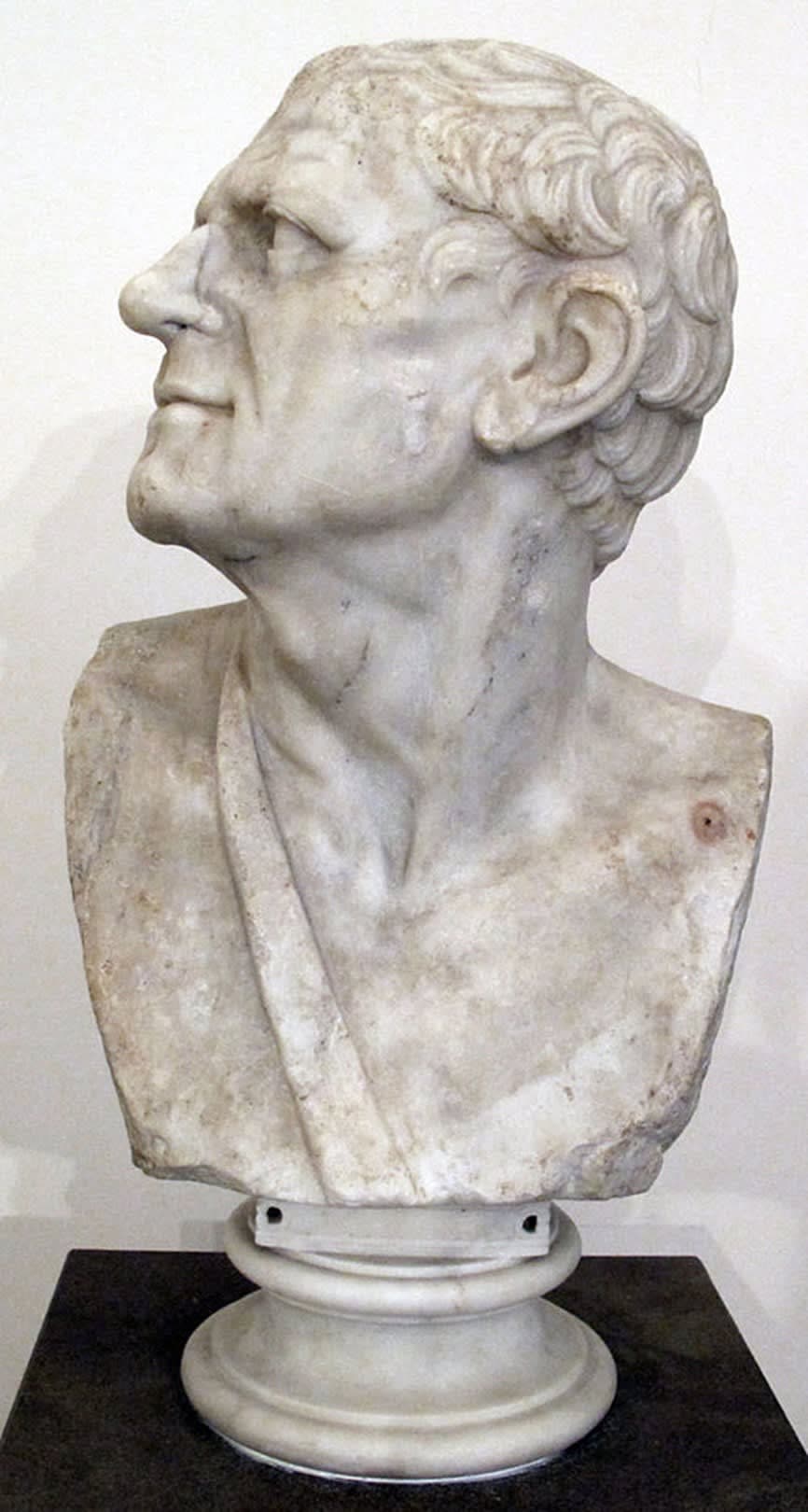

Lysimachus was born in the Macedonian capital, Pella, sometime between 361 and 351 BC. His father, Agathocles, according to some versions, came from Thessaly and was called a mere buffoon by his detractors. In reality, however, the family of Agathocles held a firm position at the court of Philip II. Lysimachus’s brothers served as envoys and pages, while Lysimachus himself was honored with becoming one of Alexander the Great’s seven somatophylakes — personal bodyguards.
It was during this period that the most famous legend about Lysimachus arose — his fight with a lion. It was said that once, angered at Lysimachus for helping the disgraced Callisthenes, Alexander ordered him to be thrown into a cage with a ferocious beast. But Lysimachus did not flinch: wrapping his hand in his cloak, he thrust it into the animal’s mouth and tore out its tongue, killing the lion with his bare hands. Seeing this, the king’s anger turned to mercy, and he forever respected his bodyguard. According to another, more prosaic version, Lysimachus simply saved Alexander during a hunt in Syria by killing a lion that had already torn his shoulder down to the bone.


Lysimachus accompanied Alexander throughout the entire great Eastern campaign. He was beside the king in Maracanda when Alexander, in a fit of rage, killed Cleitus, and he tried to prevent the tragedy. He fought in India, was wounded during the assault on Sagala, and ultimately received an honorary golden crown at Susa for his services. Even then, the seer Aristander predicted royal power for him after seeing Alexander’s diadem accidentally touch Lysimachus’s head while stopping the blood from a wound.

After Alexander’s sudden death in 323 BC, Lysimachus received Thrace in the division of the empire. At that time it was one of the most restless and “wild” provinces. The local tribes, led by the Odrysian king Seuthes III, rose in revolt, seeking to throw off the Macedonian yoke. Lysimachus, with only 4,000 infantry and 2,000 cavalry, marched against a Thracian army of 28,000 men. The battle was incredibly fierce and produced no clear victor, but Lysimachus’s veterans inflicted such heavy losses on the enemy that a temporary lull followed.

Lysimachus understood that to hold power he needed not only swords, but alliances. He strengthened his position through marriage to Nicaea, the daughter of the powerful governor of Macedonia, Antipater. While the other Diadochi tore the empire apart in the First and Second Wars, Lysimachus methodically fortified his frontiers. In 309 BC, he founded a new capital — Lysimachia on the Thracian Chersonese — making it a symbol of his independence.
In 313 BC, he had to confront a revolt of the Black Sea cities — Callatis, Odessos, and Istros — supported by the Scythians and by the same Seuthes III. Lysimachus acted with lightning speed: he successively defeated the Thracians in the mountain passes of Haemus, destroyed Antigonus’s landing force, and crushed the rebellion, confirming his status as master of the region.
Lysimachus’s true hour of glory came during the Fourth War of the Diadochi. Having entered an alliance with Seleucus, Cassander, and Ptolemy against Antigonus Monophthalmus, he invaded Asia Minor in 302 BC. While his ally Prepelaus captured Ephesus and Sardis, Lysimachus maneuvered skillfully, avoiding a decisive battle until the main forces of Seleucus arrived.
The decisive Battle of Ipsus in 301 BC changed the map of the world. Antigonus fell, and Lysimachus, who until then had possessed only “miserable Thrace,” received vast territories in Asia Minor. His kingdom became one of the richest and most powerful states of the Mediterranean. At this time, he changed wives: he divorced Amastris in order to make a political alliance with Ptolemy I by marrying his daughter Arsinoe II.


At the beginning of the third century BC, Lysimachus turned his gaze northward, beyond the Danube, deciding to subdue the tribes of the Getae. This campaign ended in unexpected humiliation. First, Lysimachus’s eldest son Agathocles was captured by the Getic king Dromichaetes. Trying to rescue his son, Lysimachus himself led an army of 100,000 men, but he was lured into waterless wastelands. His army, exhausted by thirst, was forced to surrender.
The scene in captivity became classic. Dromichaetes arranged a feast at which the Macedonian prisoners were served refined dishes on golden tables, while the Getae themselves ate simple food from wooden boards. The Getic king asked Lysimachus: “Why did you, having such a luxurious way of life, come to our poor lands, where even survival is difficult?” Lysimachus, admitting his mistake, made peace, gave his daughter to Dromichaetes in marriage, and returned home, leaving the lands of the Getae in peace.
In 287–285 BC, Lysimachus reached the height of his glory. He drove Pyrrhus out of Macedonia, seized Paeonia, and began to rule a vast kingdom uniting Thrace, Macedonia, and Asia Minor. He accumulated colossal treasures — in Pergamum alone, 9,000 talents of gold were stored.

Yet disaster was ripening within his own house. His young wife Arsinoe II, wishing to secure the throne for her own children, began weaving intrigues against the heir to the throne, Agathocles. In 283–282 BC, Lysimachus, blinded by suspicion or by his wife’s influence, ordered the execution of his eldest son. This caused a wave of outrage: Agathocles’s friends and his widow Lysandra fled to Seleucus, urging him to war.
War with the last of Alexander’s companions, Seleucus Nicator, became inevitable. The aged Lysimachus — he was about 70 to 80 years old — personally led the army. In February 281 BC, on the plain of Corupedium in Lydia, the final battle of the great Diadochi took place. Lysimachus fell in battle, pierced by the spear of Malacon.

It was said that after the battle, Lysimachus’s body could not be found for a long time among the thousands of fallen. It was discovered only thanks to his faithful dog, which guarded its master’s corpse from vultures for many days. His son Alexander obtained his father’s body from the victors with difficulty and buried it in Lysimachia. With Lysimachus’s death, his kingdom instantly collapsed: his Asian possessions passed to Seleucus, while Thrace and Macedonia were soon swept into the chaos of the Celtic invasion.
Lysimachus remained in history as a contradictory figure. On the one hand, he was a fearless warrior, a pupil of Aristotle, a patron of the sciences, the founder of great cities, and a builder of Ephesus. On the other, he was a cruel and suspicious tyrant who did not spare his own son and tortured thousands of allied soldiers.
His coins, depicting Alexander the Great with the horns of the god Ammon, are considered among the most beautiful of antiquity. They became one of the first examples of how the Diadochi used the image of their great master to legitimize their own power. Lysimachus was an “iron” ruler whose state rested on his personal will — and it collapsed at the very moment when that will faded on the battlefield.


