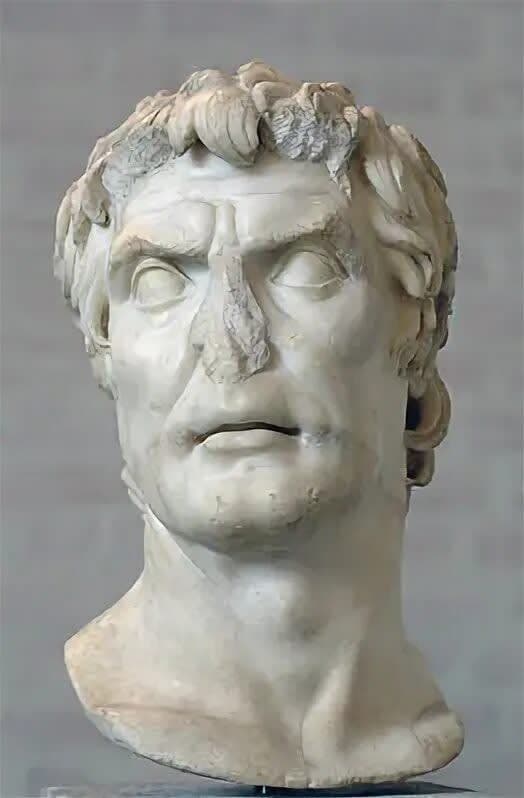

The story of Lucius Cornelius Sulla begins not with the glitter of gold, but with the echo of former greatness. He belonged to the ancient and noble patrician family of the Cornelii, but by the time of his birth in 138 BC, this branch of the family had finally faded and lost its political weight. Sulla’s distant ancestors had once shaped the destiny of Rome: the first known representative of this line was Publius Cornelius Rufinus, dictator in 334 BC, while his descendant, also named Publius Cornelius Rufinus, twice held the consulship, in 290 and 277 BC. Yet Rufinus’s brilliant career ended in disgraceful expulsion from the Senate — a censor caught him violating the sumptuary laws after discovering in his house silverware weighing more than ten pounds, exceeding the permitted limit.
After this scandal, the family of the Sullae withdrew into obscurity for a long time. The future dictator’s great-great-grandfather, Publius Cornelius, the first to adopt the cognomen “Sulla,” was content with the honorable but politically powerless office of priest of Jupiter. Lucius’s grandfather and great-grandfather barely reached the praetorship; the latter, praetor in 186 BC, governed Sicily without leaving behind any great fame. Lucius’s father, who bore the same name as his son, held no high offices at all; it is only known that he was married twice and was not wealthy.
Lucius grew up in conditions that, for a Roman noble, could be called poverty. After the death of his father, who left no will, the fourteen-year-old youth found himself in extremely constrained circumstances. While his peers from wealthy families were beginning military or legal careers, Sulla lived in rented lodgings, not even possessing a house of his own — a mark of extreme poverty for a man of his birth. His fortune was estimated at only 150,000 sesterces, a significant part of which probably went toward paying his father’s debts. Yet despite his need, Lucius received a brilliant education: he had perfect command of Greek and deep knowledge of ancient literature. But instead of practicing eloquence in the Forum, the young Sulla sought comfort in a dissolute way of life. He was seen in the company of comedians, mimes, and drunkards; the biographer Plutarch later noted with indignation that this man could spend whole days in debauchery, becoming completely inaccessible to serious business, although in moments of necessity he displayed incredible energy.

Military fortune smiled on Sulla late — only in 107 BC, when, at about thirty years old, he received the office of quaestor under the consul Gaius Marius. He was to go to North Africa for the Jugurthine War. Skeptics of the time wondered how this pampered lover of banquets would cope with the harsh realities of campaigning. Yet Sulla surprised everyone: within a few months he raised auxiliary cavalry in Italy, transported it to Numidia, and proved his valor in action, quickly winning the boundless respect of the soldiers.

It was in this war that his talent as a diplomat and cunning strategist revealed itself. When the Mauretanian king Bocchus began to waver, Sulla went to him as a legate. Risking his life, passing through lands swarming with enemies, Lucius managed to convince Bocchus that an alliance with Rome was more profitable than supporting the Numidian king Jugurtha. Even when Sulla found himself trapped, face to face with Jugurtha’s superior forces, he showed icy calm, refusing to flee and passing through the enemy camp under the protection of Bocchus’s son Volux. In the end, after secret night negotiations, Sulla achieved the impossible: Bocchus handed Jugurtha over to the Romans. The captured king was delivered personally into Sulla’s hands, and although Lucius immediately brought him to Marius, people in Rome began saying that the true victor in the war was the patrician quaestor. This wounded pride of Gaius Marius became the first stone in the foundation of their future bloody feud.
No sooner had the African campaign subsided than a new calamity fell upon Rome — the invasion of the Germanic tribes of the Cimbri and Teutones. In 104–103 BC, Sulla continued to serve under Marius, holding the offices of legate and military tribune. He subdued the chieftain of the Tectosages, Copillus, and brought the tribe of the Marsi into alliance, but the officer’s growing fame began to frighten Marius. Sensing the commander’s envy, Sulla transferred in 102 to the army of the second consul, Quintus Lutatius Catulus.
Here his talents fully unfolded: he organized the army’s supply system and took part in the great Battle of Vercellae on July 30, 101 BC. While Marius, according to the version of Sulla’s supporters, was vainly searching for the enemy in a thick fog, Catulus and Sulla bore the main Germanic assault in the very center of the battle and secured Rome a complete victory.


Returning to the capital as a hero, Sulla decided that the time had come to restore consular dignity to his family. However, his first attempt to obtain the praetorship ended in failure. The people expected from him lavish games using African beasts, which he supposedly could easily obtain through his friendship with King Bocchus. Sulla learned from his mistakes and, according to rumor, did not disdain bribing the voters; he eventually achieved the praetorship in the mid-90s, most likely in 97 or 93 BC. As urban praetor, he finally met the plebs’ expectations by staging an unprecedented spectacle — the hunting of one hundred lions.
After a year in Rome, Sulla was sent to Cilicia with the rank of proconsul. His mission in Cappadocia was extremely complex: he had to restore to the throne the pro-Roman king Ariobarzanes, who had been overthrown by the protégés of Mithridates VI Eupator and the Armenian king Tigranes II. With only a small detachment, Sulla swiftly defeated the forces of the usurpers and fulfilled the Senate’s order. It was here that his historic meeting with a Parthian embassy took place — the first official contact between the two great powers. Sulla, demonstrating Roman greatness, took the central seat between the Parthian Orobazus and King Ariobarzanes, deeply humiliating Parthia. Orobazus was later executed by his king for allowing such arrogance from a Roman.

In 91 BC, Italy burst into flames: the Italian allies rose in rebellion against Rome. In this bloody slaughter, Sulla finally overshadowed the aging Marius. First, in 90, he fought successfully against the Marsi, and in 89 he led a major offensive in Campania and Samnium. Sulla showed himself to be a brilliant tactician: after defeating the army of Lucius Cluentius, he destroyed tens of thousands of enemies near the walls of Nola.
The siege of the city of Aeclanum became an example of his decisiveness. When the inhabitants asked for time to consider, hoping for reinforcements, Sulla surrounded the wooden walls with brushwood in an hour and set them on fire, forcing the city to surrender. Then came the capture of Pompeii and the taking of the rebels’ new capital, Bovianum. For his exceptional services, Sulla received the “Grass Crown” — an extremely rare award granted by soldiers to a commander who had saved an entire army. The path to the consulship was now open.
The year 88 BC became a turning point in the history of the Republic. Sulla was elected consul together with Quintus Pompeius Rufus. The main objective was the war against Mithridates VI, who had carried out the massacre of Romans in Asia. By lot, the command fell to Sulla, but Marius, hungry for power, entered into an alliance with the tribune Publius Sulpicius Rufus. Sulpicius proposed radical laws: to distribute the newly enfranchised Italian citizens among all the tribes, which would give them control over voting, and, most importantly, to transfer command of the eastern army to Marius.

Riots began. Sulla and Pompeius Rufus tried to resist by declaring public business suspended, but Sulpicius answered with violence. The son of the second consul was killed, and Sulla himself was forced to seek refuge in the house of his enemy Marius in order to survive. Under pressure, he lifted the ban on assemblies, after which Sulpicius passed his laws.
But Sulla did not submit. He fled to his legions in Capua. The soldiers, dreaming of rich eastern spoils, were furious that command was being transferred to Marius. For the first time in Roman history, a sitting magistrate turned his legions against his own city. The officers abandoned the army in horror, unwilling to participate in sacrilege, but six legions — about 35,000 men — entered Rome through the Esquiline and Colline gates. Real fighting broke out in the streets. Marius and Sulpicius tried to arm slaves, but the regular army swept away their resistance.
Having seized Rome, Sulla showed severity: Sulpicius was killed, while Marius was declared an enemy of the state and fled to Africa. Sulla immediately repealed all the tribune’s laws and carried through a series of his own reforms, which became the prelude to his future dictatorship. He limited the power of the tribunes, strengthened the Senate by adding 300 new members, and restored the old system of voting by centuries.
Yet his power was fragile. The people, dissatisfied with the presence of troops, elected as consuls for the following year, 87 BC, Gnaeus Octavius and Lucius Cornelius Cinna. The latter was an open enemy of Sulla. Despite a formal oath of loyalty, Cinna immediately after taking office began legal proceedings against Sulla. But Lucius Cornelius, confident in his star, did not wait for trial. Wishing his accusers “long life,” he sailed east with his loyal army. Ahead of him waited Mithridates, and behind him he left Rome in chaos, soon to be seized again by the Marians.
In 87 BC, Lucius Cornelius Sulla finally left turbulent Italy and landed in Epirus. The First Mithridatic War awaited him — a campaign that would either raise him to the summit of glory or ruin him completely. Because of political strife in Rome, Sulla had delayed his departure for a long year and a half, and during that time the Pontic king Mithridates VI Eupator had managed to put down deep roots in Greece.
Sulla’s path led into Attica, toward Athens, which had become a stronghold of Pontic influence. The siege was long and exhausting. Sulla spared neither men nor history: for the construction of siege engines he ordered the sacred groves of Plato’s Academy and Aristotle’s Lyceum to be cut down. Needing gold to pay his soldiers, he committed sacrilege by plundering the greatest temples of Hellas, including the Delphic oracle, from which countless treasures were removed. On March 1, 86 BC, Sulla found a weak point in the city wall and took Athens by storm. The city drowned in blood; the soldiers were given full right to plunder, and the slaughter was so vast that many Athenians killed themselves rather than witness the death of their homeland. Only after the capture of the Acropolis did Sulla, with a mercy paradoxical for him, spare the city, declaring that he “forgave the few for the sake of the many, the living for the sake of the dead,” paying tribute to Athens’ great past. Piraeus, however, was wiped from the face of the earth, and the arsenal of Philon was destroyed.


The decisive clashes with Mithridates’ general Archelaus took place at Chaeronea in the spring of 86 and at Orchomenus. In these battles, Sulla showed himself to be a brilliant tactician, utterly defeating the superior Pontic forces. His soldiers, struck by his daring, proclaimed him imperator for the first time. Mithridates, realizing the collapse of his ambitions, requested peace. In 85, at Dardanus, Sulla dictated his terms: the king would pay 20,000 talents, hand over part of his fleet, and return to his “ancestral borders.” Sulla was in a hurry — reports were coming from Rome that the Marians had seized power, killed his friend, the consul Octavius, and declared Sulla himself an enemy of the state. Even the new commander sent by Marius, Flavius Fimbria, died as the result of a mutiny, leaving Sulla the sole master of the East.
In 83 BC, Sulla landed at Brundisium. Against him stood a vast but loose Marian coalition. Despite being outnumbered, Sulla acted confidently: he moved along the Appian Way toward Rome, and the nobles who had survived the terror were drawn to him like iron to a magnet. It was then that the future pillars of Rome joined his standards — Quintus Metellus Pius, Marcus Licinius Crassus, and the young Gnaeus Pompey, who brought with him three legions raised from his own estates.

The Marians lost their leader after Cinna’s death in a soldiers’ mutiny, and their resistance began to collapse. Sulla besieged Praeneste, where Gaius Marius the Younger had shut himself in. The climax of the war was the terrible Battle of the Colline Gate in November 82 BC. It was a struggle for the very existence of Rome. When Sulla’s left flank began to waver and he himself came close to defeat, Crassus won on the right flank and saved the situation. The Marians were finally defeated: Gaius Marius the Younger committed suicide, and the heads of executed enemies began to be displayed in the Forum.
Having seized Rome, Sulla decided to legitimize his power in a way not seen for more than a century. At his insistence, the interrex Lucius Valerius Flaccus passed a law appointing Sulla dictator “for the writing of laws and the reconstitution of the republic” — dictator legibus scribundis et rei publicae constituendae. This dictatorship was not limited to the traditional six months: Sulla received power for an indefinite term. Twenty-four lictors walked before him, as before the ancient kings, and the Senate approved in advance all his future and past actions.
Then came the time of terror that entered history under the name of the proscriptions. On November 3, 82 BC, the first lists of persons declared outlaw were posted in the Forum. Anyone who killed a proscribed man and brought his head to Sulla received a reward of two talents of silver. Slaves were granted freedom for doing so, while those who sheltered the condemned faced death. The sons and grandsons of the executed lost citizenship, and their property was sold off for next to nothing to the dictator’s associates. Crassus and Pompey made fabulous fortunes from these confiscations. The lists were expanded three times; they included not only political enemies, but also simply wealthy men whose gardens or villas had caught the eye of Sulla’s followers. The total number of victims reached into the thousands, including 90 senators and 2,600 equites. In that dreadful time, the young Gaius Julius Caesar escaped by a miracle: under pressure from relatives, Sulla spared him, but prophetically remarked that “in this boy there are many Mariuses.”

Having become absolute master, Sulla began a radical reconstruction of the state, seeking to return Rome to an idealized past and permanently strengthen the authority of the Senate.
The curse of the tribunes: He practically destroyed the office of the people’s tribunes, depriving them of the right of legislative initiative and of the possibility of holding any other office in the future. This made the magistracy a “dead end” and stripped it of appeal for ambitious men.
The renewal of the Senate: The dictator increased the number of senators from 300 to 600, enrolling loyal equites and veterans.
Cursus honorum: The Lex Cornelia de magistratibus established strict age requirements — quaestor at 29, praetor at 39, consul at 42 — and a mandatory ten-year interval before a second consulship.
The army and veterans: Sulla granted land to about 120,000 of his veterans, creating military colonies throughout Italy that became a reliable support for his regime. To secure a majority in the popular assembly, he freed 10,000 slaves of his enemies, calling them the “Cornelii.”
In 80 BC, Sulla, demonstrating the return to normal life, held the consulship together with Metellus Pius. And in 79 he performed an act that shocked the ancient world: he voluntarily laid down the powers of dictator. He dismissed the lictors and began appearing in the Forum as a private citizen, declaring that he was ready to give an account of his actions.

Retiring to his villa at Puteoli, Sulla gave himself over to luxury and banquets, violating his own laws against excess. Yet his “good fortune” began to desert him. The dictator fell ill with a terrible disease that contemporaries called the “lousy disease” — phthiriasis: according to legend, his body literally decayed alive and swarmed with parasites. In 78 BC, Sulla died.
His funeral became his final grand triumph. His body, dressed in golden garments, was carried across all Italy. Despite the protests of the consul Lepidus, Sulla was cremated on the Campus Martius — the first of the Cornelii to be so treated. On his tomb were inscribed words he had composed himself: “Here lies a man who, more than any other mortal, did good to his friends and evil to his enemies.”
Lucius Cornelius Sulla was a man of contradictions: a refined connoisseur of Greek culture and a merciless executioner, a loyal defender of the Senate and the first man to march troops on Rome. His piercing blue eyes and face covered with crimson spots inspired fear. He sincerely believed himself protected by the goddess Venus, under the name Epaphroditus, and by Bellona. Although his “constitution” was abolished within a decade, Sulla created the precedent of one-man rule supported by the swords of the legions — a path later followed by Caesar and Octavian Augustus.


