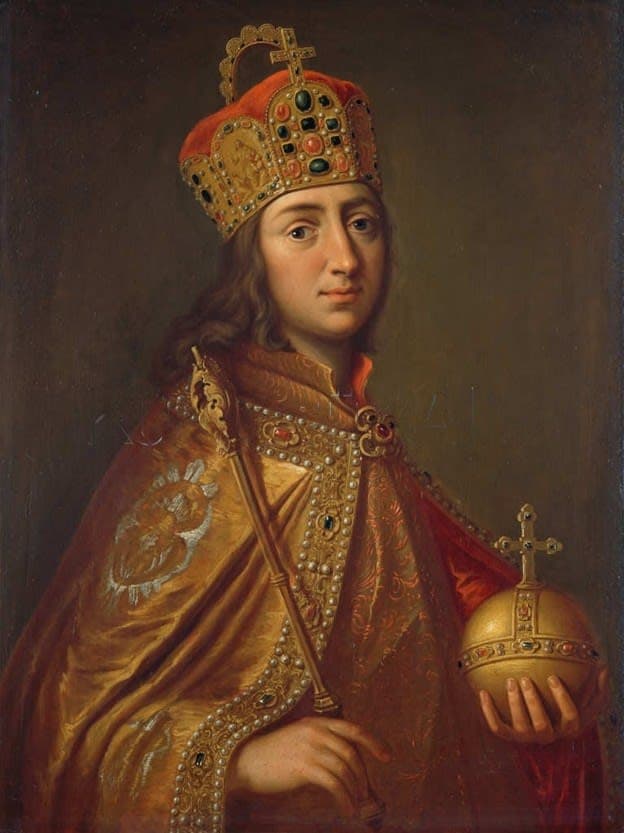

The story of Louis IV, who entered history as Holy Roman Emperor, began in Munich. His father was Louis II the Strict, Duke of Upper Bavaria and Count Palatine of the Rhine, while his mother was Matilda of Habsburg, daughter of the powerful German king Rudolf I.

Louis belonged to the ancient and distinguished House of Wittelsbach, whose rise had begun under his great-great-grandfather Otto I the Red, who received the Duchy of Bavaria for his loyal service to the legendary Emperor Frederick Barbarossa.
Thanks to this elevated status, Louis’s family maintained close political and dynastic ties with the celebrated Hohenstaufen dynasty. Elizabeth of Bavaria, for example, had been the wife of the German king Conrad IV.

The future emperor’s father, Louis the Strict, was a far-sighted politician.
He made enormous efforts to bind the Empire’s leading princely houses together through a network of dynastic marriages.
His own marriage was a product of this diplomacy. During the coronation of Rudolf of Habsburg, Louis the Strict succeeded in arranging a marriage with Rudolf’s daughter Matilda.
This family connection shaped the early years of Louis IV, who was raised at the Austrian court of Albert of Habsburg.
The irony of fate was that there he grew up and studied alongside Frederick the Fair—the man who would eventually become his bitterest enemy and principal rival for the German throne.

In 1294, Louis the Strict died, leaving his sons a wealthy but disputed inheritance.
Years later, on 14 October 1308, the now adult Louis married the Silesian princess Beatrice from the ancient Piast dynasty.
Family peace, however, did not last long.
As early as 1310, a bitter dispute over their father’s inheritance erupted between Louis and his brother Rudolf I.
According to the division of the family possessions, the brothers were supposed to govern the Electoral Palatinate and Upper Bavaria jointly, but personal ambitions quickly overwhelmed their agreements.
In December of that same year, Stephen I of Lower Bavaria died, triggering a new and more extensive conflict—this time between Louis and the House of Habsburg over rights to Lower Bavaria.
The former Hungarian king Otto III considered Louis the legitimate guardian of the children of the deceased Stephen, Otto IV and Henry XIV.
The local nobility, however, opposed this arrangement and transferred the guardianship to Frederick the Fair.
This decision provoked open confrontation.
A pragmatist by nature, Louis decided to act cautiously.
On 21 June 1313, he concluded the Peace of Munich, reconciling with his brother Rudolf and establishing the terms of their joint administration of Upper Bavaria.
The agreement was intended to last for only one year, but Louis used this period of peace not for rest, but for careful military preparation for the coming confrontation with Frederick.
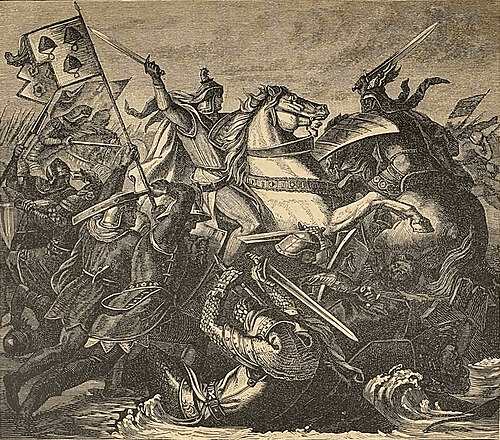
When hostilities resumed in November 1313, Louis’s forces decisively defeated Frederick at the Battle of Gammelsdorf.
The Bavarian duke’s triumph was so complete that even reinforcements sent by Leopold I of Austria failed to save Frederick from defeat.
The victory greatly increased Louis’s prestige within the Holy Roman Empire and forced Frederick to surrender his claim to the guardianship of the young dukes.

In August 1313, Emperor Henry VII died, leaving the Empire without a ruler.
There followed an exhausting struggle among the seven prince-electors over the election of a new king, lasting approximately fourteen months.
At first, the leading candidate appeared to be the late Henry’s son, John of Luxembourg, who had worn the Bohemian crown since 1310.
His candidacy was actively promoted by the Bohemians and by influential churchmen, including Peter of Aspelt, Archbishop of Mainz, and Baldwin of Luxembourg, Archbishop of Trier.
King Philip IV of France also attempted to enter the contest, hoping to place his own son Philip on the throne, but the German princes decisively rejected the French candidate.
The path seemed open for John.
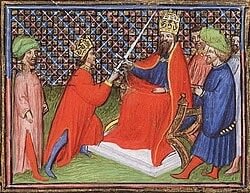
The Habsburgs, however, opposed the Luxembourgs.
They considered John too young and regarded the House of Luxembourg itself as dangerously powerful.
Frederick the Fair, son of King Albert I, who had ruled before Henry VII, began actively gathering supporters.
Recognizing the threat, the archbishops of Mainz and Trier persuaded John of Bohemia to withdraw his candidacy and support Louis of Bavaria as a compromise candidate capable of halting Habsburg expansion.
The Empire split into two camps.
On 19 October 1314, at Sachsenhausen south of Frankfurt, Archbishop Henry II of Virneburg of Cologne assembled four electors.
Among them were Louis’s own brother Rudolf I, Count Palatine of the Rhine, who opposed him; Duke Rudolf I of Saxe-Wittenberg; and Henry of Carinthia, whom the Luxembourgs had removed from the Bohemian throne.
They cast their votes for Frederick the Fair.
The pro-Luxembourg faction responded immediately.
The very next day, 20 October, five other electors gathered in Frankfurt at the initiative of Peter of Aspelt.
Archbishop Peter himself, Archbishop Baldwin of Trier, King John of Bohemia, Margrave Waldemar of Brandenburg, and Duke John II of Saxe-Lauenburg—who disputed the electoral vote claimed by Rudolf of Saxe-Wittenberg—elected Louis as king.

The Empire now had two kings, and on 25 November two paradoxical coronations took place.
Louis was crowned by Archbishop Peter at Aachen, the traditional center of royal authority.
Frederick, meanwhile, was crowned at Bonn by the Archbishop of Cologne, who by ancient custom possessed the formal right to perform the coronation.
Louis did not possess the genuine imperial regalia and therefore had to use copies, provoking a wave of propaganda from both sides.
Chroniclers competed in mutual insults.
The pro-Bavarian Chronica Ludovici, for example, claimed that during his coronation Frederick sat on a barrel and disgracefully fell inside it.
The political chaos benefited only certain territories.
In 1316, for example, Louis, in urgent need of allies, formally recognized Switzerland’s independence from Habsburg authority.
Intervention by Rome was initially prevented by the vacancy of the papal throne.
After the death of Clement V on 20 April 1314, the Holy See remained vacant for approximately two years.
Without a supreme arbiter, both sides believed that God would settle their dispute on the battlefield.
Nevertheless, remembering Frederick’s crushing defeat at Morgarten, the two factions avoided a decisive battle between 1314 and 1322.
The conflict instead continued through local clashes: at Speyer and Buchloe in 1315, Esslingen in 1316, Mühldorf in 1319, and Strasbourg in 1320.
The death of Louis’s ally Waldemar, Margrave of Brandenburg-Stendal, failed to give either side a decisive advantage.
Yet the political situation was becoming increasingly dangerous for the Bavarian.
The new pope, John XXII, appointed Matthias of Bucheck, a Habsburg supporter, as the new Archbishop of Mainz, and in 1316 openly declared himself against Louis.
Supported by Rome and by his brother Leopold, Frederick appeared to be on the verge of complete victory.

Louis’s personal life also entered a dark period.
In August 1322, his wife Beatrice died.
Of their six children, only three survived: Matilda, Louis, and Stephen.
Yet it was precisely at this grim moment that the fate of the Empire changed dramatically.
On 28 September 1322, the rival armies met in the decisive Battle of Mühldorf, on the Ampfing Heath.
Frederick’s forces were defeated.
Frederick himself, together with more than 1,300 noble knights from Austria and Salzburg, was captured.
Louis’s great victory was assisted by the support of Frederick IV, Burgrave of Nuremberg, and by the secret intelligence network of Fürstenfeld Abbey, which later received special privileges in return.
Frederick spent the next three years as a prisoner within the grim walls of Trausnitz Castle.
Despite his triumph, Louis soon came under attack from Avignon.
By assuming the title of King of the Romans and beginning to exercise authority over territories in northern Italy without papal approval, he provoked the anger of John XXII.
The pope gave him three months to renounce his claims and, when Louis refused, excommunicated him from the Church.
Louis responded with a series of forceful legal appeals: the Nuremberg Appeal of 1323, the Frankfurt Appeal of January 1324, and the Sachsenhausen Appeal of May 1324.
He argued that the authority conferred by the prince-electors stood above papal approval.
Rome responded by threatening to deny communion to Louis’s loyal supporters and to deprive Louis himself of his hereditary Bavarian territories.
Frederick’s brother Leopold immediately exploited the papal anathema and organized determined resistance.
Surrounded by enemies—after John of Bohemia abandoned his alliance and under increasing Habsburg pressure—Louis took an extraordinary diplomatic step.
On 13 March 1325, he released Frederick from prison without demanding any ransom.
Under their secret agreement, Frederick renounced the crown and the imperial Habsburg fiefs and recognized Louis as the legitimate guardian of the young Wittelsbachs.
The Peace of Trausnitz was confirmed by a written document, an oath, and joint communion at Easter.
Frederick, a man deeply committed to his word, promised to return voluntarily to captivity if he failed to persuade his brothers to accept the agreement.
He also swore to defend Louis against the pope and promised that his daughter Elizabeth would marry Louis’s son Stephen.
Frederick failed to overcome the stubborn resistance of his brother Leopold.
True to his oath, even though the pope had formally released him from it, Frederick voluntarily returned to Munich as a prisoner.
This honorable gesture impressed Louis so deeply that the former enemies revived the friendship of their youth and decided to govern the Empire together.
On 7 January 1326, an unprecedented agreement establishing a dual monarchy was concluded at Ulm.
Frederick would govern Germany as King of the Romans, while Louis would travel to Italy to obtain the imperial crown.
Leopold, in order to reassure him, received the office of imperial vicar.
This system, founded on symbolic and political brotherhood—the co-rulers ate and drank together, shared a bed, exchanged oaths, and even issued a joint seal—had no real precedent.
Historians still debate Louis’s motives.
Heinz Thomas interpreted the arrangement as a cunning tactical deception, while Michael Menzel, Martin Clauss, and Roland Pauler have emphasized the king’s sincerity, regarding the agreement as a brilliant political maneuver against the papacy.
The legitimacy of monarchy was now presented as deriving from the will of the electors and the union of two great dynasties rather than from the hands of the pope.
This remarkable diarchy, however, did not last long.
On 7 January 1326, Louis even offered the pope his own withdrawal if the pontiff would recognize Frederick by 26 July.
The pope predictably remained silent.
Louis could therefore present Rome to his subjects as uncompromising and claim a moral justification for further conflict.
Soon afterward Leopold died in 1326.
Frederick withdrew from imperial affairs and returned to Austria, where he died on 13 January 1330.
Relations between the co-rulers had already deteriorated before this.
Their final tense meeting took place in Innsbruck, and in February 1327 Louis violated their agreement by appointing Henry of Carinthia as imperial vicar instead of Frederick.
Having secured his rear, Louis turned his attention toward Italy, where Guelphs and Ghibellines remained locked in endless civil conflict.
As early as 1323, Bavarian troops had defended Milan against papal and Neapolitan forces.
At Pentecost in 1327, Louis placed the Iron Crown of Italy upon his own head in Milan.
At the same time, he removed the city’s ruler Galeazzo I Visconti, whom he suspected of connections with the pope.

Pope John XXII was furious.
He deprived Louis of the title Duke of Bavaria, declared him a heretic, and contemptuously referred to him in correspondence as Ludovicus Bavarus—“Louis the Bavarian.”
Nevertheless, Louis’s triumphal march continued.
In January 1328, he entered Rome amid the celebrations of the population.
His imperial coronation was a direct challenge to the Catholic world.
It was organized not by the pope but by the popular leader known as the “captain,” Sciarra Colonna.
In St. Peter’s Basilica, with the participation of three bishops and representatives of the Roman people, Louis was crowned emperor, declaring that his authority came directly from God.
On his new seals, he was depicted wearing ecclesiastical robes, emphasizing the sacred nature of his authority despite the absence of papal approval.
On 18 April 1328, Louis declared Pope John XXII a heretic, deposed him, and elevated the Franciscan Pietro Rainalducci as Antipope Nicholas V.
Although the political impact of this action was limited—Nicholas V soon abandoned Rome and formally abdicated in 1330—the ideological challenge to papal authority had been unmistakable.

At the same time, Louis continued to reorganize the affairs of his dynasty.
Under the Treaty of Pavia of 1329, he transferred the Palatinate to his nephews Rupert I and Rudolf II while retaining Bavaria for himself.
The Wittelsbach branches would not be fully reunited until 1777.
After spending the winter of 1328–1329 in Pisa, where he faced the fleet of King Robert of Naples, Louis returned to Germany in February 1330 as the sole and undisputed ruler.
On 28 April 1330, fulfilling a vow, he founded the famous Ettal Abbey in the foothills of the Alps.
Munich’s Old Court, the Alter Hof, became the first permanent imperial residence and a center of intellectual resistance to the papacy.
Under the emperor’s protection found refuge some of the most brilliant thinkers of the age: the Franciscan theologians Michael of Cesena and William of Ockham, as well as the philosopher Marsilius of Padua.
Louis’s foreign policy was equally ambitious.
In 1333, he offered the crown of the Kingdom of Arles to Humbert II of Viennois, who refused it out of fear of neighboring powers and the Church.
That same year, on 13 November 1333, Louis attempted another sophisticated diplomatic maneuver.
He proposed that Duke Henry XIV become King of Bavaria in exchange for Louis’s own partial abdication, hoping to demonstrate to the princes his willingness to compromise.
In 1337, Louis entered into an alliance with King Edward III of England against King Philip VI of France and the Avignon pope Benedict XII.
The culmination of the alliance came at the imperial diet of 1338 in the Church of St. Castor at Koblenz, where Edward was appointed Vicar-General of the Empire.
That same year, six prince-electors adopted the historic Declaration of Rhense, establishing in law that election by the princes automatically conferred authority over the Empire without the need for papal confirmation.
However, in 1341, tired of waiting for the English money that had been promised to him, Louis ended his alliance with Edward and reconciled with France.
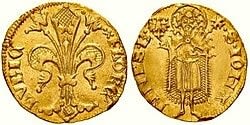
The emperor also actively strengthened the economy of the Empire.
In 1330, he granted privileges to the Frankfurt Fair.
In 1340, he authorized Lübeck to mint gold guilders.
In 1337, he granted the Teutonic Order the right to conquer Lithuania and Rus’, while shielding its knights from foreign judicial authority.
Louis’s dynastic policy was ruthlessly effective.
In 1323, he acquired Brandenburg and granted it to his son Louis V.
On 2 May 1335, at Linz, he transferred Carinthia to the Habsburgs Albert II and Otto.
After the death of John I in 1340, Louis expelled Margaret of Bohemia, a member of the Luxembourg dynasty, and reunited the whole of Bavaria.
In 1342, he acquired Tyrol through the highly controversial annulment of Margaret Maultasch’s marriage to John Henry of Bohemia and her subsequent marriage to Louis’s son Louis V.
Finally, in 1345, Louis transferred extensive territories to his wife Margaret II of Hainaut: the counties of Hainaut, Holland, Zeeland, and Friesland, openly disregarding the claims of her sisters.
This aggressive territorial expansion finally exhausted the patience of the German princes.
In the summer of 1346, the House of Luxembourg struck back.
With the support of Pope Clement VI, Charles IV was elected as anti-king.
Supporters of Louis, including William of Ockham, contemptuously called Charles rex clericorum—“the king of the clerics.”
The Habsburgs, free imperial cities, and the knightly class nevertheless remained loyal to Louis.
Civil war appeared inevitable, especially after Charles’s father, John of Bohemia, was killed at the Battle of Crécy while Charles himself narrowly escaped.

Yet large-scale bloodshed never came.
In October 1347, while hunting a bear near the village of Puch outside Fürstenfeldbruck, the aging emperor suffered a fatal stroke.
Louis IV—the man who had challenged the popes and gathered around himself some of the greatest intellectuals of his age—was buried in Munich’s Frauenkirche.
His death did not end the rivalry between the dynasties.
Louis’s sons later supported Günther von Schwarzburg as anti-king.
After Günther’s death in 1349, they reconciled with the Luxembourgs and once again divided the Wittelsbach possessions.
Political vindication for the Bavarian dynasty came only half a century later.
In 1400, Louis’s great-great-nephew Rupert of the Palatinate received the imperial crown, once again raising the banner of the House of Wittelsbach over the German throne.


