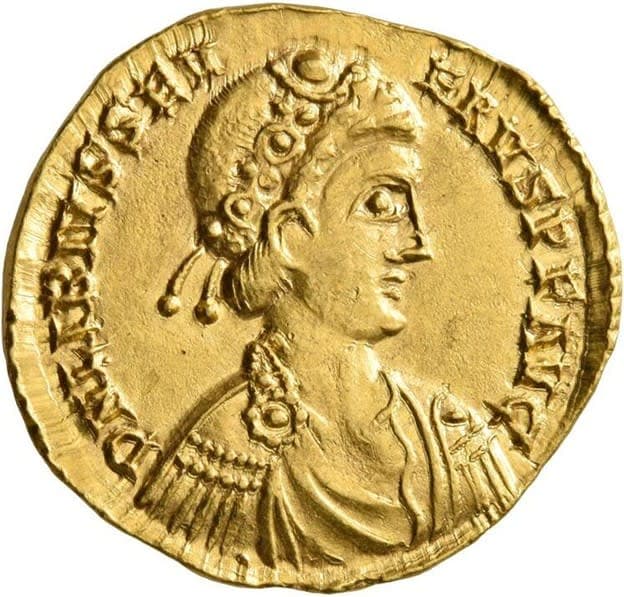
Absolutely nothing is known about Severus’s life before the imperial mantle was placed upon his shoulders.
The famous historian Edward Gibbon believed that he had lived entirely as a wealthy private provincial. Most likely, Severus belonged to the old senatorial class and came from an influential Lucanian circle that traditionally held considerable weight in the Roman Senate.
He may have held civilian offices, but his hands had never held a commander’s baton. It was precisely this lack of connection with the army that made him an ideal candidate for the true master of Rome.
By the time Severus rose to power, the Western Roman Empire lay in ruins from civil wars and barbarian invasions.
In 455, Valentinian III, the last emperor of the Theodosian dynasty, was assassinated.
The conspirator Petronius Maximus usurped power and forcibly married the murdered emperor’s widow, Licinia Eudoxia.
According to legend, the desperate woman appealed for help to Genseric, king of the Vandals.
In June 455, the Vandal fleet entered the mouth of the Tiber. Petronius Maximus was torn apart by a mob, while Rome was subjected to a devastating sack that became a point of no return in the decline of the empire.
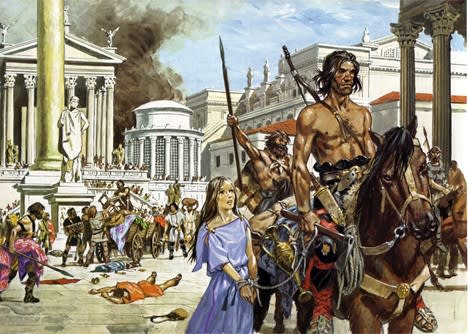

Power began passing rapidly from one ruler to another.
In July 455, Avitus assumed the imperial crown in Gaul with Visigothic support, but already in 456 he was overthrown by the de facto dictator of Italy — the powerful magister militum Ricimer, a barbarian of Suevic origin.
Avitus, who attempted to become a bishop, fled and died of plague.
In April 457, Ricimer placed his associate, the talented commander Majorian, on the throne.
Majorian attempted to restore the greatness of Rome: he forgave tax arrears, restored order in the provinces, and recovered parts of Gaul and Spain from the Visigoths.
However, Majorian’s ambitious plan to destroy the Vandals collapsed when Genseric burned the Roman fleet of three hundred ships that had been assembled for the expedition.
After losing his army, Majorian was not forgiven for weakness.
In August 461, a revolt broke out near Tortona. Ricimer forced the emperor to abdicate, and shortly afterward Majorian died under suspicious circumstances.

A power vacuum followed.
For three and a half months, the Western throne remained empty.
The Vandal king Genseric, sensing Rome’s weakness, aggressively promoted his own candidate — Olybrius, who was related by marriage to Genseric’s son.
To reinforce his demands, the Vandals broke the peace treaty and unleashed fierce raids on Sicily and the Italian coastline.
Ricimer, however, remained uncompromising.
He had no desire to accept a puppet of Carthage.
On 19 November 461, at Ravenna, he proclaimed the obscure Lucanian senator Libius Severus emperor of the West.
Some chronicles, however, including the records of Victor of Tunnuna and Hydatius, suggest that the Senate may have nominated Severus in Rome as early as 7 July 461, forcing Ricimer to accept the choice.
The selection was pragmatic.
Because Severus had no connections among the legions, he posed no threat to the commander-in-chief, while his senatorial background was expected to improve Ricimer’s relationship with the Italian aristocracy.
In 462, the new ruler predictably assumed the consulship.

Thus began a reign in which imperial authority existed largely in name only.
The empire of Libius Severus had effectively contracted to the Italian Peninsula.
Governors in Spain, Gaul, and Dalmatia refused to recognize the usurper. Africa was under Vandal domination, while Britain had long since broken away from imperial control.
Severus became the perfect puppet.
The unprecedented extent of Ricimer’s authority was even reflected in numismatics.
On bronze coins, alongside the emperor’s portrait, appeared the monogram “R M C E,” which is generally interpreted as referring to the commander-in-chief.
Moreover, a bronze civic weight preserves the inscription:
“By the blessing of our lords and of the patrician Ricimer.”
Such wording was almost unthinkable in Roman imperial tradition.
Nevertheless, the machinery of government continued to function through sheer inertia.
Severus’s coins were minted in Rome, Ravenna, and briefly at Arelate, with the quality of the gold solidi noticeably improving.
A magnificent gold medallion from his reign has even survived.
The emperor also issued several laws, or novellae, which were later incorporated into the Theodosian Code.
The first, dated 20 February 463 and addressed to Prefect Caecina Decius Basilius, regulated inheritance law and protected gifts made to widows.
The second, somewhat hypocritically issued on 25 September 465 in the names of both the Western and Eastern emperors, tightened marriage law by binding the children of mixed marriages between coloni and craftsmen to their masters.

Yet while Severus signed documents in the palace, the empire was suffocating under rebellions.
Immediately after Majorian’s overthrow, the late emperor’s associates began to resist.
The commander Nepotianus entered Visigothic service.
Aegidius in Gaul and Marcellinus in Dalmatia raised the banner of defiance.
Marcellinus, entrenched in wealthy Salona, formally recognized the authority of the Eastern emperor Leo I and in 463 began preparing a fleet for an attack against Ricimer.
Unable to fight on two fronts, Ricimer was forced to beg Constantinople for assistance.
Leo I sent an envoy named Phylarchus, who miraculously persuaded Marcellinus not to begin a full-scale civil war.

In Gaul, the situation became a deadly political knot.
Aegidius, who controlled the northern territories, prepared for a possible campaign into Italy.
In desperation, Ricimer appointed Aegidius’s bitter enemy Agrippinus commander-in-chief of Gaul, even though Agrippinus had previously been sentenced to death for treason.
Northern Gaul remained under Aegidius, while Agrippinus controlled the south.
Barbarian groups surrounded them on every side: Visigoths, Burgundians, Franks along the Rhine, and rebellious Bagaudae in Armorica.
To destroy Aegidius, Ricimer resorted to extreme measures.
In 463, the Burgundian king Gundioc, Ricimer’s brother-in-law, became magister militum.
Agrippinus, without hesitation, surrendered the vital Mediterranean port of Narbo to the Visigothic king Theodoric II in exchange for his help in destroying the Gallic rebel.
The Roman Arborius replaced Nepotianus in the Gothic army in an attempt to attract the support of local aristocrats.

Ricimer’s grand plan, however, collapsed.
Theodoric II sent his brother Frederic on campaign, but at the Battle of Aurelianum, modern Orléans, on the banks of the Liger River, Aegidius’s army, reinforced by the Salian Franks of King Childeric I, decisively defeated the Visigoths.
Frederic was killed in battle.
Aegidius retained control of Gaul, although he no longer had enough strength to march on Rome.
Instead, he attempted to form an alliance with the Vandals and sent an embassy to Genseric in the spring of 464.
Aegidius and Marcellinus did not challenge Severus’s imperial title.
They simply removed him from their political reality, effectively passing their own authority on to their successors — Syagrius in Gaul and Julius Nepos in Dalmatia.

The threat came not only from Roman generals.
In 464, the Alans under their king Beorgor, driven from Gaul, crossed the Alps and descended upon the Po Valley, plundering everything in their path.
This time Ricimer acted with extraordinary speed.
On 6 February 464, in the bloody Battle of Bergamo, he destroyed the Alan army.
King Beorgor was killed, while surviving barbarians were incorporated into the Roman army.
The historian Jordanes would later mistakenly place this victory during the reign of Procopius Anthemius.
Yet the Vandals were far more dangerous.
Every spring their swift ships appeared on the horizon.
Genseric personally led punitive expeditions.
The coasts of Spain, Liguria, Tuscany, Campania, Lucania, Bruttium, Apulia, and Calabria burned under repeated attacks.
The Vandals also assaulted Sardinia, while Genseric skillfully conducted diplomatic intrigues that ensured the Eastern emperor largely ignored the destruction.
Relations with the Eastern Empire ultimately became a political death sentence for Libius Severus.
Emperor Leo I Macella never recognized him as an equal, regarding him as a brazen usurper.
Eastern chronicles, from Jordanes to Marcellinus Comes, wrote of Severus with open disdain.
Severus desperately attempted to build bridges with Constantinople.
In 463, he appointed the distinguished senator Caecina Decius Basilius as Western consul.
In 464 and 465, however, the West humbly nominated no candidates of its own and simply recognized the consuls appointed at Constantinople.
One of those Eastern consuls in 464 was the very same Olybrius — the Vandal-backed candidate and rival claimant to Severus’s throne.
Even this unprecedented political submission failed to melt the hostility of the Constantinopolitan court.

The final act came in the autumn of 465, when Libius Severus, after approximately four painful years on the throne, suddenly died in Rome.
The Fasti Vindobonenses place his death on 15 August, which appears unlikely given the publication of one of his laws on 25 September, although the law may possibly have been issued posthumously.
Prosopographical reference works, without clear evidence, often give 14 November as the date of his death.
The sixth-century historian Cassiodorus explicitly claimed that the emperor had been poisoned on Ricimer’s secret orders.
By contrast, Sidonius Apollinaris, a contemporary of the period, insisted in 468 that Severus had died of natural causes.
Nevertheless, the poisoning theory has a grim internal logic.
A puppet who had never been recognized by the East and had failed to bring peace to the West had become a useless burden to Ricimer.


