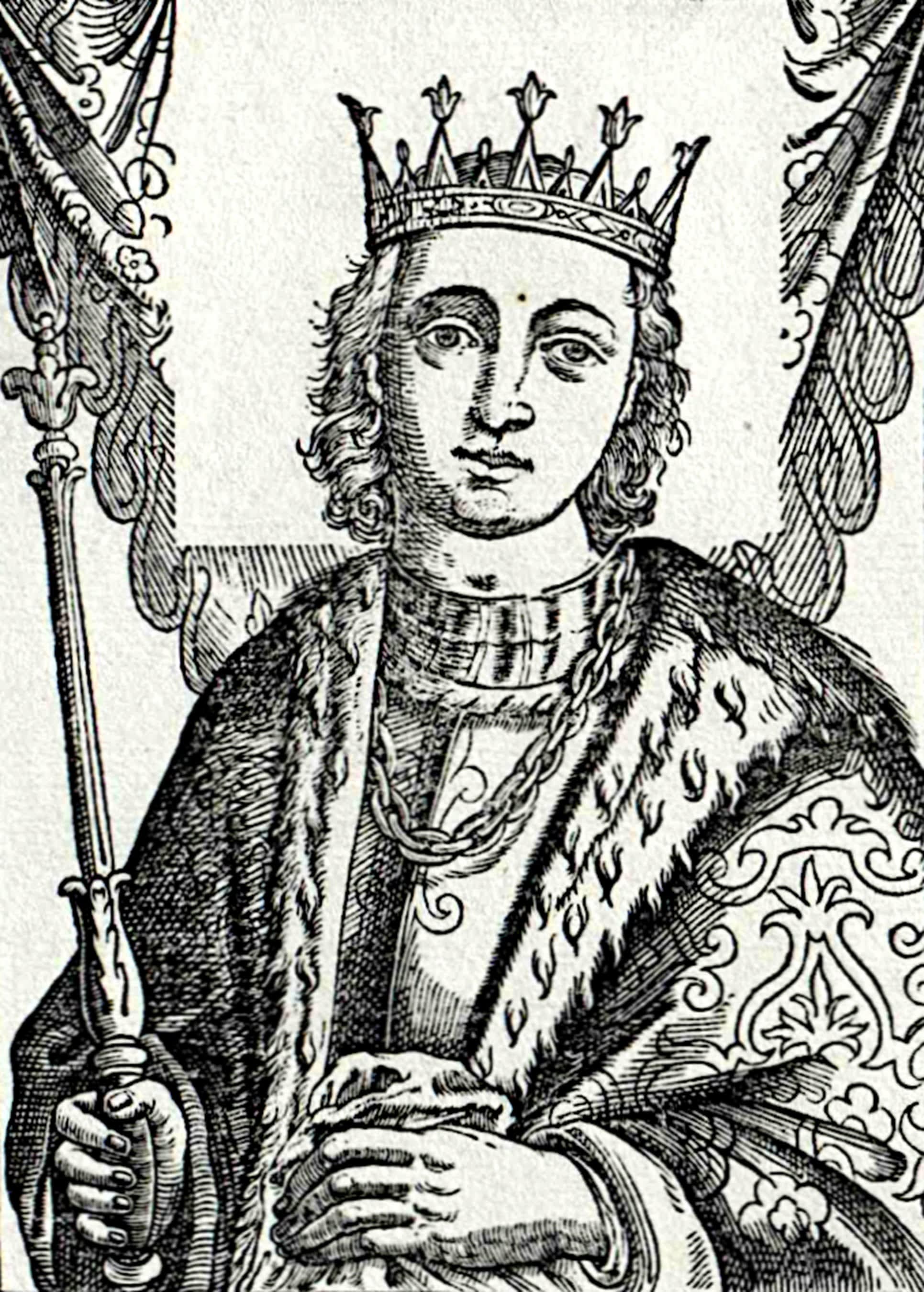

The inheritance that passed to the young Ladislaus in 1386 was truly unenviable and soaked in blood. Following the tragic death of his father, the ambitious Charles III, the Neapolitan throne faced the threat of complete collapse.
Because of the new king's young age, the immense burden of governing a kingdom torn apart by internal conflicts fell upon his mother, the dowager Queen Margaret of Durazzo.
The position of the royal family appeared catastrophic. They faced opposition from both pontiffs of the Great Western Schism — Urban VI of Rome and Clement VII of Avignon. Refusing to recognize the legitimacy of the dynasty, each of them condemned the royal family and excommunicated its members from the Church.
The situation was further aggravated by internal divisions. A significant portion of the influential Neapolitan nobility had never forgiven Charles III for his seizure of power and had formed a powerful domestic opposition.

However, the greatest threat came from abroad.
The shadow of an old blood feud loomed over Naples in the person of Louis II of Anjou, the son of the very Louis I against whom Ladislaus's father had fought so fiercely.
In 1390, this dynastic rival landed on the Neapolitan coast at the head of a well-equipped mercenary army.
The invasion was swift and devastating. Louis easily occupied the capital and seized several strategically important coastal provinces.
Having suffered defeat, the young Ladislaus and his mother Margaret were forced to flee their own palace, finding their last refuge behind the formidable walls of the fortress of Gaeta.

From that moment began an exhausting decade of continuous warfare between the supporters of Ladislaus and Louis II, lasting from 1390 to 1400.
While remaining in Gaeta, the maturing Ladislaus refused to surrender. Instead, he systematically and determinedly prepared to reclaim his throne.
One of the most important steps toward restoring his authority was a skillful diplomatic maneuver — a strategically advantageous marriage to Constance, daughter of the powerful Sicilian admiral Chiaramonte.
This marriage of convenience brought Ladislaus an enormous financial advantage. Constance's substantial dowry provided the king with the gold he desperately needed to pay his troops.
Meanwhile, the political climate in the Vatican was also changing.
The uncompromising Urban VI was succeeded by a new Roman pontiff, Boniface IX.
A native of Naples, the new Pope showed sympathy toward the exiled king.
Boniface not only solemnly lifted Ladislaus's excommunication but also provided him with direct military assistance.
Moreover, the pontiff undertook an enormous and patient diplomatic effort, gradually reconciling the rebellious Neapolitan nobility with their legitimate monarch.
These combined efforts eventually bore fruit. By 1400, the forces of Louis II had been completely driven out of the kingdom, and the now-mature Ladislaus triumphantly returned to Naples.

However, regaining his crown did not bring peace to the kingdom.
Ladislaus devoted all the remaining years of his reign to relentless and aggressive warfare aimed at establishing absolute control over Southern Italy.
His ambitions extended far beyond the borders of Naples.
In 1407, skillfully exploiting a bitter conflict between the new Pope Gregory XII and the rebellious citizens of Rome, Ladislaus marched his troops toward the Eternal City.
The siege ended in complete success.
The king forced the proud Roman nobility to recognize him as the rightful sovereign of Rome, granting him the exclusive right to personally appoint the senator responsible for governing the city.
It was a remarkable triumph. Following the fall of the capital, the entire Papal States submitted to Ladislaus, while Pope Gregory XII himself was forced to acknowledge the power of the Neapolitan monarch.

However, Ladislaus's supremacy did not last long.
By 1409, the European cardinals of both rival factions — Roman and Avignonese — had finally grown weary of the ecclesiastical schism that had persisted for thirty years.
At the historic Council of Pisa, they took an unprecedented step: they elected a third Pope, Alexander V, declaring the previous two pontiffs deposed.
Alexander V, and subsequently his successor John XXIII, received unconditional political and financial support from France and the powerful Republic of Florence.
Viewing Ladislaus as the principal threat to stability, they once again summoned his old enemy, Louis II of Anjou, and unleashed a large-scale war.

The offensive launched by this formidable coalition proved devastating.
Throughout 1409–1410, the Neapolitan troops, unable to withstand the enemy's advance, were completely expelled from the territories of the Papal States.
In 1411–1412, the flames of war spread to the Kingdom of Naples itself.
The campaign culminated in a disastrous confrontation at the Battle of Roccasecca in May 1412.
Ladislaus's army was utterly defeated, and the king himself narrowly escaped the humiliation of captivity, saving his life only by fleeing the battlefield.
It seemed that his downfall was inevitable, but in that same year, 1412, fate presented Ladislaus with an unexpected opportunity.
The victors, intoxicated by their success, became embroiled in bitter quarrels among themselves.
Disillusioned, Louis II abandoned his army and departed permanently for France, while the pragmatic Pope John XXIII preferred to conclude a peace treaty with Ladislaus.
The king was forced to pay a considerable price for this deliverance: he officially renounced his sovereignty over Rome.
Nevertheless, Ladislaus had never been particularly faithful to treaties imposed upon him.
As soon as he had rebuilt his strength, in 1413, he treacherously broke the peace agreement and recaptured Rome in a rapid offensive.
His victorious troops advanced relentlessly northward, reaching as far as Perugia.
All of Italy waited anxiously to see where his conquests would lead next.
Then, something unforeseen occurred.
While staying in Perugia, the king, who stood at the height of his glory, suddenly fell seriously ill.
Dark rumors immediately began circulating at court. It was whispered that the seemingly invincible monarch had been poisoned by a local apothecary, whose beautiful daughter Ladislaus had pursued with excessive persistence.
Whether these rumors were true or not, the ruler's condition deteriorated rapidly.
Gravely ill and approaching death, Ladislaus was hastily transported back to Naples, where he died in August 1414 after suffering unbearable agony.
Thus ended the life of one of the most ambitious and warlike rulers of his era, whose name had become synonymous with Neapolitan expansion for decades.


