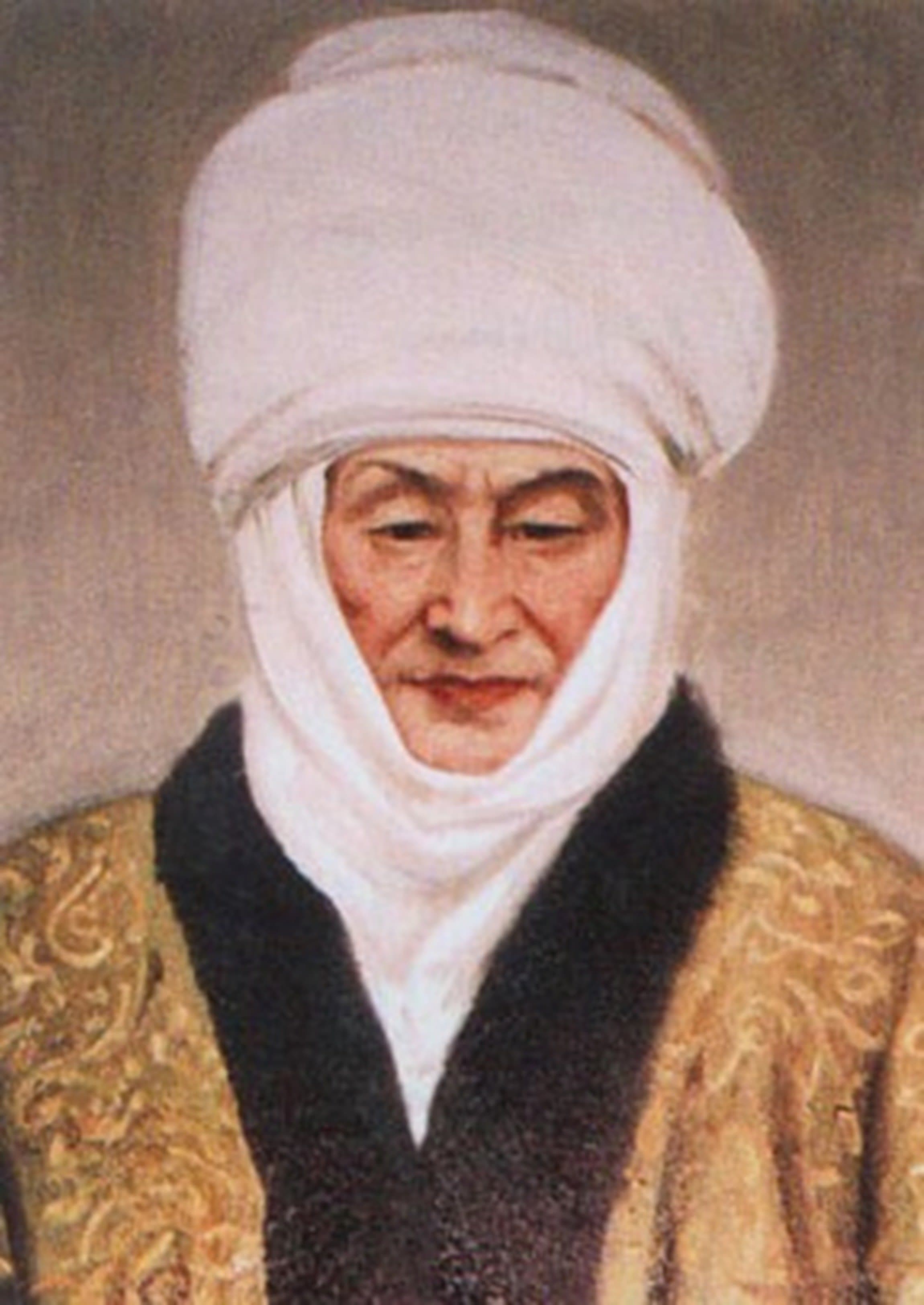

Kurmanjan was born in 1811 into a nomadic family of the Mungush tribe in the Alay Mountains. In her youth she showed a strong will: she refused to marry a man twice her age and lived in her father’s household for three years, defying tradition.
In 1832 she married the influential Alay bek Alimbek Datka, who released her from the earlier marriage contract. Kurmanjan became not merely a wife but her husband’s constant aide and counselor. Their marriage lasted 29 years, until 1862, when Alimbek was killed amid palace intrigues in the Kokand Khanate. After his death power passed to the 50-year-old Kurmanjan who relying on a devoted force of 10,000 jigits effectively took the leadership of Alay.

She defended her right to rule in a confrontation with the Kokand khan Khudoyar. Not only did she oppose his attempts to tax the Alay Kyrgyz, she compelled him to recognize her as ruler of Alay and to confer upon her the honorary title of datka (“just ruler”). The title was also confirmed by the Emir of Bukhara, Muzaffar. Thus, Kurmanjan Datka became one of the few women in the Muslim world ever to stand at the head of a state. Her seat was in the aul of Gulcha, and she enjoyed immense authority among her people.

In 1876 Russian troops invaded and seized the Kokand Khanate. The Alay Kyrgyz, under Kurmanjan Datka and her five sons, put up fierce resistance. Their detachments—about 1,500 jigits—took positions in the difficult terrain of Zhanyryk, where on April 25, 1876, the first major battle with Russian forces took place. The Kyrgyz were defeated and forced to withdraw.
Afterward Kurmanjan Datka attempted to retreat to Afghanistan, but she was surrounded and overtaken by a detachment of the Russian general Mikhail Skobelev. At his headquarters she was received with special honors. Admiring her wisdom and courage, Skobelev addressed her as “princess” and urged her to end the resistance. In exchange for a promise of clemency for her followers especially her sons and their appointment to leadership posts, Kurmanjan Datka agreed. She wrote to her sons ordering them to cease fighting and officially announced the accession of the Alay Kyrgyz to the Russian Empire. For this, the Russian government granted her the rank of colonel.
As a result, Alay was divided into five volosts, four of which Kichi-Alay, Naukatskaya, Gulchinskaya, and Uzgenskaya were placed under the administration of her sons: Kamchybek, Mamytbek, Asanbek, and Batyrbek. Only the eldest son, Abdyldabek, did not return; he set out for Mecca and, before reaching it, died of wounds sustained in battles with the Russians.
Kurmanjan Datka maintained friendly relations with the Russian authorities, corresponding and exchanging gifts with them. In 1881 Governor Konstantin Kaufman petitioned for a pension for her, as she had lost most of her property. In 1893 her sons were arrested on charges of murder and smuggling. Despite her personal pleas, her beloved son Kamchybek was executed on March 3, 1895, in the city of Osh. This tragedy led Kurmanjan to withdraw from public life and live in seclusion.
She died on February 1, 1907, at the age of 96. Shortly before her death she was visited by the Russian traveler Carl Gustaf Mannerheim, who was struck by her wisdom and simplicity.



