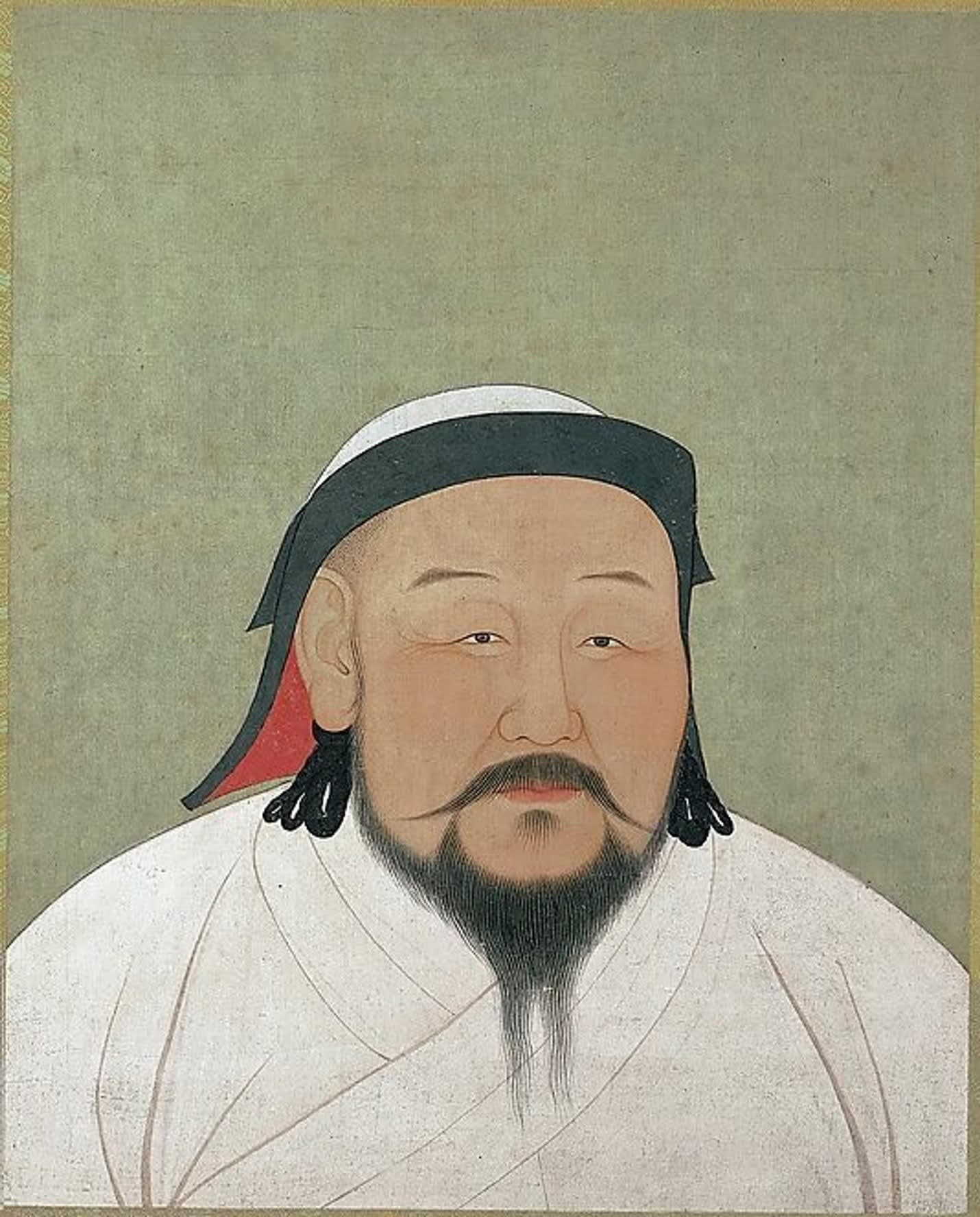

Kublai was born in 1215 to Tolui, the fourth son of Genghis Khan, and the Kerait princess Sorghaghtani Beki, a Nestorian Christian renowned for her intelligence and statecraft. She deeply shaped her sons Möngke, Hülegü, Ariq Böke, and Kublai raising them to prize learning and pragmatism.

Kublai began his military career under his elder brother Möngke, who became Great Khan in 1251. Möngke entrusted him with administering the conquered territories of North China. In 1252 Kublai, together with the commander Uriyangqadai, opened a campaign against the Song empire in the south. In 1253 he subdued the Dali kingdom in Yunnan, completing a ring around Song.

Back in the north, Kublai founded the city of Kaiping as his summer residence Shangdu (Xanadu). At the end of 1258 the Mongols renewed their push against Song, and Kublai led two armies toward the Yangtze. In 1259, during the siege of Wuchang, news reached him that Möngke had died. He concluded a truce and hurried back to take part in the succession struggle.
Möngke’s death sparked a civil war between Kublai and his brother Ariq Böke. A kurultai at Kaiping proclaimed Kublai Great Khan, but Ariq Böke, backed by the traditionalist Mongol aristocracy, contested the decision. The war lasted from 1260 to 1264. In 1260 Kublai transferred the imperial capital from Karakorum to Dadu (present-day Beijing). His strategy was to cut Ariq Böke off from agrarian food supplies. By 1262 Kublai’s allies, including Qadan, had secured key regions, leaving Ariq Böke with only one farming heartland—the Yenisei valley. Defeated, Ariq Böke surrendered on 21 August 1264. Though Kublai first showed leniency, he executed ten of Ariq Böke’s lieutenants to placate his own supporters; Ariq Böke died in captivity in 1266.
With victory in the civil war, Kublai returned to his chief objective: conquering South China. From 1261 he pursued a policy of conciliation toward the Chinese population, freeing captured merchants and rewarding Song defectors. The long siege of Xiangyang began in 1267; after its fall in 1273, the commander Bayan pressed the offensive, taking the Song capital Hangzhou in 1276. Resistance continued until 1279, when the Song fleet was destroyed and the last emperor Zhao Bing died in the naval Battle of Yamen.


In 1271, seeking to legitimize his rule in China, Kublai adopted the dynastic name Yuan (“Origin”) and founded the Yuan Empire. He brought Burma, Cambodia, and Korea into tributary submission, but his campaigns in Vietnam and his two invasions of Japan (1274 and 1281) ended in crushing failures, puncturing the myth of Mongol invincibility.

In domestic governance Kublai showed pragmatism and religious tolerance. In 1291 he divided the empire into twelve provincial administrations. He patronized Buddhism yet also employed Muslims and Christians at court—including the Venetian traveler Marco Polo.
Even so, in 1279–1280 he issued decrees imposing the death penalty for slaughtering livestock according to Islamic and Jewish rites (halal and kosher) and banned circumcision, practices he deemed contrary to Mongol custom. He reinforced Mongol identity in government, promoting the Mongolian language and commissioning the scholar-monk Phagpa to create a new “square” script (the Phags-pa script).
Kublai’s last years were shadowed by personal loss. The early deaths of his beloved wife Chabi (1281) and of his designated heir Zhenjin (Chinkin) in 1286 undermined his health. He turned to drink and heavy eating, suffering from gout and related ailments. Kublai died on 18 February 1294 in Khanbaliq (Beijing), aged 78.


