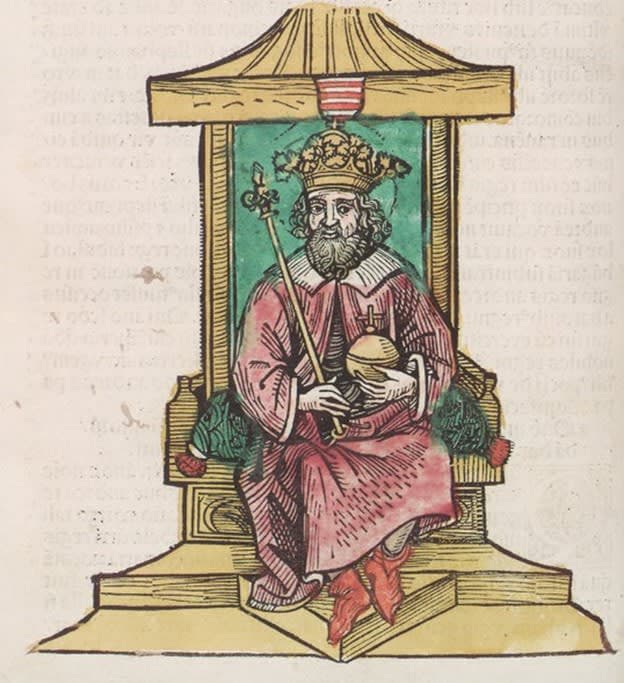
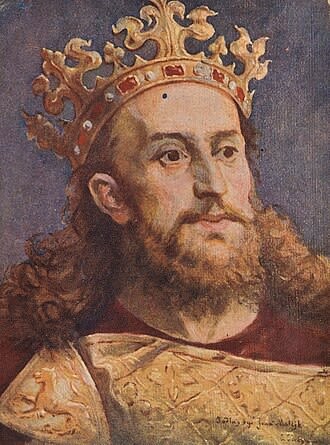
Wenceslaus III was born into the family of Wenceslaus II, King of Bohemia and Poland, and Judith of Habsburg, daughter of Emperor Rudolf I. His birth was overshadowed by loss: his twin sister Agnes died in infancy. From an early age, the young Wenceslaus became a pawn in the grand political chess game played by his father. In 1298, when he was barely nine years old, he was betrothed to Elizabeth, the only daughter of King Andrew III of Hungary.

In 1301, Andrew III died without a male heir, bringing the Árpád dynasty to an end. Hungary descended into political chaos. The magnates, fearful of the growing influence of Charles Robert of Anjou, began searching for a monarch who possessed at least some connection to the bloodline of the Árpáds.
Wenceslaus III, as the grandson of Kunigunda of Slavonia and the fiancé of Elizabeth, appeared to be an ideal candidate. Wenceslaus II spared no expense on bribes and diplomatic pressure, and on August 27, 1301, the twelve-year-old prince was crowned King of Hungary under the name Ladislaus V.

The crown, however, quickly became a crown of thorns. Hungary was fragmented into a number of semi-independent territories controlled by powerful magnates. Wenceslaus III’s effective authority extended little beyond Buda and parts of present-day Slovakia, where he enjoyed the support of powerful nobles such as Máté Csák and members of the Aba family.
The young king’s position became even more difficult with the arrival in Buda of the papal legate Niccolò Boccasini, the future Pope Benedict XI. The Roman Curia openly supported Charles Robert, arguing that only the pope possessed the authority to determine who should wear the Hungarian crown.
Pressure mounted from all sides. King Albert I of Germany, despite his previous relations with Wenceslaus II, abandoned his former position and aligned himself with the Angevin cause.

In May 1303, Pope Boniface VIII sent Wenceslaus II an ultimatum whose demands were extraordinarily severe. He insisted not only that the Hungarian crown be surrendered to Rome’s preferred candidate, but also demanded control over the silver mines of Kutná Hora and the payment of an enormous fine of 80,000 talents of silver.
Wenceslaus II responded with a firm refusal.
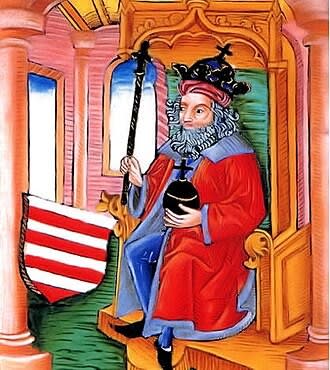
Meanwhile, the situation in Hungary became critical. Former supporters such as members of the Aba and Csák families abandoned the young king. Wenceslaus III found himself effectively besieged in Buda.
When his father learned of the crisis, he arrived with a powerful army. Recognizing that the political situation had become hopeless, Wenceslaus II made a decisive choice: he took his son and the sacred Hungarian royal crown back to Prague.
Later, after his father’s death, Wenceslaus III formally renounced his claims to Hungary in December 1305 in favor of Otto III of Lower Bavaria.

In 1305, following the death of Wenceslaus II, the fifteen-year-old prince suddenly found himself carrying the burden of two crowns — those of Bohemia and Poland.
Powerful enemies immediately challenged his rights. Among them were Albert I of Habsburg and Władysław the Short.
At this critical moment, Wenceslaus III displayed a degree of decisiveness unusual for someone of his age. In October 1305, he broke off his engagement to Elizabeth of Hungary and, only four days later, married Viola of Teschen.
Contemporary writers spoke of the bride’s remarkable beauty, but the marriage also had a clear political logic. The Duchy of Teschen controlled a strategically important route connecting Prague with Kraków.
To free himself for the struggle over Poland, Wenceslaus concluded peace with the Habsburgs, surrendering territories in the Egerland, Pleissenland, and Meissen.
This allowed him to concentrate his resources in the east. By that time, Władysław the Short had already occupied Wawel Castle in Kraków.
A fragile truce was concluded that was intended to last until September 1306. Wenceslaus decided to use the remaining months to prepare for a decisive campaign.

In June 1306, Wenceslaus III began a large-scale collection of funds and the formation of an army. The young king was determined to recover his Polish inheritance.
At the beginning of August, his forces arrived in Olomouc, which was intended to serve as the main staging ground for the coming offensive.
On August 4, 1306, the calm of Olomouc was shattered by news of a shocking crime.
The king was resting in the deanery after the heat of the afternoon when an unknown assassin entered and stabbed him three times in the chest. Death was immediate.
Witnesses reportedly saw a man named Konrad of Botenstein leap from a window of the residence holding a bloodstained dagger. Enraged guards killed him on the spot before he could say anything.
To this day, historians continue to debate who may have been behind the assassination.
Wenceslaus III remained an ambiguous figure in the chronicles. Medieval writers accused him of extravagance and excessive drinking, while modern historians have often offered a more nuanced assessment, pointing to the political ability he demonstrated during his brief period of independent rule.
In only about a year, he managed to pursue a series of calculated diplomatic maneuvers and practical reforms.
His remains were initially buried in the Cathedral of Saint Wenceslaus in Olomouc. Later, his devoted sister Elisabeth transferred them to Zbraslav Monastery so that he could rest beside their father.
With the death of Wenceslaus III, the male line of the Přemyslid dynasty came to an end. Bohemia lost the dynasty that had transformed it into one of the great powers of Central Europe, and a prolonged struggle began over the “orphaned” Přemyslid inheritance.


