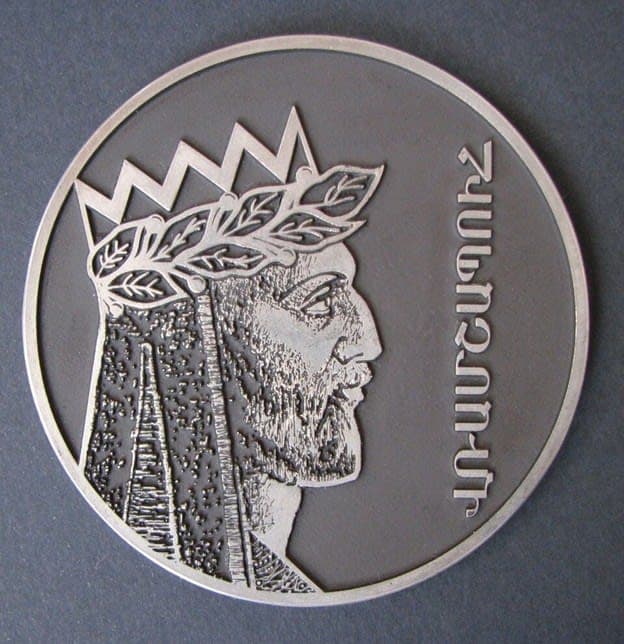

The year of this remarkable monarch's birth remains a mystery, but it is known that he was born into the family of King Varazdat and that his original birth name was Vagharsh. His path to power began amid an extremely severe political crisis: in AD 388, the Persian ruler Bahram IV (Vram IV) deposed Vagharsh's elder brother, King Khosrov IV, and imprisoned him in the dark dungeons of the Fortress of Oblivion. Unwilling to destroy the centuries-old royal order, the Sasanian shah placed Vagharsh on the throne of Greater Armenia. He officially inherited his brother's crown in AD 388 or 389.
At the same time, his Persian patron radically changed his Parthian name, renaming the young king Vramshapuh in honor of himself and his father. The name itself represents a carefully constructed Armenian combination of the traditional Persian names "Vram" and "Shapuh." These names were considered dynastic names of the powerful Sasanian dynasty and vividly illustrate the profound cultural influence that the Persian court exerted over the last monarchs of the Armenian Arsacid dynasty. In some historical chronicles, he is also mentioned under the name Stahrshapuh.

Vramshapuh proved to be a brilliant strategist and diplomat. Skillfully taking advantage of the political balance established between Sasanian Persia and the Roman Empire, he managed to build strong and friendly relations with both rival courts. His diplomatic talent became particularly evident during a successful peacekeeping mission in Mesopotamia, where he served as an influential mediator between Byzantium and Persia. Vramshapuh achieved something extraordinary: he gained the complete trust of both the Sasanian shah and the pro-Roman Armenian elites. As a result, he ruled for a quarter of a century in an atmosphere of peace and political wisdom, ensuring rapid economic and cultural development. His reign therefore deservedly became known as the "Golden Age."
The king's domestic policy was aimed at strengthening the unity of the state. Under his active patronage, Sahak I Partev was restored to the position of catholicos, while Mesrop Mashtots was appointed as his vicar. To adapt the administrative system to new political realities, Vramshapuh completely revised the Gahnamak (Table of Ranks), which strictly regulated the positions and offices of the nakharar noble houses within the country. The king sent this updated document to the Persian capital of Tizbon (Ctesiphon) and successfully secured its official recognition. Responding to a request from Sahak Partev, the monarch granted the powerful Mamikonian family the "fifth rank" in the state hierarchy and appointed his son-in-law, Hamazasp Mamikonian, as sparapet — commander-in-chief of all armed forces. In addition, the king confirmed the offices of mardpet (chief of the palace guard and administrator of royal property) and aspet (commander of the cavalry), who received the supreme honor of placing the crown upon Vramshapuh's head during his coronation.

However, Vramshapuh's most enduring achievement was a cultural revolution. The king and the remarkable group of Armenian intellectuals who emerged on the historical stage under his patronage clearly recognized that it was impossible to develop national scholarship and education solely through Greek, Syriac, and Persian schools. Therefore, Vramshapuh, together with his hazarapet (chief administrator), Aravan, enthusiastically supported the initiatives of Sahak Partev and Mesrop Mashtots to create an Armenian writing system.
This sacred undertaking began when Mesrop Mashtots, recognizing the grave danger of cultural assimilation and the weakening of the Armenian people's Christian faith, arrived in Vagharshapat and appealed to the king and the catholicos for assistance. After listening to their concerns, Vramshapuh explained that during his recent mission to Mesopotamia, he had learned from an elderly man named Abel about a Syriac bishop named Daniel, who had unexpectedly discovered letters believed to be suitable for the Armenian language. The king immediately ordered a man named Vahrich to locate and bring back these characters. When the letters arrived, they inspired great hope: by royal decree, children were gathered from across the country and taught the new writing system for two years. Unfortunately, time revealed that these symbols were critically insufficient to represent the full richness of the Armenian language's phonetic features.
Unwilling to abandon his great objective, Mashtots, having received the complete approval and comprehensive support of Vramshapuh and Sahak Partev, traveled with his students to the major intellectual centers of Mesopotamia — the cities of Edessa and Amida. It was there, after prolonged spiritual struggles and exhausting searches, that he experienced a divine vision through which an entirely new and remarkable Armenian alphabet was created. The Greek calligrapher Ropanos gave the alphabet its final aesthetic form, with an elegant alternation of thick and thin strokes. There, too, the first historic translation into Armenian was completed — the opening words from the Book of Proverbs of Solomon: "To know wisdom and instruction."
Mashtots' triumphant return to his homeland became a nationwide celebration. On the banks of the Rah River, he was joyfully welcomed in person by King Vramshapuh, Catholicos Sahak, all the prominent nakharars, and a vast crowd of rejoicing people. The historian Movses Khorenatsi compared this magnificent reception to a grand wedding or an unprecedented celebration, describing how the king rejoiced sincerely at the victorious beginning of enlightenment in his homeland. The alphabet created under his patronage became an exceptionally powerful instrument for the spiritual unification of all Armenians living in both the Byzantine and Sasanian Empires. It provided the Armenian people with an enduring Christian identity, becoming the principal key to the survival of Armenian culture and giving society a unifying strength that would sustain it for millennia.
Following this extraordinary event, relatively little information has survived about the final years of Vramshapuh's reign. The great king and patron of education passed away in AD 417, leaving behind his young son Artaxias IV, who, because of his age, could not immediately inherit his father's throne. Nevertheless, the era of Vramshapuh has forever remained synonymous with wisdom, constructive achievement, and the triumph of the human spirit.


