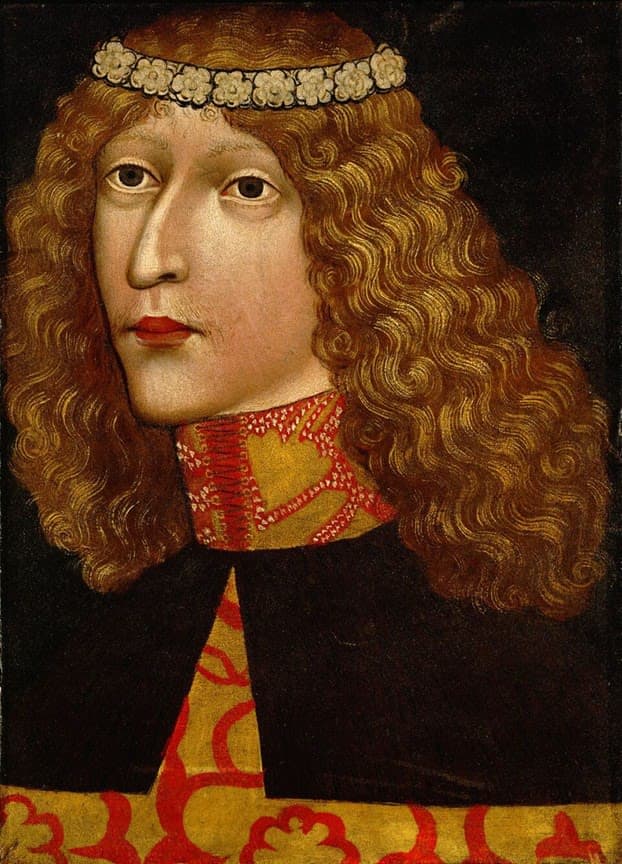

The fate of Ladislaus, who entered the annals of history with the revealing Latin epithet Posthumus ("the Posthumous"), became a direct continuation of his father's tragedy.
When Albert II, Duke of Austria and ruler of an enormous realm, suddenly died of dysentery in a military camp in late October 1439, his widow, Elizabeth of Luxembourg — daughter of the late Emperor Sigismund — was carrying their child.
Four long months later, in May 1440, a boy was born who, from his very first breath, was destined to become the center of a brutal political struggle.
As the only legitimate son of Albert II, the infant Ladislaus inherited the throne of the Duchy of Austria.
However, guardianship over the newborn monarch, together with the title of King of Germany and the crown of the Holy Roman Empire, was skillfully seized by his ambitious relative — Frederick III, Duke of Inner Austria.

Ladislaus's mother, the determined Queen Elizabeth, understood perfectly well that any delay threatened the loss of all her late husband's territories.
Immediately after her son's birth, in May 1440, she organized the infant's hasty coronation with the Hungarian crown.
In this daring political undertaking, the widowed queen was supported by the influential pro-Habsburg faction of Hungarian barons, led by the powerful Count Ulrich of Celje.
However, the overwhelming majority of the Hungarian nobility categorically opposed the rule of an infant.
Faced with the growing Ottoman threat, the nation needed a strong leader capable of wielding a sword, and its choice fell upon King Władysław III of Poland.
He was soon crowned in Hungary under the name Wladislaus I, inevitably plunging the country into a bloody civil war between two irreconcilable factions.
In this confrontation, military superiority lay with the supporters of the Polish king.
Nevertheless, the Habsburgs did not surrender completely.
Frederick III succeeded in establishing firm control over the cities of western Hungary, while the loyal commander John Jiskra, acting on behalf of the young Ladislaus, managed to capture a considerable portion of Upper Hungary, corresponding to present-day Slovakia.
The queen mother's greatest achievement, however, was a secret operation through which she successfully removed the kingdom's most sacred treasure — the Crown of Saint Stephen and the other royal regalia — from the country.
These priceless symbols of authority were entrusted to Frederick III as the young monarch's official guardian.

Meanwhile, in neighboring Bohemia, Ladislaus was recognized almost immediately and unconditionally as the legitimate king.
However, this recognition was purely formal.
The country was being torn apart by a brutal struggle for power between rival noble factions.
Catholics, who controlled the southern frontiers of the kingdom, were locked in an uncompromising confrontation with the Utraquist Hussites, whose principal stronghold lay in eastern Bohemia.
Against this background of anarchy, the royal institutions of government became completely paralyzed.
All attempts by Frederick III to establish control over the kingdom in the name of his young ward ended in failure.
The situation changed dramatically in 1444, when the outstanding statesman and military commander George of Poděbrady emerged as the leader of the Bohemian Utraquists.
Relying on support from the towns and the lesser nobility, he began systematically defeating the opposing Catholic faction.
In 1448, he triumphantly seized control of the capital, Prague.

European geopolitics was shaken once again in 1444, when the Hungarian ruler Wladislaus I was killed in the catastrophic Battle of Varna against the Ottoman Turks.
His death triggered another fierce struggle for power.
Exhausted by instability, the ruling elites agreed to a compromise.
In 1445, Hungary officially recognized Ladislaus as its king under the name Ladislaus V.
However, one strict condition was imposed: Frederick III had to immediately release his young grandnephew from guardianship and return the Crown of Saint Stephen.
Frederick, unwilling to surrender control over the heir, categorically refused.
Left without an effective monarch, Hungary elected John Hunyadi as regent in 1446.
A brilliant and fearless military commander, Hunyadi immediately launched a determined struggle against the Ottoman armies that regularly devastated the kingdom's southern frontiers.
Events unfolded along similar lines in Bohemia, where George of Poděbrady was officially proclaimed regent, or provincial governor, in 1450.
Thus, Frederick III, while continuing to keep Ladislaus the Posthumous in the position of an honored captive, retained effective control only over the territories of the Duchy of Austria itself.

Beginning in 1451, pressure upon the stubborn Frederick III reached a critical level.
Deep-seated dissatisfaction developed into open rebellion.
In 1452, the Austrian nobility itself rose against the emperor.
The rebels concluded a strategic alliance with the Hungarians and Bohemians, issuing an ultimatum demanding the immediate release of the young king and the return of the stolen royal regalia.
Finding himself isolated, Frederick was forced to capitulate and release the thirteen-year-old Ladislaus.
In 1453, the Hungarian national assembly once again recognized Ladislaus as king, this time in the monarch's own presence.
For the first time since the death of Albert II, the country had a sovereign whose legitimacy was acknowledged by all the previously warring factions.
As a gesture of reconciliation, a general amnesty was proclaimed, pardoning those who had once taken up arms in support of Wladislaus I.
That same year, Ladislaus was also officially crowned King of Bohemia.
However, because of his young age, the monarch could not govern independently.
In Hungary, Ulrich of Celje — a cunning Slovenian count and sworn enemy of John Hunyadi — became the country's effective ruler.
Nevertheless, this political triumph did not prevent Hunyadi from retaining complete control over the kingdom's foreign policy.
In 1456, Hunyadi's relatively small but battle-hardened army accomplished a miracle: it decisively defeated the enormous Ottoman army at Belgrade.
This victory kept the immediate Turkish threat away from Hungary's borders for many years.

But the triumph was overshadowed by tragedy: in that same victorious year of 1456, John Hunyadi died.
Political authority in Hungary began to falter, and competing ambitions erupted into a bloody confrontation.
The deceased hero's eldest son, Ladislaus Hunyadi, openly challenged Ulrich of Celje and brutally murdered him.
The powerful count's death had important dynastic consequences.
The Habsburgs immediately annexed his extensive possessions in Carniola, Carinthia, and Slavonia.
Nevertheless, Ladislaus the Posthumous refused to forgive such an act of defiance.
In early 1457, on the king's orders, Ladislaus Hunyadi was treacherously arrested and executed.
This decision proved a fatal mistake.
The execution of the national hero's son provoked a massive uprising among the supporters of the Hunyadi clan throughout Hungary, forcing the king to flee in panic to the safety of Prague's walls.

In Bohemia, despite the coronation of 1453, real authority remained firmly in the hands of George of Poděbrady.
The regent pursued a strict but effective policy, systematically strengthening central authority and ruthlessly suppressing every aristocratic rebellion.
Under his direction, in 1453–1454, the Diet of the Kingdom of Bohemia adopted a series of important decrees.
These measures regulated the complicated relationships between peasants and feudal lords, reformed judicial procedures, and undermined the foundations of separatist movements and rebellious barons.
Having arrived in Prague in 1457 as a fugitive from Hungary, Ladislaus began preparing for a new chapter in his life — extensive marriage negotiations concerning Madeleine of Valois, daughter of King Charles VII of France.
This alliance promised extraordinary political opportunities.
But fate had other plans.
In November, the seventeen-year-old king suddenly fell ill with an unknown disease and died within just three days.

The young monarch's sudden death immediately gave rise to sinister rumors.
Popular suspicion fell primarily upon Regent George of Poděbrady, who subsequently ascended the vacant Bohemian throne himself.
Another, far more romantic and sinister explanation was recorded by the famous memoirist Philippe de Commynes.
According to his account, the king was poisoned by a noblewoman from Prague.
Commynes wrote that the monarch and this woman had been involved in a secret love affair.
When she learned of his impending marriage to the French princess, she became enraged, interpreting it as an act of betrayal.
According to the legend, she poisoned the young king while he was bathing, offering him an apple that had been deceptively sliced with a knife coated in deadly poison on only one side.
However, modern science has dispelled these medieval myths.
Extensive research by the Czech anthropologist Emanuel Vlček conclusively demonstrated that Ladislaus the Posthumous had fallen victim to leukemia — a severe cancer of the blood about which medieval physicians had no understanding.
The death of Ladislaus the Posthumous, who left neither a wife nor children, brought an end to the first attempt at uniting the states of Central Europe, a project originally envisioned by Emperor Sigismund.
Ladislaus's successor in Austria was his relative Frederick V, also known as Frederick III.
With the young king's death, the Albertinian branch of the House of Habsburg became extinct forever, while the Austrian territories were once again united under a single ruler.
However, in Hungary and Bohemia, the imperial vision collapsed.
The two kingdoms, left without a monarch, elected their own national kings, leading to their political separation.
Soon afterward, the new Hungarian king, Matthias I Corvinus, keenly aware of the seemingly inevitable advance of the Islamic threat, would make another attempt to unite the region.
Yet he, too, would run out of time because of his premature death.
The disunity of Central Europe proved fatal.
The region would not be definitively reunited under the Habsburgs until 1526.
But a terrible price would be paid for this delay: the once-great Kingdom of Hungary would collapse and bleed in its unequal struggles against the Ottoman Empire.


