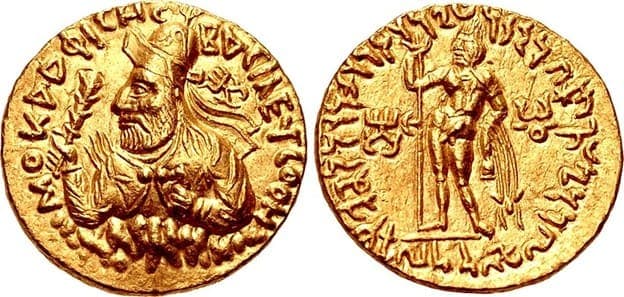
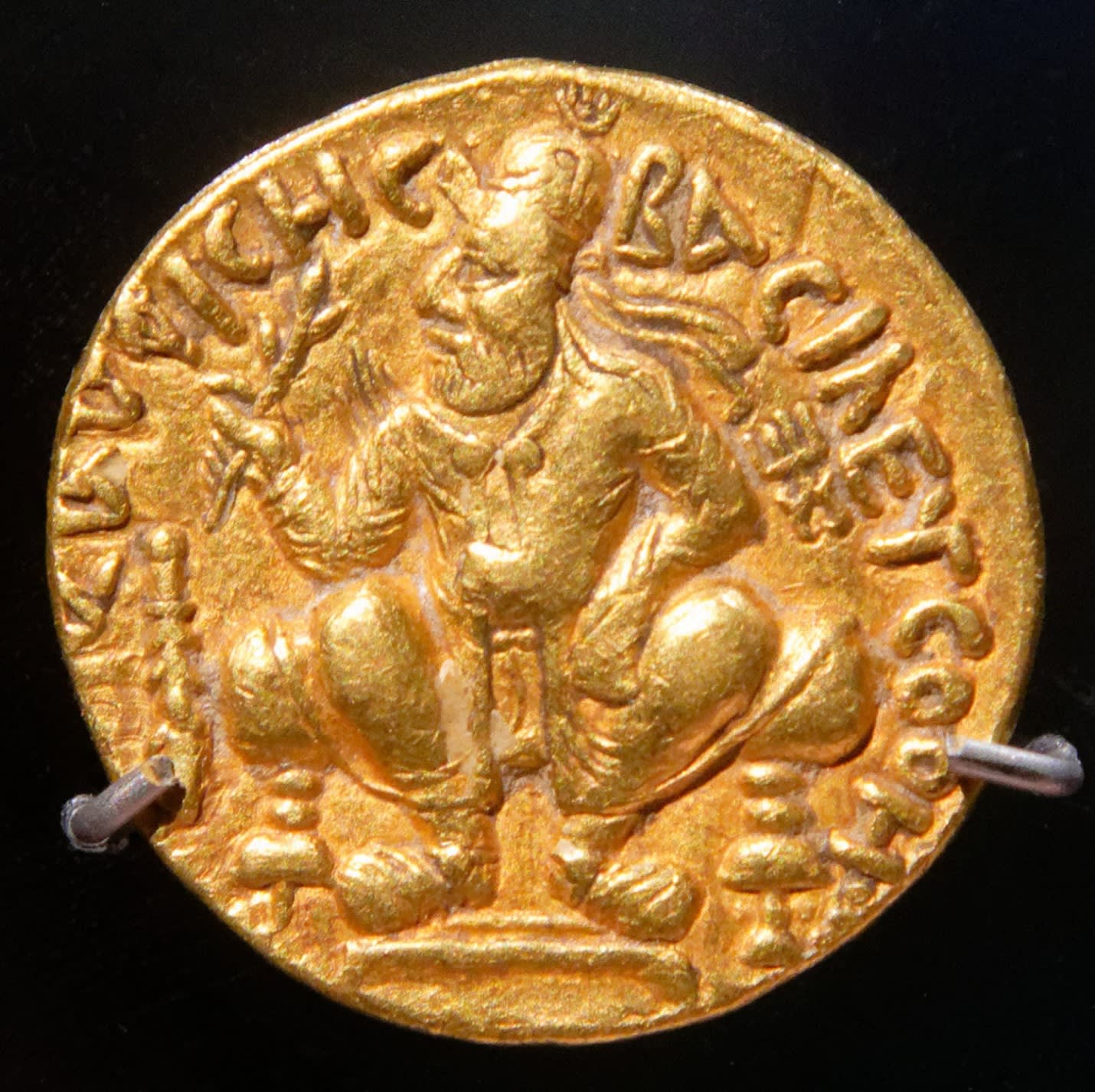
The figure of the powerful King Vima Kadphises stands out in the history of the Kushan Empire as one of the most remarkable, yet at the same time most mysterious, rulers of the ancient world. His legacy is truly immense; however, the paradox of studying his era lies in the fact that historians continue to engage in intense debates over exactly when he lived and ruled. The problem of establishing a precise chronology of his reign has developed into a genuine historiographical puzzle, giving rise to numerous sharply conflicting hypotheses.
The range of proposed dates is striking. Some scholars believe that the reign of Vima Kadphises belongs to the period of Late Antiquity, approximately 230–278 CE. However, the overwhelming majority of modern scholars tend to revise this chronology radically, placing the monarch’s lifetime more than 170 years earlier. For example, the prominent Indian historian H. Raychaudhuri (Hemchandra Raychaudhuri), followed by the authoritative Soviet Historical Encyclopedia, dates his reign to approximately 47–78 CE. There are also intermediate and more narrowly defined theories: L. A. Borovkova argues that the king ruled from 80 to 103 CE, while the British researcher Robert Bracey extends this period to approximately 80–115 CE.
Nevertheless, through the haze of millennia emerges the image of a ruler of extraordinary strength and ambition. At the very beginning of his reign, Vima Kadphises launched a large-scale military expansion that culminated in the triumphant conquest of extensive territories in Central India, a land referred to in Chinese chronicles as the kingdom of Tianzhu. This breakthrough dramatically increased the power and wealth of the Kushan Empire. The unprecedented economic prosperity of the period was reflected in a radical monetary reform: Vima Kadphises began the large-scale minting of magnificent, full-weight gold and silver coins. Continuing the religious traditions of his predecessors, he placed images of the Hindu god Shiva on these coins, thereby emphasizing the spiritual and ideological foundations of his rule over the newly acquired Indian territories.
Aware of his enormous power, Vima Kadphises began to conduct diplomacy on equal terms with the greatest empires of the East. In 87 CE, an unprecedented diplomatic initiative took place: the Kushan ruler sent an official embassy to the court of the Chinese emperor with the bold proposal of arranging a dynastic marriage. It was largely through these envoys that Chinese historians obtained valuable information about the Kushan state, which was carefully recorded in the famous chronicle Hou Hanshu (Book of the Later Han).
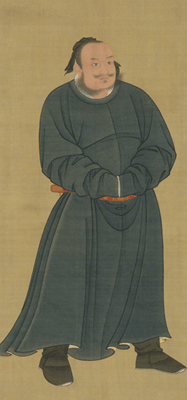
However, this diplomatic mission ended in tragedy. Presumably, the authorities of the Chinese Empire were seriously alarmed by the rapidly growing power of their western neighbor. Although agreements were formally concluded, the Kushan embassy was treacherously attacked on its return journey and completely massacred. This brutal act was carried out by the formidable Chinese general Ban Chao, whose forces at that time controlled the strategically important oases of Yarkand and Kashgar.
The Kushans could not leave such an insult unpunished. In 90 CE, a powerful Kushan army crossed the mountain passes, sent to avenge the murdered envoys and punish those responsible. Ban Chao, however, proved to be not only a ruthless warrior but also a skillful strategist. Avoiding a direct confrontation with the formidable army, he employed a scorched-earth strategy, carefully concealing all food supplies in the region. The Kushan punitive expedition ended in disaster: the enormous army, desperate to find provisions in the devastated lands, was forced to plunder the local population, but ultimately, driven back by hunger, it had no choice but to retreat to its homeland.
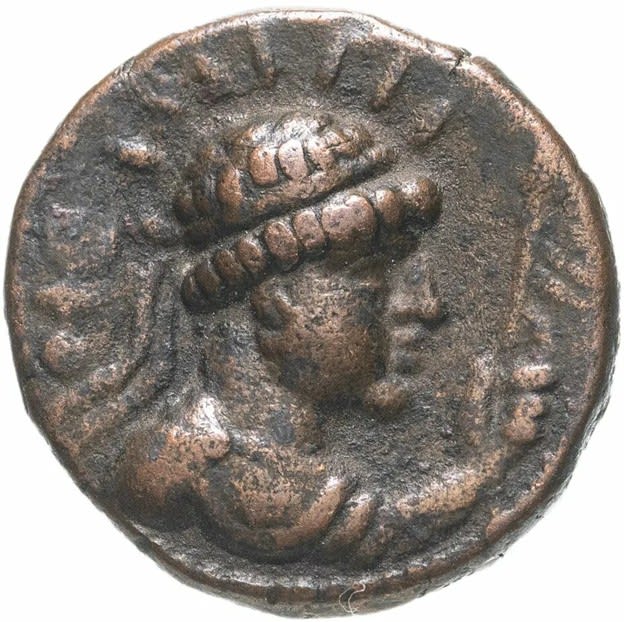
At first glance, the history of this period appears to form a logical sequence of events. Yet at the end of the twentieth century, the famous Rabatak Inscription overturned long-established ideas about the Kushan dynasty. This text, carved into stone, conclusively demonstrated that Vima Kadphises was not the direct successor of the empire’s founder, Kujula Kadphises. The inscription revealed that another king had ruled between them—Vima Takto, who was the son of Kujula Kadphises and, consequently, the father of Vima Kadphises.
This sensational discovery gave rise to a new and alternative interpretation of historical events, which is supported today by a number of prominent scholars. According to this hypothesis, it may have been the previously “missing” ruler Vima Takto who was responsible for the greatest achievements of this era: the extensive conquest of India, the intense diplomatic and military relations with Han China, as well as the mass production of the famous anonymous coins bearing the title “Soter Megas” (“Great Savior”), which had previously been mistakenly attributed to Vima Kadphises himself.
Thus, the brilliant age of Vima Kadphises continues to preserve its mysteries, balancing between great victories and unresolved historical enigmas.


