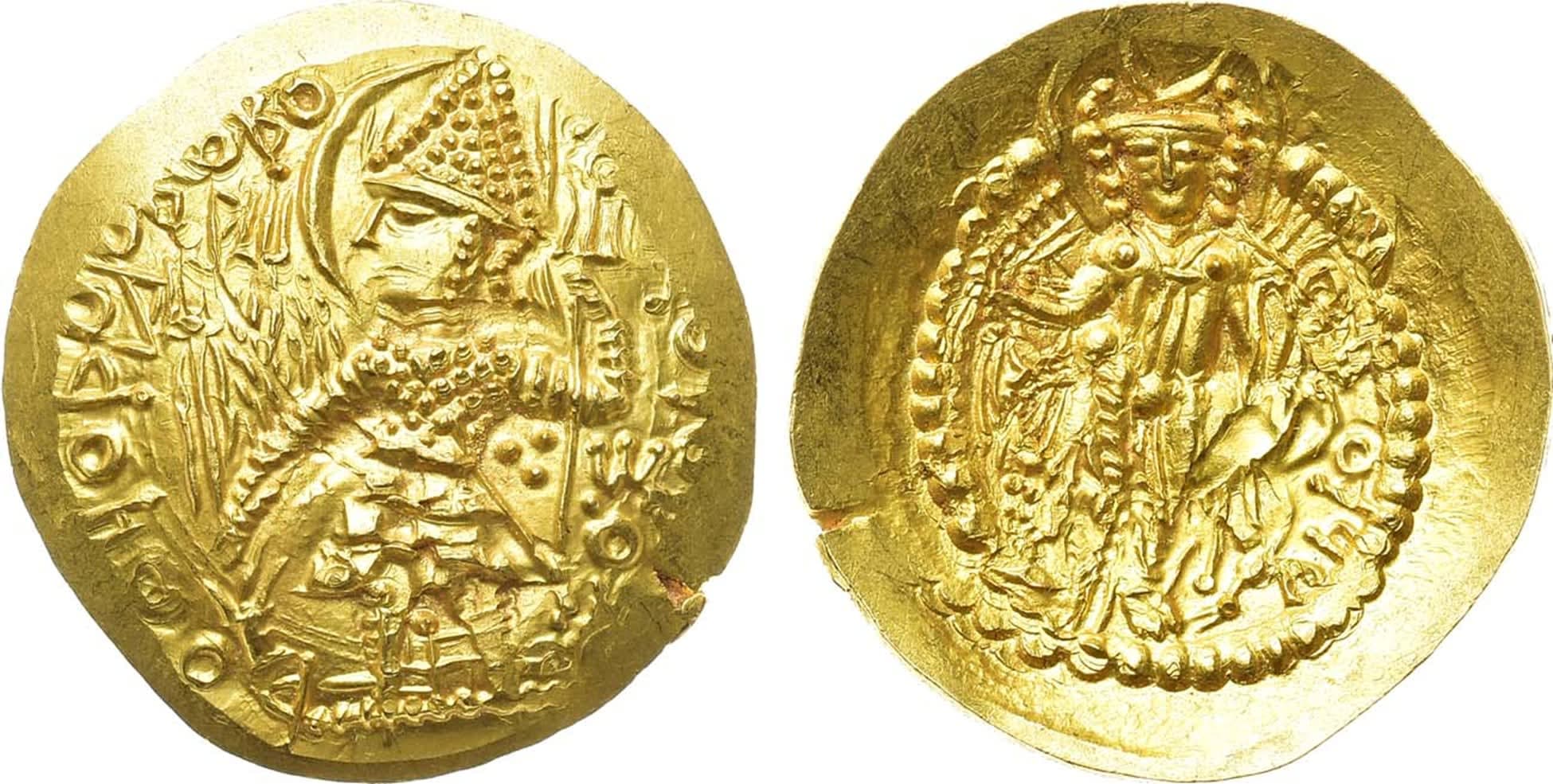
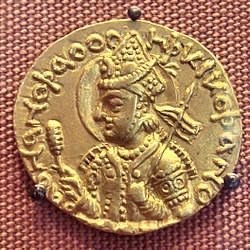
Based on dated inscriptions bearing his name from Years 64 to 98 of the era of the great Kanishka, historians believe that Vasudeva ruled the empire continuously from at least 191 to 232 CE. This chronology corresponds remarkably well with other evidence: the latest known inscription of his predecessor, Huvishka I, dates to Year 60 of the Kanishka era, or 187 CE, while Chinese chronicles confirm that Vasudeva remained firmly in power at least until 229 CE. His authority extended over vast territories of northern India and Central Asia, while Balkh in Bactria remained one of the most important economic centers for the minting of his coinage.

The reign of Vasudeva marked an unprecedented cultural and religious turning point in the history of the Kushan dynasty. He became the first Kushan emperor to adopt a name associated with the popular Indian deity Vasudeva, traditionally identified with Krishna. This was not merely a symbolic gesture: during his reign, the emperor formally embraced Hinduism.
Such a profound turn toward Indian culture clearly indicates that the geopolitical center of gravity of the Kushan Empire had finally shifted southward, with the Indian city of Mathura probably becoming one of the principal bases of imperial power.
The emperor’s religious transformation was reflected most vividly in his coinage, which included full-weight gold dinars, quarter-dinars, and copper currency. Unlike Kanishka and Huvishka, whose coins displayed an extraordinary variety of deities drawn from many different cultural traditions, Vasudeva I pursued a policy of strict religious and iconographic standardization.
He almost completely abandoned the former cosmopolitan pantheon. Apart from extremely rare issues depicting the lunar deity Mao and the goddess Nana, the reverse of almost all his coins features Oesho, a deity whom scholars confidently identify with the Hindu god Shiva.
On the eastern frontiers of his empire, Vasudeva I demonstrated considerable strategic skill. His reign coincided with a period of profound crisis in China, during which Chinese authority weakened and began rapidly withdrawing from Central Asia. The Kushan ruler took advantage of the resulting political vacuum and expanded his influence throughout the region.
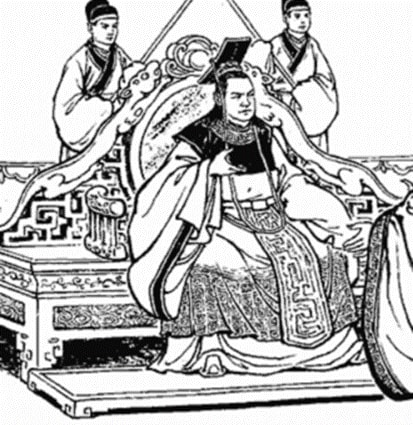
The famous Chinese chronicle Records of the Three Kingdoms preserves an important historical account of these diplomatic maneuvers. In 229 CE, during the third year of the Taihe era (太和), Vasudeva sent a ceremonial embassy bearing tribute to Emperor Ming of the state of Wei. The chronicle records:
“The king of the Great Yuezhi, Bodiao (Vasudeva), sent his envoy with tribute, and His Majesty granted him the title ‘King of the Great Yuezhi, Intimate with Wei.’”
Vasudeva was destined to become the last Kushan ruler whose name was mentioned in official Chinese historical sources. Historians also associate this period of intense regional interaction with the widespread expansion of the Dharmaguptaka school of Buddhism throughout Central Asia.
Despite the threatening developments along the empire’s frontiers, Vasudeva’s reign remained relatively peaceful internally, allowing the empire to experience a genuine flourishing of the visual arts, especially sculpture. The Kushans’ southern capital, Mathura, became an enormous artistic workshop.
Masterpieces of Buddhist and Jain art from this period have survived to the present day and serve as exceptionally valuable chronological reference points for modern archaeologists.
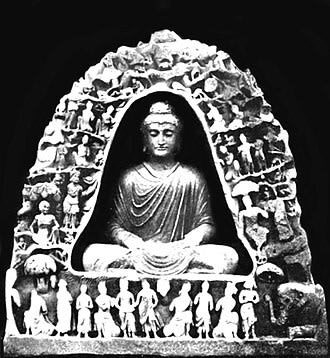
The Mathura Museum carefully preserves the pedestal of a monumental Buddha statue bearing the inscription: “In the 93rd year of the Great King, the Son of God, Vasudeva” (Mahārājasya Devaputrasya Vāsudeva). If the Kanishka era is calculated from 127 CE, the creation of this masterpiece dates to approximately 220 CE, or to 171 CE according to older chronological systems.
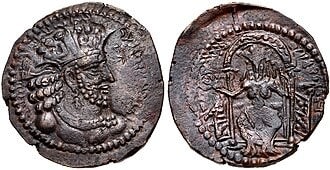
The end of Vasudeva I’s reign became a prelude to the collapse of the great Kushan state. His final years were overshadowed by the rapid rise of a new and powerful force in the west—the Sasanian Empire.
Persian armies advanced steadily toward northwestern India. The decisive catastrophe came when Vasudeva lost control of Bactria and of his northern capital, Balkh. The city fell under the blows of Ardashir I Kushanshah. From approximately 240 CE onward, a buffer state ruled by the Indo-Sasanians, or Kushanshahs, emerged in the conquered territories.
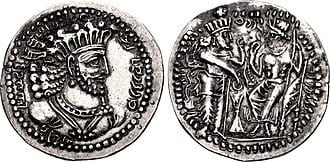
The territory of the once vast empire contracted dramatically, becoming largely confined to the eastern provinces of western and central Punjab. Yet the economic and cultural legacy of Vasudeva I proved so powerful that even the conquerors were compelled to draw upon his prestige.
New rulers such as Ardashir I Kushanshah, who ruled approximately 230–245 CE, and Peroz I Kushanshah, who ruled from 246 to 275 CE, issued large quantities of gold coins at Balkh that directly imitated the coinage of the last great Kushan emperor.


