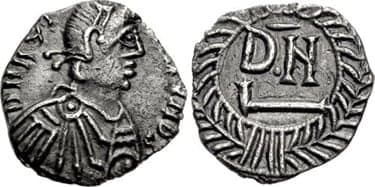

In 496, following the death of King Gunthamund, a new and remarkable chapter opened in the history of the Vandal Kingdom in North Africa. According to the unshakable law of seniority established by the founder of the state, Geiseric, power passed to the eldest male member of the royal dynasty. This man was Thrasamund, the son of Gento and one of only two surviving grandsons of the great Geiseric.
Unlike many of his predecessors, whose names were associated with bloodshed and destruction, the new ruler appeared before his contemporaries in an entirely different light. The Byzantine historian Procopius of Caesarea described Thrasamund with undisguised admiration as an “especially handsome” man, emphasizing that this Vandal monarch was “endowed with good judgment and nobility of spirit.”

Indeed, Thrasamund’s reign became a long-awaited period of prolonged and beneficial peace for North Africa. During these years, the barbarian kingdom experienced genuine economic prosperity and an unprecedented cultural revival.
Thrasamund deliberately fashioned his public image after that of the enlightened Roman emperors. In the capital, he created a favorable environment for scholarly and intellectual discussion, encouraging debates on the most difficult theological questions. In sixth-century poetry, he appears as a true “scholar-king.”
The poet Florentinus composed elaborate panegyrics praising his broad education, sharp intellect, foresight, courage, and piety, proudly declaring that under such a ruler “the citadel of Carthage shines without ceasing.” Seeking to reinforce this harmony through strict bonds of loyalty, Thrasamund introduced a compulsory practice under which his subjects were required to swear a solemn oath of allegiance to him every year, as contemporary sources also attest.
Behind the façade of this cultural renaissance, however, lay an extremely complex geopolitical struggle. Thrasamund’s accession radically altered the diplomatic position of the Vandal Kingdom. The central direction of his foreign policy became relations with the most powerful ruler in the West — the Ostrogothic king Theodoric the Great.
As the Austrian historian Herwig Wolfram notes, around the year 500, in an effort to strengthen the alliance between the barbarian kingdoms, Theodoric gave his widowed sister Amalafrida in marriage to Thrasamund. As part of her magnificent dowry, Carthage received the strategically important promontory of Lilybaeum in Sicily.

But this gift came with hidden conditions. Along with Amalafrida, Theodoric sent an enormous retinue: one thousand elite Gothic warriors and five thousand armed servants. As the historian Hans-Ulrich Wiemer has pointed out, the total size of Thrasamund’s own army was only about twice that of this Gothic contingent.
In effect, Theodoric had inserted a powerful military force into the heart of the Vandal Kingdom, giving himself the ability to intervene in Carthaginian affairs at any moment. Thrasamund found himself in the position of a dependent and subordinate ruler.
The Roman statesman Cassiodorus openly celebrated this situation, claiming that Italy’s once-formidable enemy had been “pacified by Gothic diplomacy,” while a panegyric of 507 explicitly praised the Vandals’ “obedience” to Theodoric. Instead of receiving the tribute once extracted from Italy, Thrasamund now had to content himself with the status of a friendly neighbor.

One might assume that their shared adherence to Arian Christianity would have united the Vandals, Ostrogoths, and Visigoths into a single anti-Byzantine bloc. Yet Thrasamund proved to be a pragmatist who was unwilling to risk his fleet for the interests of others.
He greatly valued his secret alliance with the Byzantine emperor Anastasius. Because of his fear of Constantinople, the Vandal monarch refused to assist Theodoric when a Byzantine fleet ravaged the coast of southern Italy, and he stood aside as the Visigothic king Alaric II suffered a catastrophic defeat at the hands of the Franks at the Battle of Vouillé.

The most severe crisis in relations with Theodoric, however, erupted around 510. Gesalec, the illegitimate son of the fallen Alaric II, had briefly become king of the Visigoths but lost Ostrogothic support, was driven from his capital at Narbonne, and fled to Carthage.
Instead of handing over the fugitive, Thrasamund generously supplied Gesalec with gold, enabling him to raise a mercenary army in Aquitaine for a campaign against the Gothic commander Ibba. The venture failed: Gesalec was defeated and was soon killed while attempting to reach the Burgundians.

Theodoric’s anger knew no bounds. The Ostrogothic king sent Thrasamund a cold and reproachful letter. In it, he indignantly reminded the Vandal ruler that he had given him the most precious member of his family — his own sister, “the sole glory of the Amal dynasty,” a woman whose wisdom Carthage ought to obey.
Theodoric expressed astonishment at the black ingratitude of his brother-in-law, who had received a sworn enemy, provided him with money, and sent him back to spread unrest.
“What can strangers expect from you, if even kinship established through marriage is treated in such a manner?” the ruler of Italy demanded.
Realizing that Theodoric, now the undisputed master of the Iberian Peninsula, was speaking from a position of overwhelming strength, Thrasamund backed down. He humbly begged for forgiveness and sent magnificent gifts of pure gold to Ravenna. Theodoric diplomatically forgave him but returned the gold.
The British historian Peter Heather has perceptively described this gesture as a “calculated insult” — a chilling warning that Carthage was effectively on probation. From that point onward, Thrasamund never again dared openly defy the Gothic ruler.
The domestic religious policy of the “scholar-king” was equally characterized by careful maneuvering. A committed Arian and an admirer of traditional Roman culture, Thrasamund rejected the bloody terror practiced by some of his predecessors.
Procopius confirms that Thrasamund preferred to persuade Catholics to abandon their faith through political pressure and generous bribery. In 515, he even initiated a major theological debate in Carthage, inviting one of the leading figures of the Catholic Church, Fulgentius of Ruspe. The king himself enthusiastically defended Arian doctrine.
Nevertheless, when intellectual arguments failed, the monarch was not above repression. Defiant clergymen, including Fulgentius himself and Bishop Eugenius, were sent into harsh exile on Sardinia.
Interestingly, centuries later Gregory of Tours attempted to blacken Thrasamund’s reputation by recounting a horrific story about a noble Spanish Catholic woman who was forcibly rebaptized. According to Gregory, the water in the baptismal font was stained with menstrual blood, after which the woman was beheaded.
Modern scholars, however, including John Moorhead and Andrew Cain, have thoroughly dismantled this story, demonstrating that Gregory confused different rulers and attributed to Thrasamund atrocities belonging to the age of Gunderic. Eventually, Thrasamund brought the long-standing persecution of the orthodox Christians to an end altogether, allowing him to become, in the words of Procopius, an “especially close friend of Emperor Anastasius.”

Yet the twilight of the Vandal Kingdom was deepening not in the basilicas of Carthage or the palaces of Ravenna, but along the scorching southern frontiers. Wars with the Moorish tribes, which had begun even before Thrasamund’s marriage to Amalafrida, developed into a true catastrophe.
The Moors were becoming increasingly powerful, while their raids grew ever more destructive. In the final year of Thrasamund’s life, disaster struck: combined Moorish and Berber forces sacked one of the empire’s most important port cities, Leptis Magna.
Procopius of Caesarea left an account of a major battle in Tripolitania in which the Berber leader Cabaon employed an unprecedented battlefield tactic and completely crushed the pride of the Vandal army — its heavy cavalry.
In 523, amid the growing military crisis, Thrasamund died. The throne passed to his cousin Hilderic.
The new king radically changed course: he immediately granted Catholics complete freedom of worship.
The fate of Amalafrida was also tragic. Fearing for her life after the death of her powerful husband, the widow fled to the Moors on the edge of the deserts of Byzacena. Hilderic’s agents, however, tracked her down, placed her in chains, and threw her into prison, where the celebrated sister of the Gothic ruler soon met her death.


