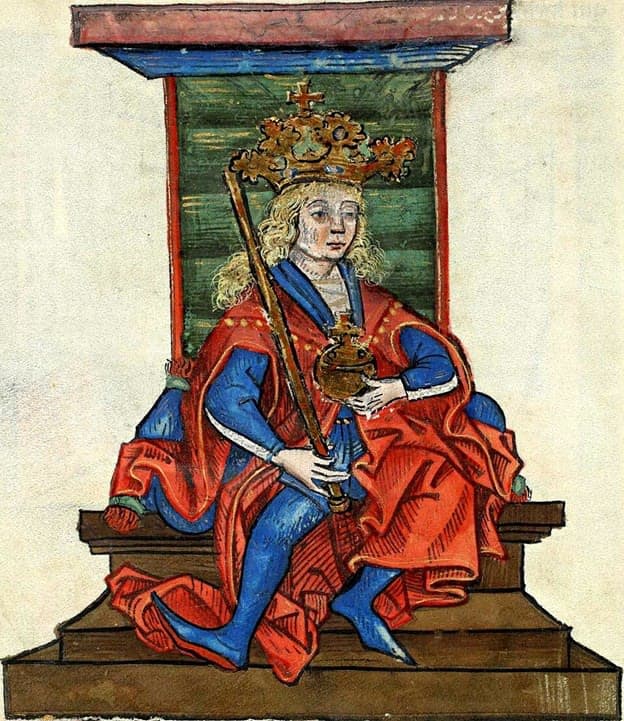

Stephen's life was marked by the flames of a great catastrophe from its very beginning.
Stephen was born into the family of King Béla IV and his wife Maria Laskarina, daughter of the Nicaean emperor Theodore I Laskaris.
He had not yet reached his second birthday when, on April 11, 1241, the Mongol tümens of Batu Khan utterly destroyed his father's army at the Battle of the Sajó River.
The prince's early childhood was spent in desperate flight. Escaping the swords of the Mongols, the royal family took refuge behind the mighty walls of Trogir, a fortified city in distant Dalmatia.
Only after the Asian hordes had withdrawn from devastated Hungary as suddenly as they had arrived could Béla IV and his family return to the ashes of their homeland.
Memories of this horror undoubtedly hardened Stephen's character, making him stern and uncompromising.

Seeking to strengthen the dynasty and prepare a worthy successor, Béla IV crowned the young Stephen as "Junior King" in 1246.
The father believed that he was granting his son genuine authority: Stephen was entrusted with the administration of the extensive territories of Croatia, Slavonia, and Dalmatia.
However, the real levers of power remained in the hands of an experienced courtier — Ban Stephen Gutkeled.
Stephen, whose desire for independence grew stronger with every passing year, resented his position as a mere figurehead.
At the same time, Béla IV, desperately needing military strength to defend his eastern frontiers, placed his hopes in the nomadic Cuman tribes.
To seal this dangerous alliance through blood ties, around 1253 he arranged Stephen's marriage to the Cuman princess Elizabeth, daughter of the deceased Khan Köten.
The blood of the steppes would now flow through the veins of Hungary's future heirs.

But Stephen was not content with the status of an obedient son.
In 1257, he openly challenged his father, demanding that the kingdom be divided and that he be granted real authority.
To reinforce his demands, the "Junior King" assembled an army of his own.
Unwilling to unleash another civil war upon a country that had not yet fully recovered, Béla IV yielded to his son's pressure in 1258, entrusting him with the administration of Transylvania and granting him the title of duke.
The young duke's ambitions were soon put to the test.
That same year, 1258, a rebellion erupted along the western frontiers: the inhabitants of Styria, recently annexed by Hungary, refused to submit to the Hungarian crown.
Stephen and his father marched through the rebellious province with fire and sword.
As a reward for the successful campaign, Béla appointed his son Duke of Styria.
However, Stephen's methods of government proved excessively harsh.
His new subjects hated their Hungarian governor and soon launched another uprising, this time relying on the powerful support of King Přemysl Ottokar II of Bohemia.
Father and son once again united their armies and invaded Ottokar's territories.
The decisive confrontation took place on July 12, 1260, at the Battle of Kressenbrunn.
Fortune turned against the Árpád dynasty: the Hungarian forces suffered a crushing defeat.
Under the terms of the humiliating Peace of Pressburg, the Hungarians were forced to permanently renounce their claims to Styria, surrendering it to the Bohemian crown.
Stephen returned to Transylvania empty-handed.

The defeat intensified the underlying tensions at the royal court.
Although Stephen and Béla IV conducted a joint and relatively successful military campaign against Bulgaria in 1261, the gulf between them rapidly widened.
The aging king openly disliked his domineering eldest son, reserving his affection for his younger son, Duke Béla of Slavonia, and his daughter Anna.
Stephen responded to his father's hostility in kind.
The royal court became divided.
Father and son began ruthlessly persecuting each other's supporters, bringing the country to the brink of a major civil war.
Attempting to prevent bloodshed, the archbishops Philip of Esztergom and Smaragd of Kalocsa brought the two sides to the negotiating table in Pressburg during the summer of 1262.
Under the resulting agreement, Hungary was effectively divided into two parts: Stephen received full authority over all territories east of the Danube.
However, the supporters of both factions constantly provoked new conflicts, and in 1264 the fragile peace collapsed.
Stephen confiscated the wealthy estates belonging to his mother and sister within the territories under his control.
Enraged, Béla IV responded with a swift military offensive.
Royal troops invaded his son's lands, capturing Stephen's wife and his young son Ladislaus.
The "Junior King" himself, accompanied by only a handful of loyal followers, was driven into the fortified Transylvanian castle of Codlea, which entered history as the "Black Castle."
It seemed that the end had come.
But Stephen demonstrated remarkable military talent.
He not only broke through the deadly siege but also launched a ferocious counteroffensive.
In March 1265, at the Battle of Isaszeg, Stephen's forces achieved a brilliant strategic victory over his father's army.
Béla IV was forced to capitulate and restore all the eastern territories to his son.
On March 23, 1266, at the Monastery of the Blessed Virgin Mary on Rabbit Island, now Margaret Island, the two opponents formally reaffirmed the terms of their peace agreement.
In 1267, these terms were solemnly approved by an assembly of prelates and noblemen in Esztergom.
Having recognized his own strength, Stephen embarked upon a policy of foreign expansion.
Shortly after making peace with his father, he launched an offensive against Bulgaria, forcing the powerful despot of Vidin, Jacob Svetoslav, to acknowledge him as his overlord.
To secure his position on the international stage, Stephen concluded a strategic alliance with the Angevin dynasty, which enjoyed the particular favor of the Roman popes.
In 1270, this alliance was sealed through a double marriage arrangement.
Stephen's daughter Maria was married to the future King Charles II of Naples, while his young son Ladislaus was betrothed to Charles's sister, Elizabeth of Sicily.

On May 3, 1270, King Béla IV died.
In his final testament, reflecting his deep distrust of his eldest son, he entrusted the administration of the kingdom to his daughter Anna and her son-in-law, King Přemysl Ottokar II of Bohemia.
But Stephen acted with lightning speed.
Realizing that they could not maintain their hold on power, Anna and her Bohemian allies fled to Prague shortly before Stephen arrived in Esztergom, taking an enormous portion of the royal treasury with them.
At last, Stephen became the sole ruler of Hungary.
Before his second coronation, this time as a fully sovereign monarch, he generously rewarded the Church by granting an entire county to the Archbishop of Esztergom.
His reign began with intense diplomatic activity.
In August 1270, Stephen met his brother-in-law, the Polish king Bolesław V the Chaste, in Kraków, where they concluded a strong military alliance against Bohemia.
In September 1270, an extraordinary incident added a mystical dimension to the king's reputation.
While visiting the village of Miholjanec, Stephen discovered the ruins of an ancient castle and an old sword.
The priests accompanying him proclaimed the discovery to be the "Sacred Battle Sword of the Scythians."
Interpreting this as a divine sign, the king publicly declared that he was "determined to conquer the world."
According to legend, he also encountered a hermit there who, upon seeing the monarch, called him the "Scourge of God."

Despite these ominous signs, on October 16, 1270, Stephen V and Přemysl Ottokar II concluded a two-year truce on an island near Pressburg.
However, tensions between the two ambitious rulers were simply too great.
Border skirmishes rapidly escalated into full-scale war.
Bohemian troops invaded Hungary.
Stephen suffered setbacks in two minor engagements, but demonstrated his determination and, on May 21, 1271, decisively defeated Ottokar II's combined Bohemian-Austrian army in a fierce and bloody pitched battle.
Under the terms of the new peace agreement, the Bohemians returned all the fortresses they had captured.
Stephen, for his part, pragmatically abandoned his futile demands for the return of the royal treasury that his sister had taken away.
It seemed that Stephen V had finally consolidated his power beyond challenge.
In the summer of 1272, the king traveled to Dalmatia, planning to meet the powerful Charles I of Anjou.
But during his journey, catastrophic news reached him, striking directly at his heart.
A powerful magnate, Ban Joachim Gutkeled, had betrayed the crown.
He had abducted the young heir to the throne, Prince Ladislaus the Cuman, and barricaded himself together with the boy inside the impregnable fortress of Koprivnica.
Overwhelmed by fury and despair, Stephen immediately turned his army around and laid siege to the kidnapper's castle.
He was desperate to rescue his son and take revenge upon the traitor.
However, the tremendous psychological strain, combined with years of exhausting military campaigns, had undermined his strength.
Right in the military camp beneath the walls of Koprivnica, Stephen V suddenly fell gravely ill.
According to contemporary accounts, the king had been overwhelmed by the profound shock of such monstrous betrayal by one of the kingdom's highest-ranking officials.
On August 6, 1272, before he could rescue his son or enjoy the hard-won authority he had finally achieved over a united Hungary, King Stephen V died unexpectedly.
His entire life had been one continuous struggle for the throne.
Yet he had remained at the pinnacle of power for little more than two years, leaving behind a country torn apart by conflict and entrusted to the care of a young son who was still in the hands of his kidnappers.


